Part One
Choices, Not Capability
Based on the paper "Educational Futures to 2035 and 2045: Scenarios, Switches and the Choices to Make Now" by Paul Penfold (Proceedings of Future Science Archives, 2026).
This part sets out the claim the rest of the book leans on: what happens to education will depend less on how capable AI becomes than on the choices people make about it. It starts with the pressures already in the room, looks at the futures others have built, offers seven of my own, and ends with the decisions that matter most.
Chapter 1 The class of 2034
In 2034, my son will finish school. By then, AI may have changed what learning, work and qualifications mean. Or it may have developed more slowly than many forecasts suggest (Penfold, 2026) [102]. Nobody can say which, and anyone who sounds certain is guessing.
That's why this book starts with futures rather than tools. Forecasts about AI and education tend to swing between promise and alarm, and most of them will be wrong. Scenario planning is a more useful discipline. Instead of predicting one future, you build several plausible ones, test today's plans against each of them, and look for the choices that decide which future arrives. The aim is to stretch our thinking, so that plans hold up against futures that might come rather than the one we expect.
The central claim of this chapter, and of the whole book, is simple. The future of education won't be decided by AI capability alone. It will be decided by choices about access, ownership, governance, assessment and the role kept for teachers and learners. Many of those choices are being made now, in budget meetings, procurement contracts and assessment policies.
Three questions run through this part:
- What pressures are already shaping the future of education?
- What futures are plausible for 2035 and 2045?
- Which present-day decisions most influence which future arrives, and what should institutions do now?
Where the material comes from
Part One draws on two series of articles I wrote for educators in 2026, one looking ahead to 2035 and one to 2045, and on my notes from UNESCO's consultation on education beyond 2030 (Penfold, 2026) [102, 155, 114, 119, 98, 138, 147, 136, 122]. I've read them alongside published scenario sets from the UK Government Office for Science (2026) [180], the World Economic Forum (2026) [204], the OECD (2020) [86], UNESCO (2021) [182] and EdTech Hub and the International Development Research Centre (Rahman & Freeman, 2025 [162], 2025 [163]).
Telling evidence from imagination
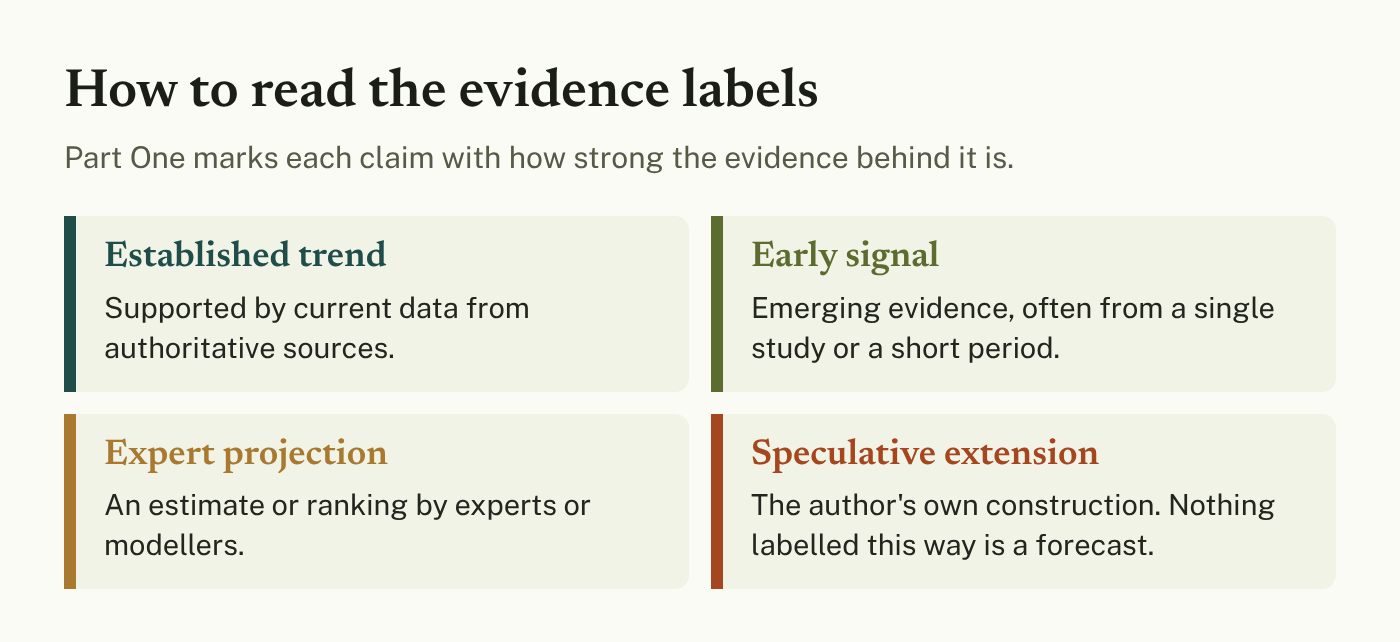
Writing about the future mixes evidence with imagination, and you should be able to tell which is which. So, throughout this part, claims carry a label that shows how strong the evidence behind them is:
- [Established trend]: supported by current data from authoritative sources.
- [Early signal]: emerging evidence, often from a single study or a short period.
- [Expert projection]: an estimate or ranking by experts or modellers.
- [Speculative extension]: my own construction. Nothing labelled this way is a forecast.
Chapter 2 Seven pressures already in the room
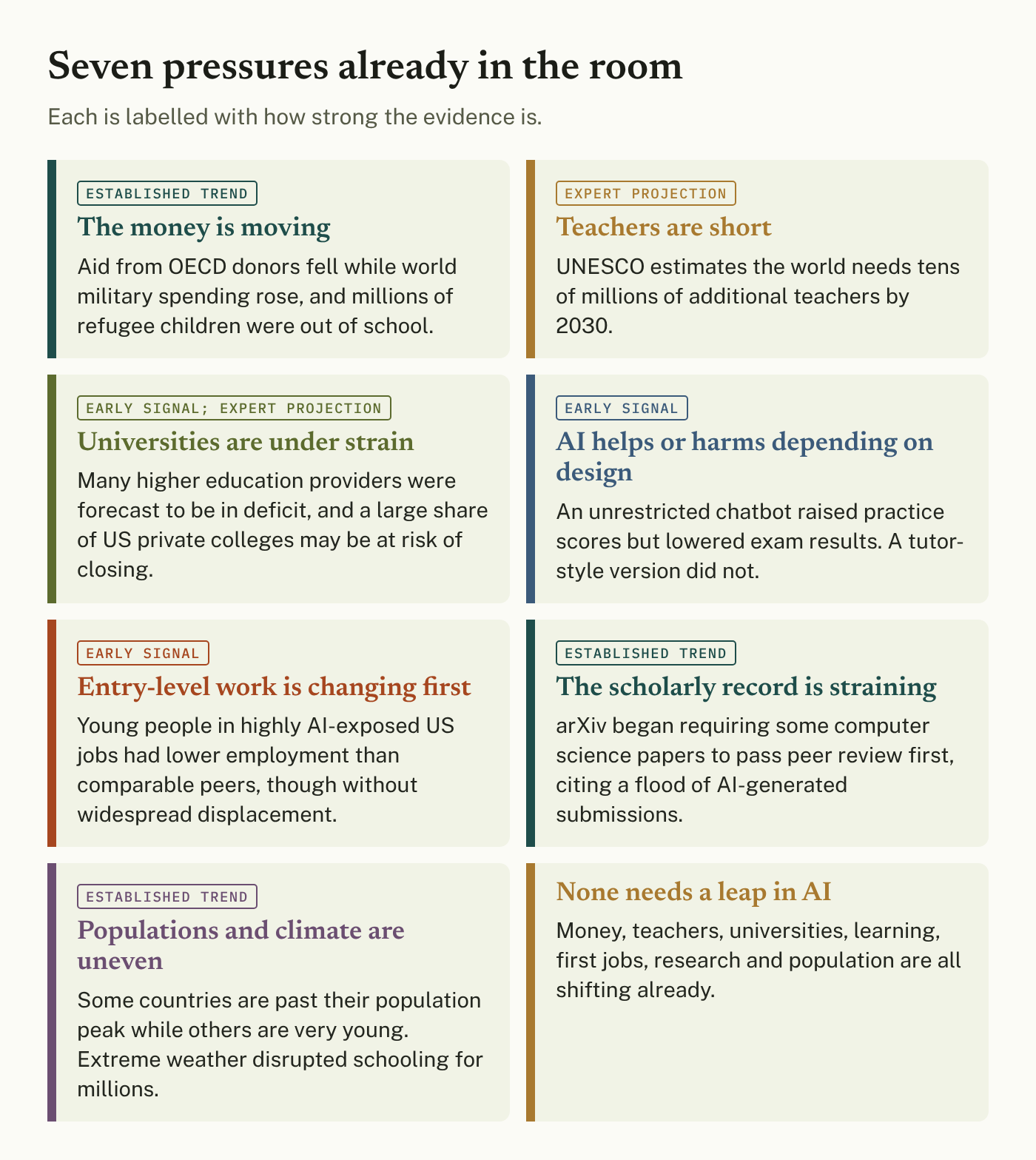
Whatever future arrives, it will arrive through pressures that are already at work. Seven of them shape every scenario in this part.
- The money is moving. Official development assistance from OECD donors fell 23.1% in 2025, while world military spending rose to about US$2.89 trillion (OECD, 2026 [89]; SIPRI, 2026 [169]). Some 5.8 million refugee children were out of school (UNHCR, 2026) [191]. [Established trend]
- Teachers are short. UNESCO estimates that the world needs 50 million additional teachers by 2030: 44 million for primary and secondary education and 6 million for pre-primary (UNESCO and partners, 2026) [209]. [Expert projection]
- Universities are under strain. In England, 42.7% of higher education providers were forecast to be in deficit in 2025–26 (Times Higher Education, 2026) [178]. The consultants Huron estimated that more than a quarter of US private non-profit colleges are at risk of closing within ten years, which is a projection rather than a count (13abc, 2026) [1]. [Early signal; Expert projection]
- AI helps or harms depending on design. An unrestricted chatbot raised practice scores but lowered exam results, while a tutor-style version did not (Bastani et al., 2025) [11]. A purpose-built AI tutor outperformed active learning in one physics course (Kestin et al., 2025) [62]. [Early signal]
- Entry-level work is changing first. Employment for 22 to 25 year olds in highly AI-exposed US jobs was about 19% below that of comparable peers in mid-2026, though without widespread displacement (Brynjolfsson et al., 2026) [19]. [Early signal]
- The scholarly record is straining. In October 2025, arXiv began requiring computer science review and position papers to have passed peer review first, citing a flood of AI-generated submissions (Nature, 2025) [80]. [Established trend]
- Populations and climate are uneven. UN projections show many countries already past their population peak while others remain very young (United Nations, 2024) [195], and at least 242 million students in 85 countries had their schooling disrupted by extreme climate events in 2024 (UNICEF, 2025) [193]. [Established trend]
None of these needs a dramatic leap in AI to matter. Money, teachers, universities, children's learning, young people's first jobs, the research record and the shape of the population are all shifting already. Later chapters return to several of them in detail: the two learning studies in Chapter 10, the jobs data in Chapter 28 and the children out of school in Chapter 49.
Chapter 3 What other scenario sets say, and where they disagree
I'm not the first to build futures for AI and education, and it helps to see what others have done.
The UK Government Office for Science (2026) [180] built five futures for 2030 from six uncertainties: the pace of capability, who controls access, security, adoption, displacement of work and international cooperation. Its scenarios are called Slow Burn, Open Frontier, Augmented Growth, Transformation Economy and Take-Off. Two of them, Augmented Growth and Transformation Economy, share the same capability score but differ sharply on how widely access is shared and how much work is displaced. That supports a point I make throughout this book: who owns and controls AI matters as much as what it can do (Penfold, 2026) [102].
The World Economic Forum (2026) [204] sets out four futures for jobs to 2030. The OECD (2020) [86] offers four scenarios for schooling to 2040, and UNESCO (2021) [182] looks as far ahead as 2050.
For low- and middle-income education systems, EdTech Hub and the International Development Research Centre asked experts to rank five AI scenarios for 2035. The one rated likeliest, and most urgent to prepare for, was a widening learning divide within and between nations (Rahman & Freeman, 2025 [162]; Penfold, 2026 [155]). [Expert projection] Their companion study on education in crisis ranked a funding collapse as the likeliest scenario (Rahman & Freeman, 2025) [163].
Where the sets disagree
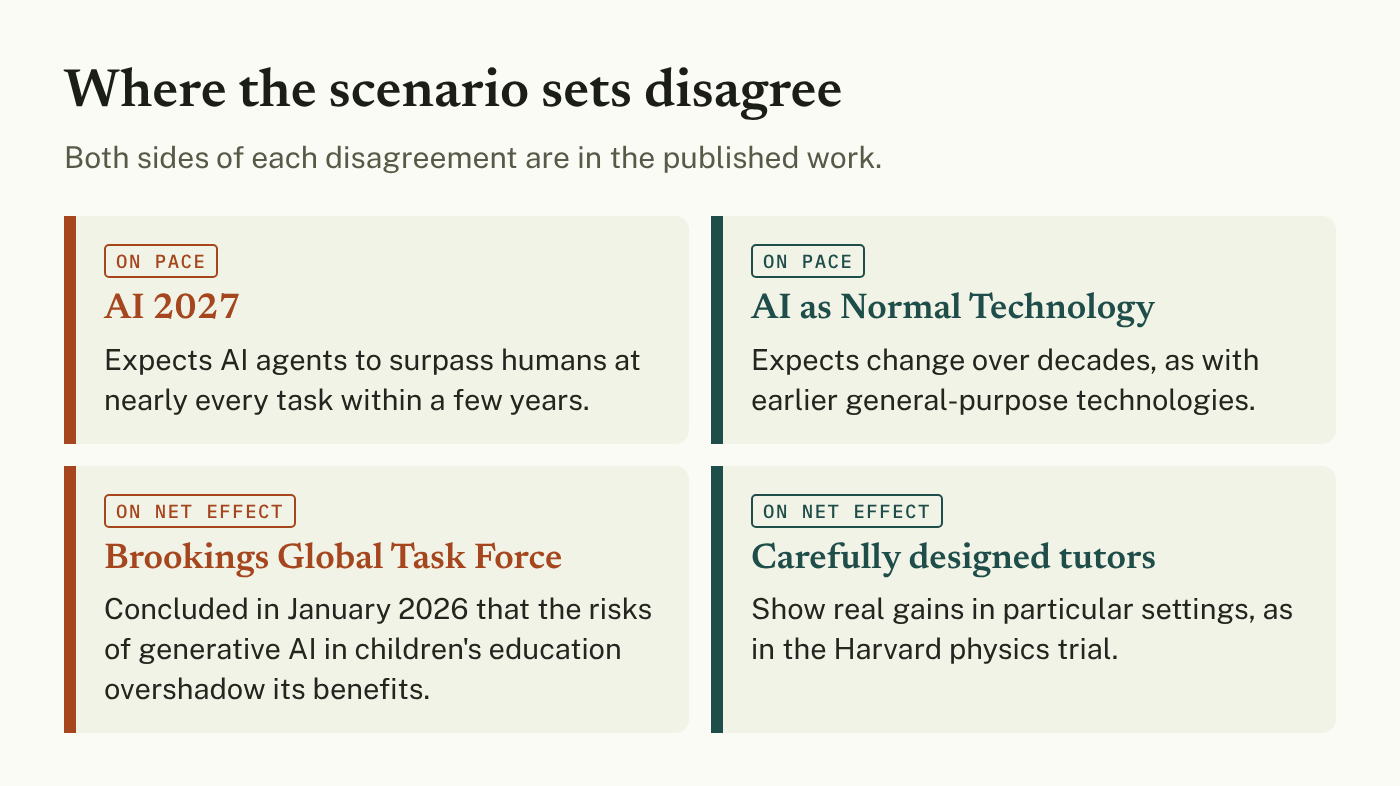
The sets disagree most on pace. AI 2027 expects AI agents to surpass humans at nearly every task within a few years (Kokotajlo et al., 2025) [63]. AI as Normal Technology expects change over decades, as with earlier general-purpose technologies (Narayanan & Kapoor, 2025) [77].
They also disagree on the net effect. The Brookings Global Task Force concluded in January 2026 that "at this point in its trajectory, the risks of utilizing generative AI in children's education overshadow its benefits" (Brookings Institution, 2026) [18]. Yet carefully designed tutors show real gains in particular settings (Kestin et al., 2025) [62]. Both can be true, because design, age and context differ.
Chapter 4 Four futures for 2035
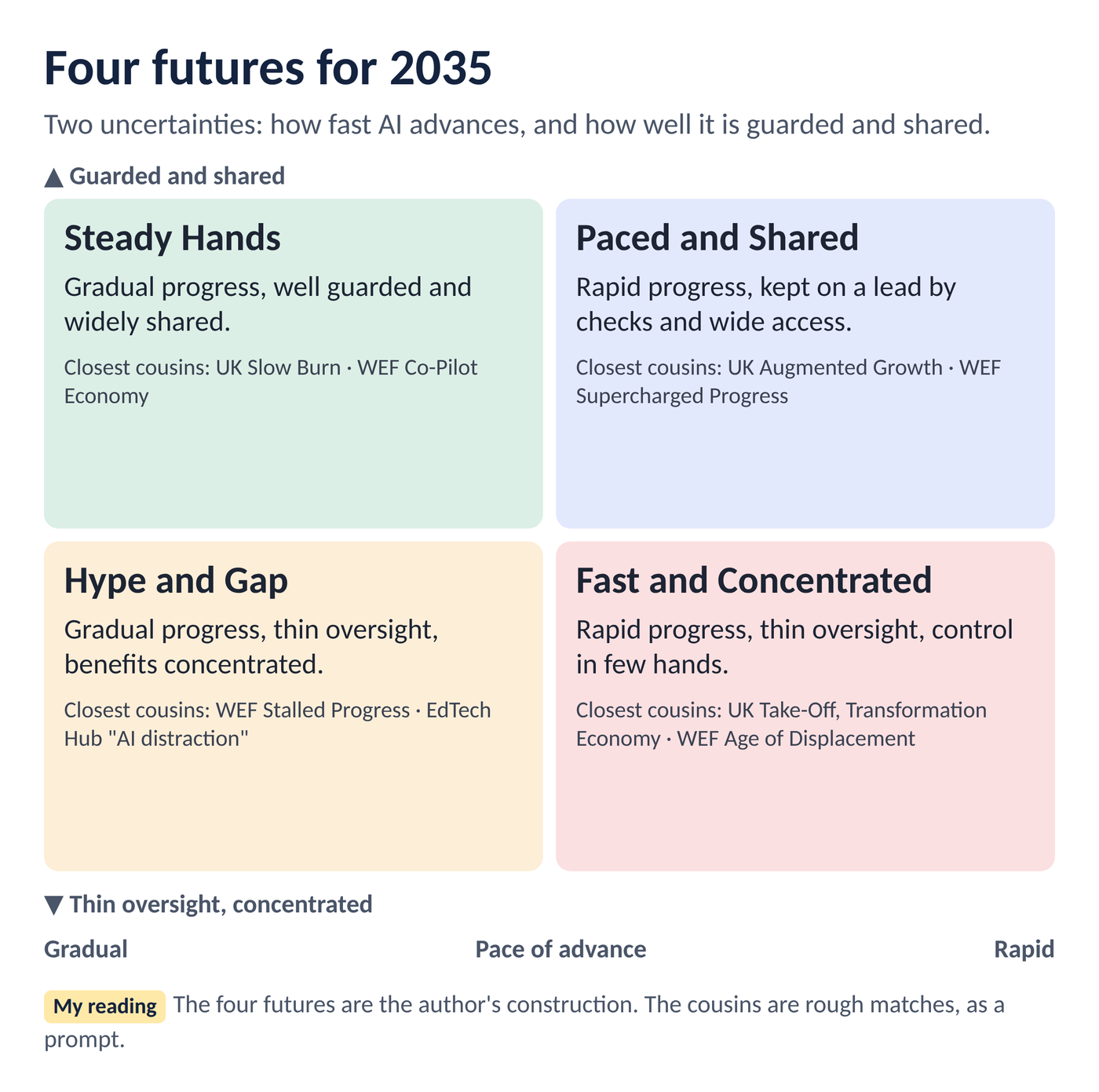
Most of the futures for 2035 turn on two uncertainties. The first is how fast AI develops. The second is whom it serves, meaning how well it is guarded and how widely its benefits and control are shared. Crossing the two gives four futures (Penfold, 2026) [98]. They are my own construction, though each has relatives in the published sets. [Speculative extension]
- Paced and Shared (rapid, guarded, widely shared). Schools use AI designed to prompt thinking, and teachers' judgement is the unit of trust. Assessment moves to what learners can do and defend. Portable certificates spread. The class of 2035 is fluent with AI and trained to check it.
- Fast and Concentrated (rapid, thinly overseen, controlled by a few). Tools arrive bundled from a handful of vendors, with lock-in and heavy collection of learner data. Wealthier families buy human teachers and small classes, while others get cheaper automation. Degrees lose some of their signal as entry-level jobs thin.
- Steady Hands (gradual, guarded, widely shared). AI becomes ordinary teaching infrastructure for preparation, feedback and administration. Teachers gain time, and training decides who benefits. Universities adapt over a decade rather than a year.
- Hype and Gap (gradual, thinly overseen, benefits concentrated). Money flows to devices and platforms with little evidence of impact. Teachers and offline access are neglected, and learner data is extracted. The gap widens between schools that design AI use and schools that do not.
Notice that the best and worst of these differ in more than speed. Paced and Shared and Fast and Concentrated are both rapid. What separates them is oversight and who benefits. That is the point of building futures this way: it shows where the real decisions sit.
Chapter 5 Three futures for 2045
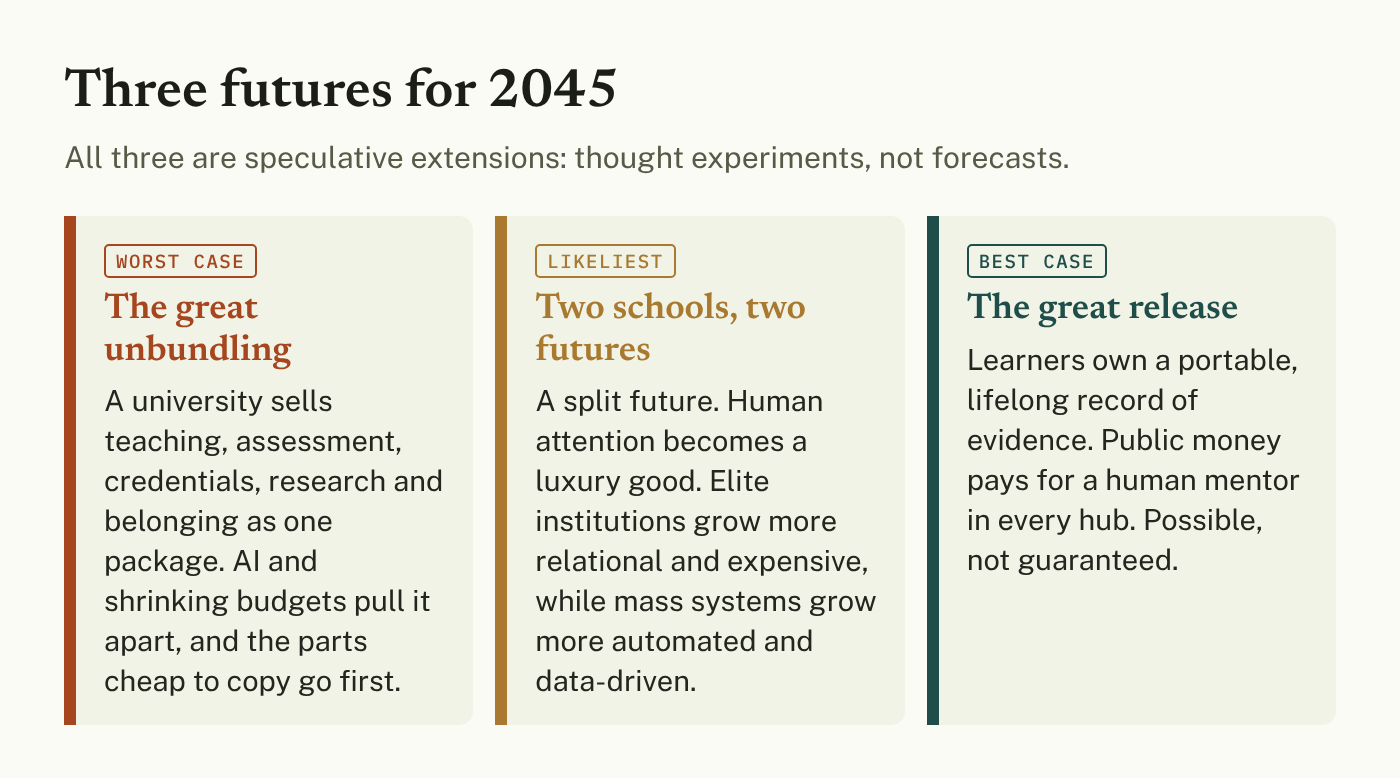
Looking further ahead, the 2045 series sketched three futures as deliberate thought experiments. All of what follows is speculative extension.
The worst case: the great unbundling
A university sells five things in one package: teaching, assessment, credentials, research and belonging. In the worst case, AI and shrinking budgets pull the package apart, and the parts that are cheap to copy go first (Penfold, 2026) [138]. Mid-ranked, fee-paying teaching universities are most exposed. Their main product, explanation, is available free at a high standard, and their degrees lose signal as entry-level jobs thin.
Graduates become "unreadable": capable, but unable to prove it in ways employers trust. Assessment becomes a theatre of suspicion, with surveillance replacing judgement. Research becomes a closed loop of machine-written papers reviewed by machines and counted by tenure committees. The poorest learners get the machine without the mentor. In this world, schools survive as childcare and universities as brands.
The likeliest: two schools, two futures
The future I consider likeliest is a split one (Penfold, 2026) [147]. Picture two 12 year olds in the same city in 2045. One has a mentor who knows her name, a group of eight, and an AI she uses after attempting a problem herself. Her portfolio belongs to her family. The other has an endlessly patient licensed platform, one supervisor for 60 learners, and a score inside a record she cannot take with her.
Human attention becomes a luxury good. Elite institutions become more relational and more expensive, while mass systems become more automated and more data-driven. What may be lost first is not academic but social: the experience of growing up among people who differ, which schools have always provided.
The best case: the great release
The best case is possible, not guaranteed (Penfold, 2026) [136]. Its main risks are underfunding, weak governance and low-quality AI at scale. In it, learners own a portable, lifelong record of evidence: observed work, projects and defended judgement. Learning happens in local hubs with human mentors, with AI providing tireless explanation and practice designed to prompt thinking.
Public money pays for a human mentor in every hub, so teaching becomes more relational. Universities return to choosing questions and verifying evidence. Vocational, caring and creative work carries prestige. Open, local-language models let learners meet their own languages and knowledge. Schools protect deep attention with tools-down time. Poorer countries gain through open, offline and multilingual tools.
Chapter 6 Six switches and what to do now
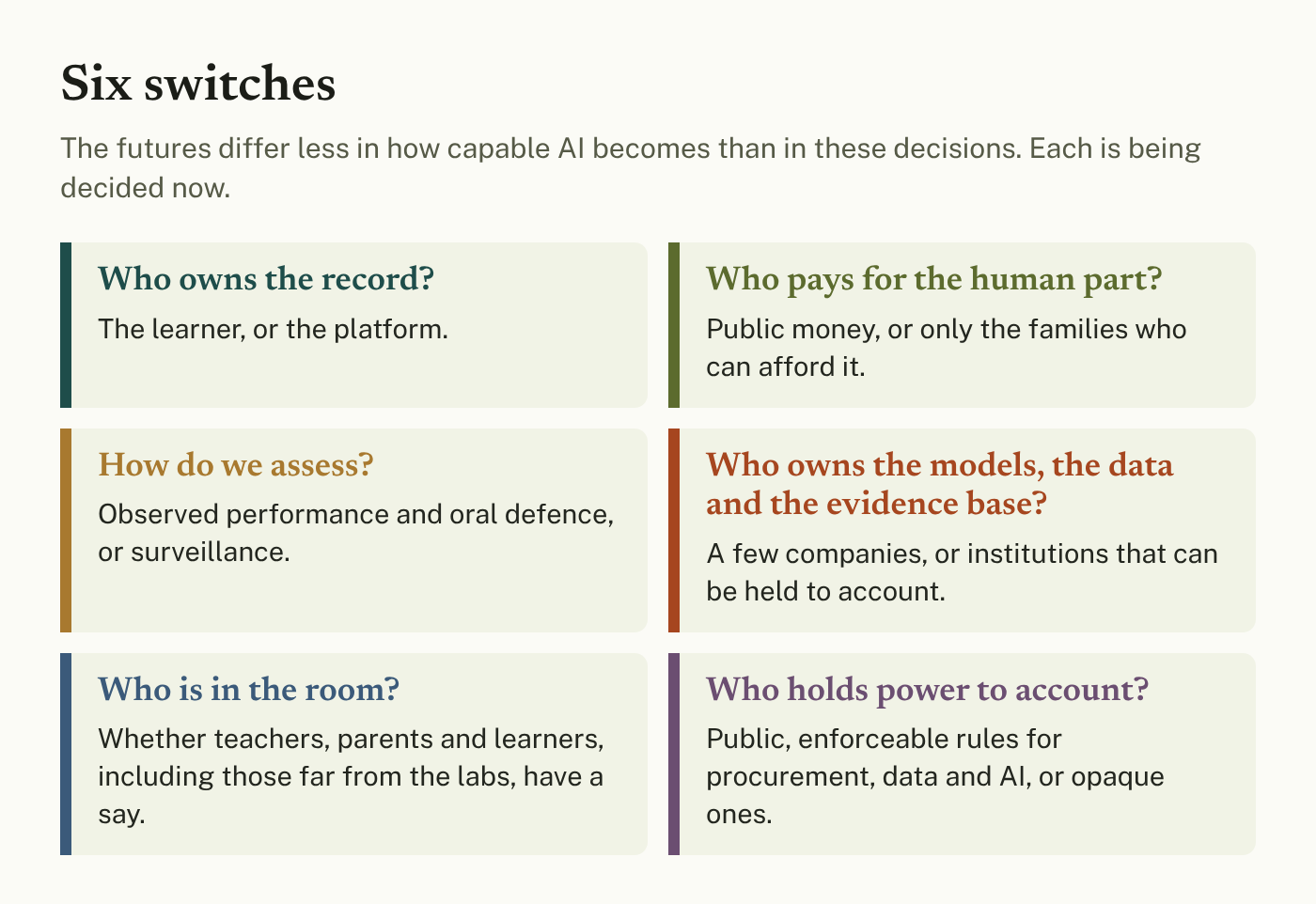
Put the 2035 and 2045 futures side by side and a pattern appears. They differ less in how capable AI becomes than in a handful of decisions. I call them switches, and each is being decided now (Penfold, 2026) [136].
- Who owns the record: the learner, or the platform?
- Who pays for the human part: public money, or only the families who can afford it?
- How do we assess: observed performance and oral defence, or surveillance?
- Who owns the models, the data and the evidence base: a few companies, or institutions that can be held to account?
- Who is in the room: do teachers, parents and learners, including those far from the labs, have a say?
- Who holds power to account: are procurement, data and AI rules public and enforceable, or opaque?
Governments may be the decisive actors on several of these, through procurement, data protection, credential regulation, connectivity and public platforms (Penfold, 2026) [147]. The options include public AI tutors commissioned as public infrastructure, national learning records with strong learner-data rights, mandatory human oversight in schooling, and recognition rules for portfolios and micro-credentials. UNESCO's education ministers pointed in the same direction in 2026, calling for auditable AI systems, portable data and teachers who help decide which systems enter their classrooms (UNESCO, 2026) [188].
Moves that hold in every future
Scenarios are most useful for finding moves that make sense whichever future arrives (Penfold, 2026) [98]:
- Teach verification: checking a confident answer, whoever or whatever gave it.
- Assess what learners can do without the tool, and keep teachers' judgement at the centre.
- Keep choice: data that can be exported and vendors that can be left.
- Design for the weakest link: offline tools and learners' own languages.
- Teach the civic question of who sets the pace of AI and who checks it.
- Plan in ranges, and review the plan every year.
- Set red lines: uses of AI an institution would refuse even if competitors adopt them.
Learning continuity as a system responsibility
UNESCO's consultation on education beyond 2030 is about the agenda that will follow Sustainable Development Goal 4. In my notes of the session, the director of the Inter-agency Network for Education in Emergencies argued that for millions of learners uncertainty is already the reality. The director questioned the idea of "returning to normal" when the pre-crisis system may already have excluded children and called for continuity of learning to become a core responsibility of education systems, with flexible pathways so that no child has to start again (Penfold, 2026) [122]. These are notes of a live session rather than a published statement, and should be checked against UNESCO's materials.
Signals to watch
By 2030 to 2035, several signals will show which way things are tilting (Penfold, 2026) [147]:
- whether public budgets protect human teachers alongside AI;
- whether learning records are controlled by learners or platforms;
- whether assessment moves towards observed performance or surveillance;
- whether open, local-language models receive public investment;
- whether employers recognise portfolio evidence;
- whether university closures cluster among teaching-only institutions; and
- whether AI narrows or widens attainment gaps.
Working backwards from 2035
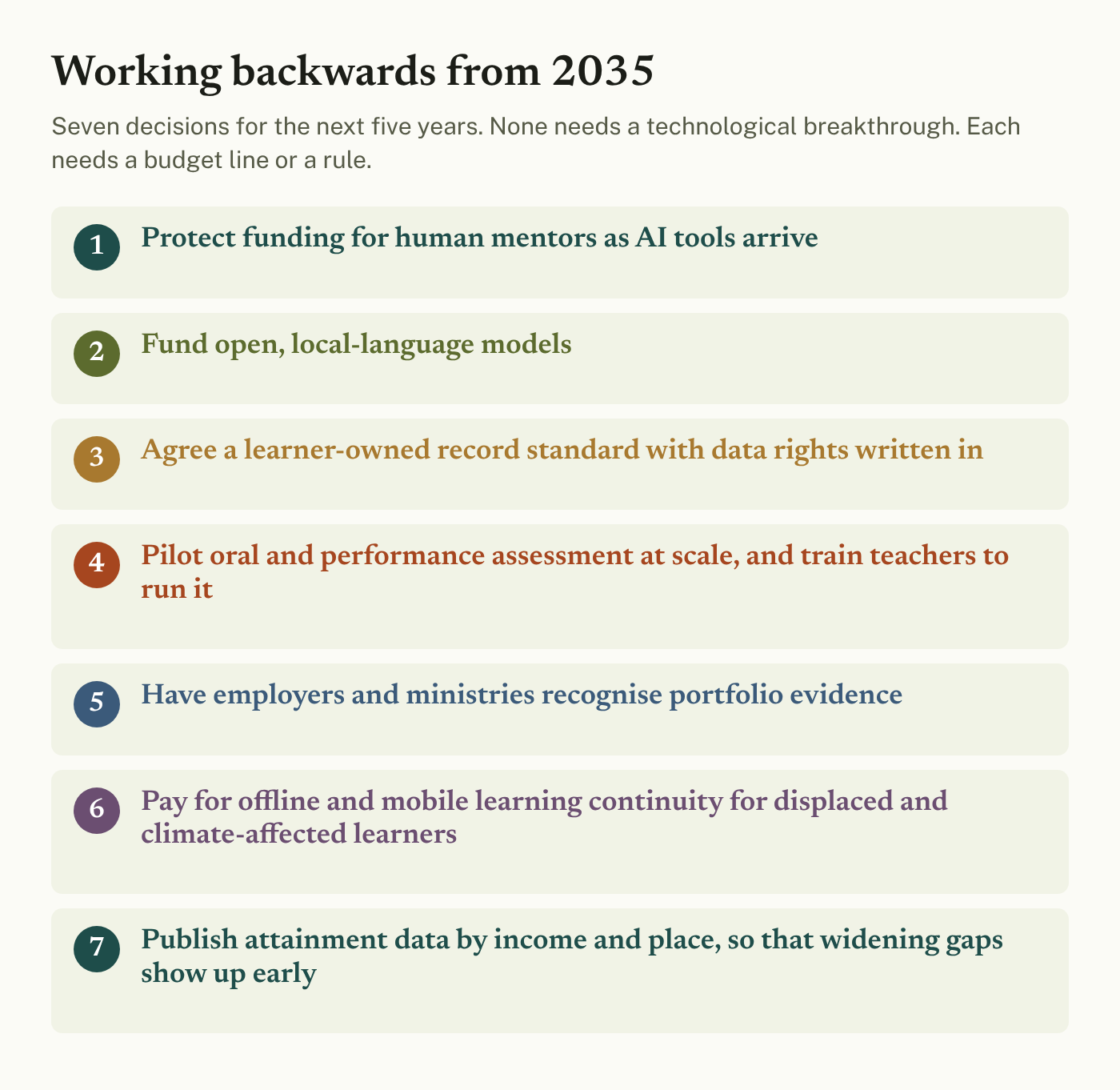
If the better future is the goal, the decisions fall in the next five years, and none needs a technological breakthrough. Each needs a budget line or a rule (Penfold, 2026) [136]:
- protect funding for human mentors as AI tools arrive;
- fund open, local-language models;
- agree a learner-owned record standard with data rights written in;
- pilot oral and performance assessment at scale and train teachers to run it;
- have employers and ministries recognise portfolio evidence;
- pay for offline and mobile learning continuity for displaced and climate-affected learners; and
- publish attainment data by income and place, so that widening gaps show up early.
What this part can't tell you
Scenarios are not forecasts. The four futures for 2035 and the three for 2045 are my constructions, and the expert rankings I've cited are opinion gathered in workshops. Some of the evidence for current pressures comes from early or single studies. The scenario sets I reviewed were developed mainly in the Global North. EdTech Hub's studies are an exception, but neither they nor the UK report name Thailand or Myanmar, which my own series sought to address (Penfold, 2026) [102]. And I've used notes from a live consultation, flagged as such.
A closing thought
Nobody will announce the day the university ended, or the day it was reborn. It will happen one budget meeting, one assessment policy and one procurement contract at a time, and those meetings are happening now (Penfold, 2026) [138]. AI will show which parts of education were always about delivering content and which were about human development, trust and shared purpose. The useful question is which futures educators are willing to build, and which they are prepared to refuse.
Coach · Part One
Think it through
Four short ways to test what this part means for you. There are no right scores. Everything you type stays in this browser and is never sent anywhere.
A situation
Your local authority asks every school to submit a three-year plan for AI. A colleague suggests choosing the most likely future and planning for that one. What do you do?
Pick the response closest to what you would do.
Read: Chapters 4 to 6
A private self-check
Rate your school or organisation on each statement. There is no right score; the feedback points you to chapters.
Reflect
Write a line or two for each. Notes save automatically in this browser.
Ask the book
Common questions about this part, answered from its own text.
Are the futures in this part predictions?
No. The four futures for 2035 and the three for 2045 are the author's own scenario constructions, offered as thinking tools. The part also says the expert rankings it cites are opinion gathered in workshops, and that most scenario sets reviewed came from the Global North.
Chapter 6; 'What this part can't tell you'
What are the six switches?
Who owns the record (learner or platform); who pays for the human part; how we assess (observed performance and oral defence, or surveillance); who owns the models, data and evidence base; who is in the room; and who holds power to account.
What do I do if I cannot tell which future we are heading for?
The book suggests looking for moves that hold in every future: teach verification, assess what learners can do without the tool, keep choice, design for the weakest link, teach who sets the pace of AI and who checks it, plan in ranges, and set red lines.
What should I watch for over the next few years?
Whether public budgets protect human teachers alongside AI; whether learning records are controlled by learners or platforms; whether assessment moves towards observed performance or surveillance; whether open, local-language models get public investment; whether employers recognise portfolio evidence; whether university closures cluster among teaching-only institutions; and whether AI narrows or widens attainment gaps.
Chapter 6 (signals to watch)
Why does the book say the choice matters more than the technology?
Because technologies of the past improved learning or did not depending less on the tool than on what the adults around them decided to do. The closing thought says the future will arrive one budget meeting, one assessment policy and one procurement contract at a time.
Foreword; Part One closing thought