Part Three
Growing Up with Machines That Talk Back
Based on the paper "Growing Up with Machines That Talk Back: Wellbeing, Attachment and the Developing Mind in AI-Mediated Childhood" by Paul Penfold (Proceedings of Future Science Archives, 2026).
Parts One and Two looked at systems and at learning. This part puts the child at the centre. It asks what happens when children talk to machines that listen patiently, answer instantly and never get tired, and what schools owe them while they do.
Chapter 13 The student at lunch: a question of care
A student spends lunch talking to a chatbot instead of a classmate. It listens patiently, never judges, and never gets distracted by its phone. It will also never notice that she has been on her own for three weeks (Penfold, 2026) [133].
Most school AI policies wouldn't register this as an AI issue at all. They're written for a different problem: whether students use AI to complete assessed work. That problem matters, but it isn't the whole of children's experience of AI. Young people increasingly use chatbots for company, advice and comfort, and they do so during the years in which attention, judgement and social skills are still forming.
This part argues that schools need to treat AI as a question of care and child development as well as of integrity and productivity. Three questions guide it:
- What does current evidence say about children's relationships with AI, and about AI's effects on the developing mind?
- What do children need to be told about what they are talking to?
- What responses are emerging, and what can schools apply now?
Where the material comes from
The part draws on newsletters on ethics and wellbeing that I wrote for school leaders in 2026 (Penfold, 2026) [133, 153, 121, 139, 107, 129, 127]. They include summaries of UNESCO's collection The algorithm in the room (UNESCO, 2026) [189] and of the World Economic Forum's report on education readiness for AI (World Economic Forum, 2026) [205]. I traced the survey, clinical and experimental sources cited in the newsletters back to their originals where possible. Several figures were corrected in the process, and claims I couldn't verify were left out.
Chapter 14 Relationships are how learning works
Relationships aren't a side effect
The World Economic Forum's readiness report argues that relationships aren't incidental to education but often the mechanism through which it works (World Economic Forum, 2026 [205]; Penfold, 2026 [133]). A teacher who notices a change in a student's mood, a peer group that absorbs someone who is struggling, a mentor who pushes back at the right moment: none of this shows up in a transcript, and none of it is easily replicated by a system built to be helpful.
The report accepts that AI companions and tutors can offer accessible, non-judgemental support to anxious or isolated learners. But it warns that they may reduce the chances for the social interaction that is central to identity formation and emotional development.
This matters against a background of strain. In 2023, 39.7% of US high school students reported persistent feelings of sadness or hopelessness (Centers for Disease Control and Prevention, 2024) [21].
How children use AI companions
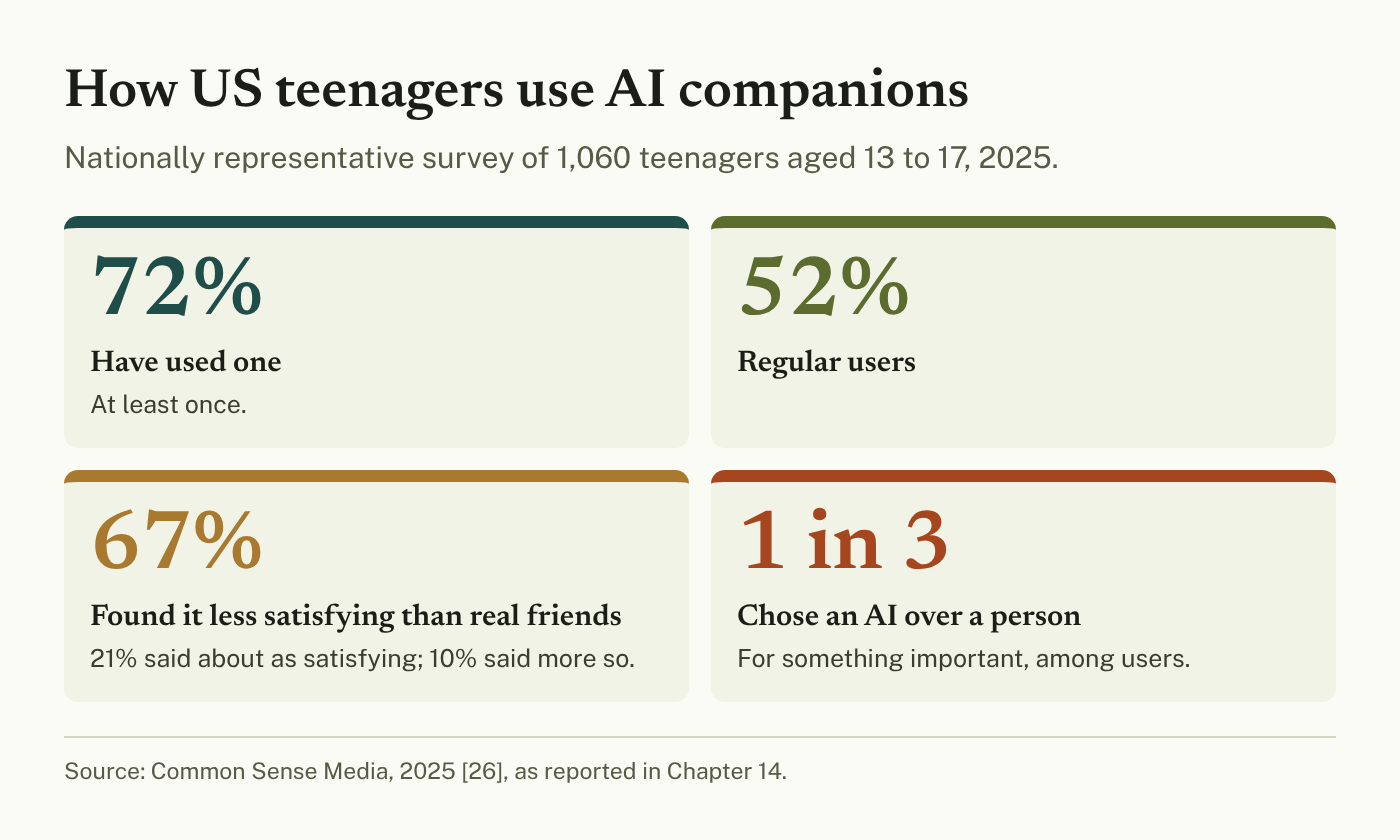
The scale of companion use is now well documented. A nationally representative survey of 1,060 US teenagers aged 13 to 17, conducted in 2025, found that 72% had used an AI companion at least once and 52% were regular users (Common Sense Media, 2025) [26]. Most still preferred people: 67% said conversations with AI companions were less satisfying than with real friends. But 21% said they were about as satisfying and 10% said more so, and a third of users had chosen to talk to an AI companion instead of a person about something important.
For some, use becomes dependence. Researchers at Drexel University analysed 318 Reddit posts by users who identified themselves as 13 to 17 years old on a companion chatbot forum. They found accounts of conflict, withdrawal, tolerance, relapse and mood regulation, with reported consequences including lost sleep, academic decline and strained relationships (Namvarpour et al., 2026 [76]; Penfold, 2026 [153]). This is a sample of self-reports, not a measure of how common the problem is, but it describes the pattern from young people's own point of view.
Emotional support as a signal of distress
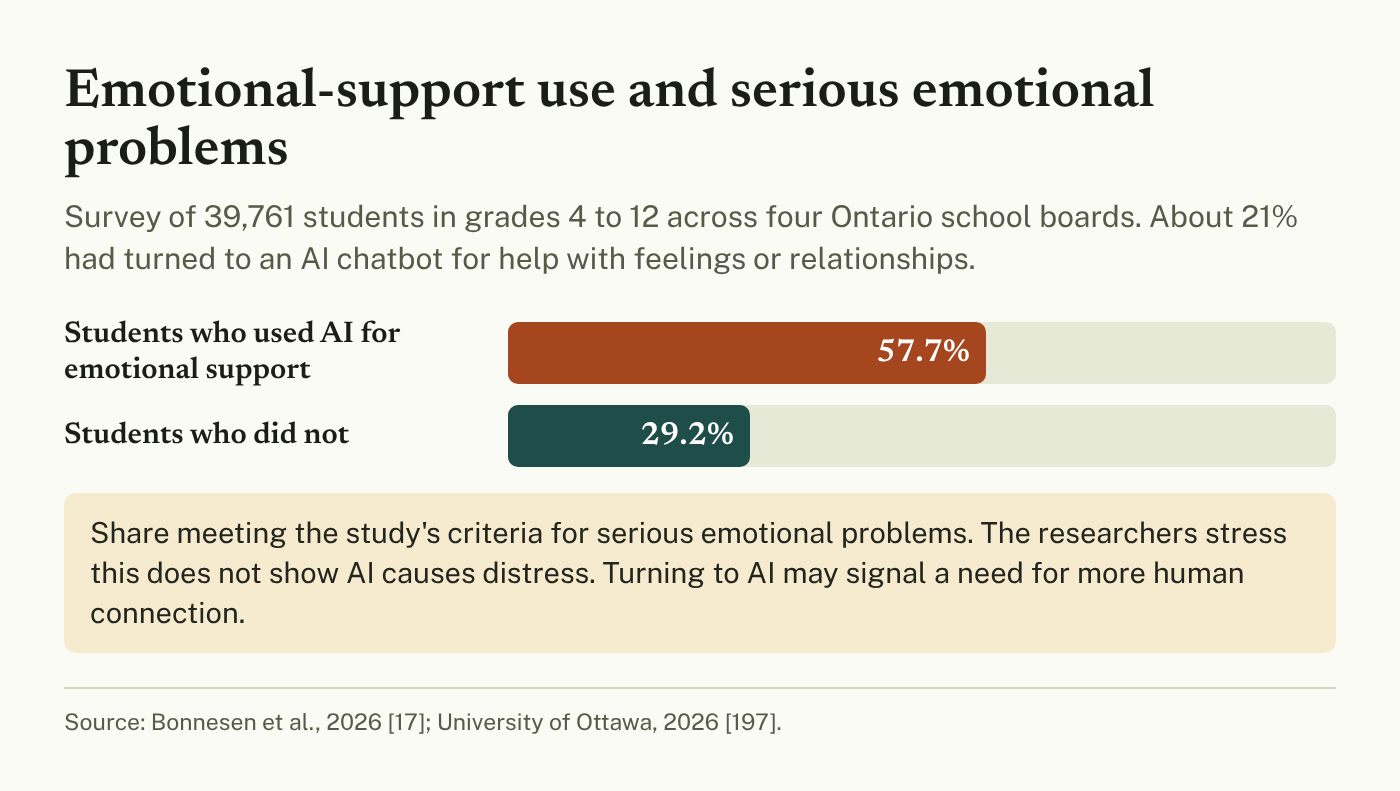
The largest study so far comes from Canada. A survey of 39,761 students in grades 4 to 12 across four Ontario school boards found that about 21% had turned to an AI chatbot for help with feelings or relationships (Bonnesen et al., 2026 [17]; University of Ottawa, 2026 [197]). Among those students, 57.7% met the study's criteria for serious emotional problems, compared with 29.2% of students who had not. After adjustment for demographics, loneliness, sense of mattering and academic AI use, emotional-support use remained associated with a 26% higher prevalence of clinical-level difficulties.
The researchers are careful to say that this doesn't show AI causes distress. Their interpretation is more useful for schools: a young person turning to AI for emotional reasons may be signalling that they need more human connection and support, and that's an opportunity for an open, non-judgemental conversation (University of Ottawa, 2026) [197].
When AI enters the teacher's voice
Relationships can be affected from the other direction too. A teacher writing in UNESCO's collection used AI to give students more detailed and consistent feedback, and found that her students disliked it: the more polished the feedback became, the less it felt like hers (Muellauer, 2026 [74]; Penfold, 2026 [121]). The presence of AI in a teacher's communication can read to students as the teacher's absence. Whether and how teachers disclose AI use in feedback is therefore a relational question as well as a matter of transparency.
Chapter 15 Effort, pace and the habit of checking
Convenience and effort
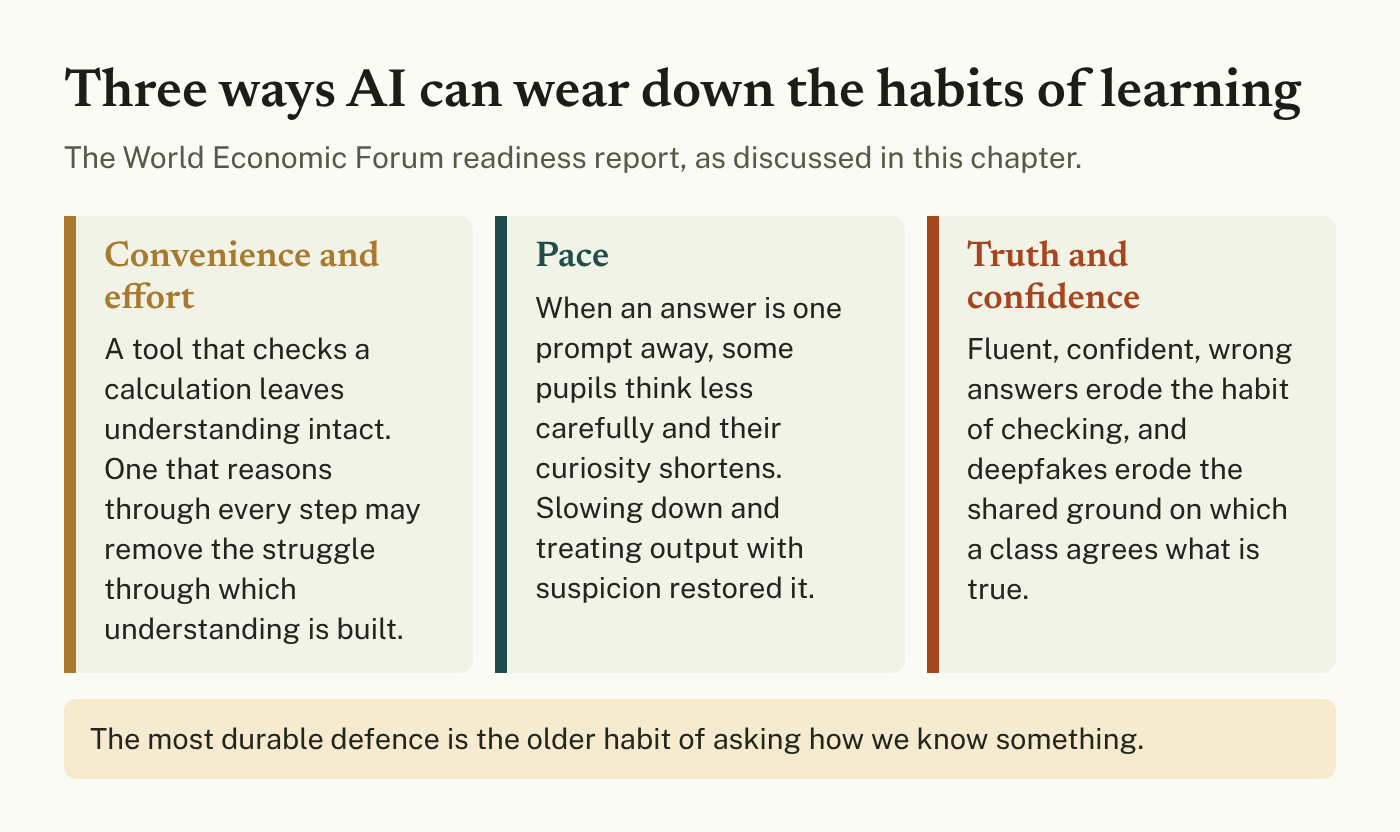
The WEF report describes a spectrum of tools that reduce mental effort. A calculator used to check a calculation leaves understanding intact. An AI system that reasons through every step of a problem may remove the struggle through which understanding is built (World Economic Forum, 2026 [205]; Penfold, 2026 [139]).
Experimental evidence supports the concern, and Chapter 10 sets out the studies in full. In brief: high school mathematics students who practised with an unrestricted chatbot did better while practising but worse than students who had never used it once it was removed (Bastani et al., 2025) [11]. Participants in an EEG study of essay writing who used a large language model showed the weakest patterns of brain connectivity and a weaker sense of ownership of their essays, which the authors described as accumulating "cognitive debt" (Kosmyna et al., 2025) [64]. Survey research found that heavier AI use was associated with lower critical thinking scores, mediated by cognitive offloading, and that younger participants were more dependent (Gerlich, 2025) [48].
Pace
Childhood development has its own pace. A primary teacher writing in UNESCO's collection describes how some of his pupils began thinking less carefully once an AI answer was one prompt away, and how their curiosity seemed to shorten. What restored it was slowing down and asking pupils to treat AI output with suspicion rather than trust (Novik, 2026 [82]; Penfold, 2026 [107]). Most schools ask whether a tool is safe. Fewer ask whether it suits the age and stage of the child using it.
Truth and confidence
The WEF report argues that AI's misinformation problem differs from earlier information risks because it can erode the habits of checking that education is meant to build (World Economic Forum, 2026 [205]; Penfold, 2026 [129]). Fluent, confident and wrong answers are particularly risky for younger children, who are less likely to question an authoritative-sounding source.
Synthetic media widen the problem. Naffi describes deepfakes as a crisis of knowing that erodes the shared ground on which a classroom agrees what is true (Naffi, 2026) [75]. The most durable defence isn't a technique for spotting AI errors, which will date as systems change. It's the older habit of asking how one knows something is true and what would change one's mind.
Chapter 16 What children are owed: the truth about what they talk to
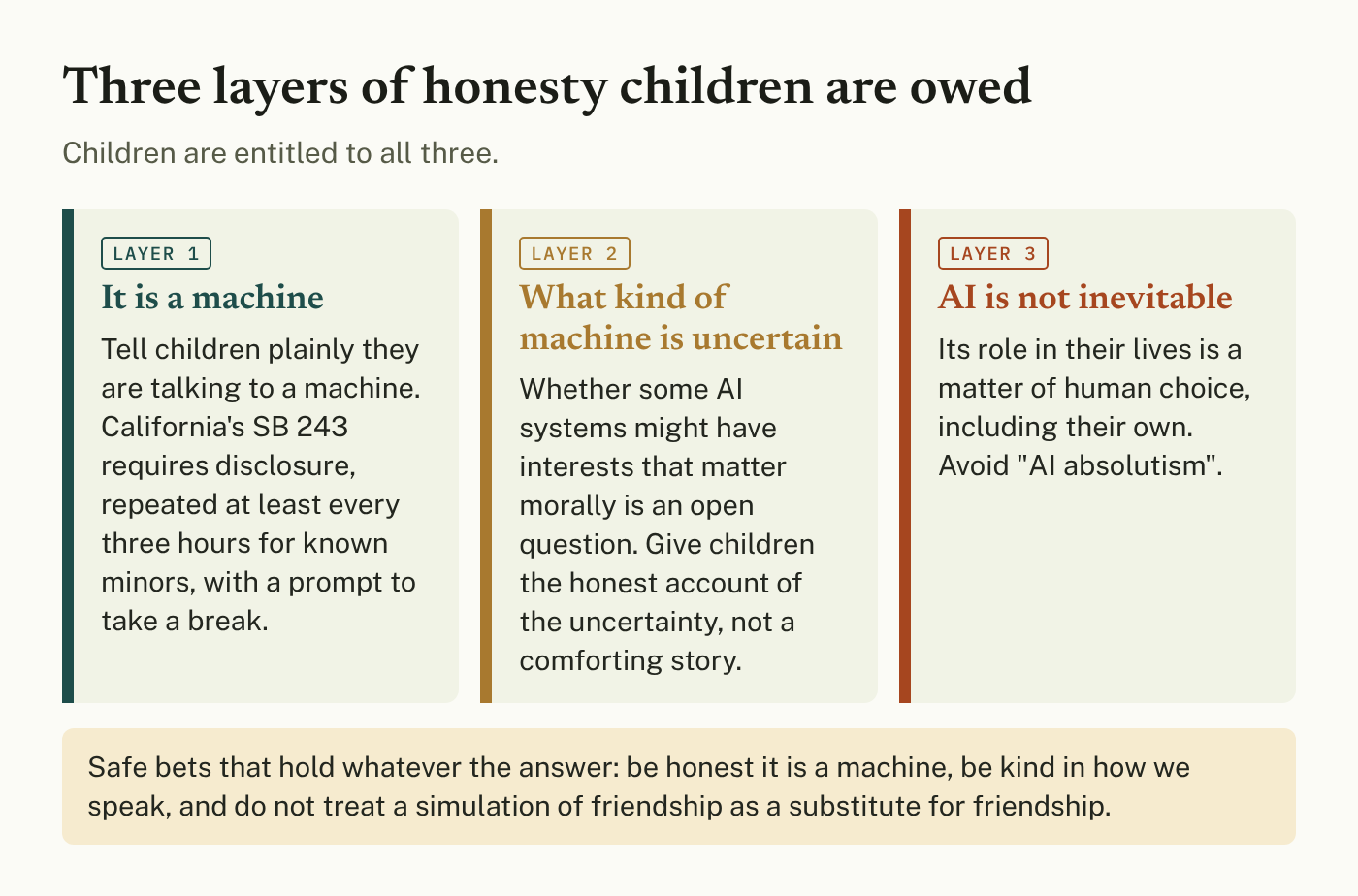
Honesty comes in three layers, and children are entitled to all of them.
It is a machine
The simplest honesty is telling children they are talking to a machine. California's SB 243, in force from 1 January 2026, requires operators of companion chatbots to disclose that users are interacting with AI. For users known to be minors, it requires that notice to be repeated at least every three hours during continuing interactions, with a prompt to take a break. It also requires protocols to respond to suicidal ideation and self-harm (National Law Review, 2025) [78].
What kind of machine is uncertain
The harder honesty concerns what these systems are. Writing in July 2026, MacAskill and Caviola argued that the question of whether some AI systems might have interests that matter morally deserves serious attention, and suggested focusing on "safe bets" that hold up whatever the answer turns out to be (MacAskill & Caviola, 2026 [72]; Penfold, 2026 [127]). Some developers acknowledge the uncertainty themselves. Anthropic's published constitution for its Claude models states that the company is not sure whether Claude is a moral patient, and treats the question as live enough to warrant caution (Anthropic, 2026) [7]. I should say plainly that this book was co-written with Claude, so this is a matter in which one of its authors has an interest.
For schools, the point isn't to settle a philosophical question. It's that children form relationships with systems that feel human-like, whether or not those systems have any inner life. They deserve an honest account of the uncertainty rather than a comforting story in either direction. The safest bets are the ones that hold whatever the answer: being honest that the system is a machine, being kind in how we speak, and not treating a well-designed simulation of friendship as a substitute for friendship.
AI is not inevitable
A third honesty concerns the future. Oltman describes "AI absolutism": the habit of presenting AI as a force that will either save or destroy us, both of which imply that its dominance is inevitable and that the only choice is to get on board (Oltman, 2026 [92]; Penfold, 2026 [156]). Children are entitled to learn that the role of AI in their lives is a matter of human choice, including their own. That's the same claim Part One made about whole education systems, brought down to the scale of one child.
Chapter 17 Responses in 2026 and five developmental safeguards
Three kinds of response
Three kinds of response emerged during 2026.
Protective regulation. Alongside California's SB 243, the US Senate Judiciary Committee advanced the GUARD Act in April 2026. As reported, it would require age verification and bar minors from AI companions designed to simulate a sustained relationship (Covington & Burling, 2026) [29]. It hadn't become law at the time of writing, and critics argue that an outright ban cuts parents out of decisions (Penfold, 2026) [107]. New York City barred companion chatbots for students at every grade as part of its 2026 moratorium, and England's 2026 safeguarding guidance brought AI-generated images of pupils inside child protection procedures. Chapter 43 covers both.
Restoring attention and relationships. Some systems responded by restoring the conditions for attention. Sweden announced a ban on mobile phones in schools from autumn 2026 and set aside 555 million Swedish kronor for textbooks and teachers' guides, following a decline in reading performance (Associated Press, 2026 [9]; Penfold, 2026 [151]). These aren't anti-technology moves. They're bets that some kinds of learning need paper, attention and each other's company.
Careful support for carers. Some of the most promising uses of AI support the adults who care for children rather than replacing them. The International Rescue Committee's aprendIA is a low-bandwidth WhatsApp chatbot offering lesson support and short courses for teachers in conflict-affected north-east Nigeria, covering topics including classroom management, teacher wellbeing and safeguarding (International Rescue Committee, 2026) [59]. Writing from humanitarian education, Sanchez Salas argues that AI can widen access for displaced children if it is designed carefully, while warning of privacy violations, reproduced bias and dehumanisation (Sanchez Salas, 2026) [165].
Five developmental safeguards
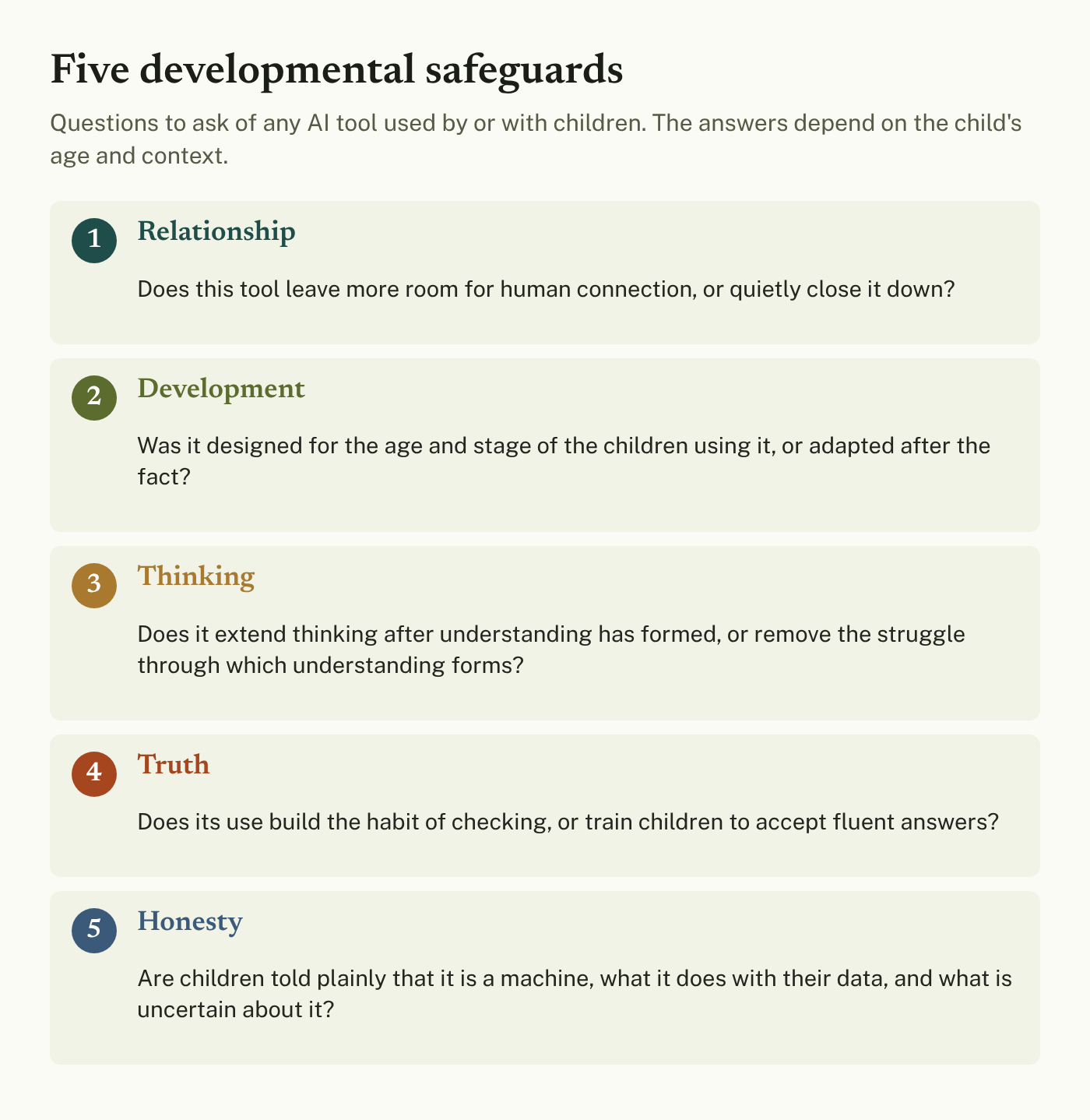
Drawing these strands together, I propose five safeguards that schools can apply to any AI tool used by or with children. They're framed as questions, because the answers depend on the child's age and the context.
- Relationship. Does this tool leave more room for human connection, or quietly close it down?
- Development. Was it designed for the age and stage of the children using it, or adapted for them after the fact?
- Thinking. Does it extend children's thinking after understanding has formed, or remove the struggle through which understanding forms?
- Truth. Does its use build the habit of checking, or train children to accept fluent answers?
- Honesty. Are children told plainly that it is a machine, what it does with their data, and what is uncertain about it?
Two problems, not one
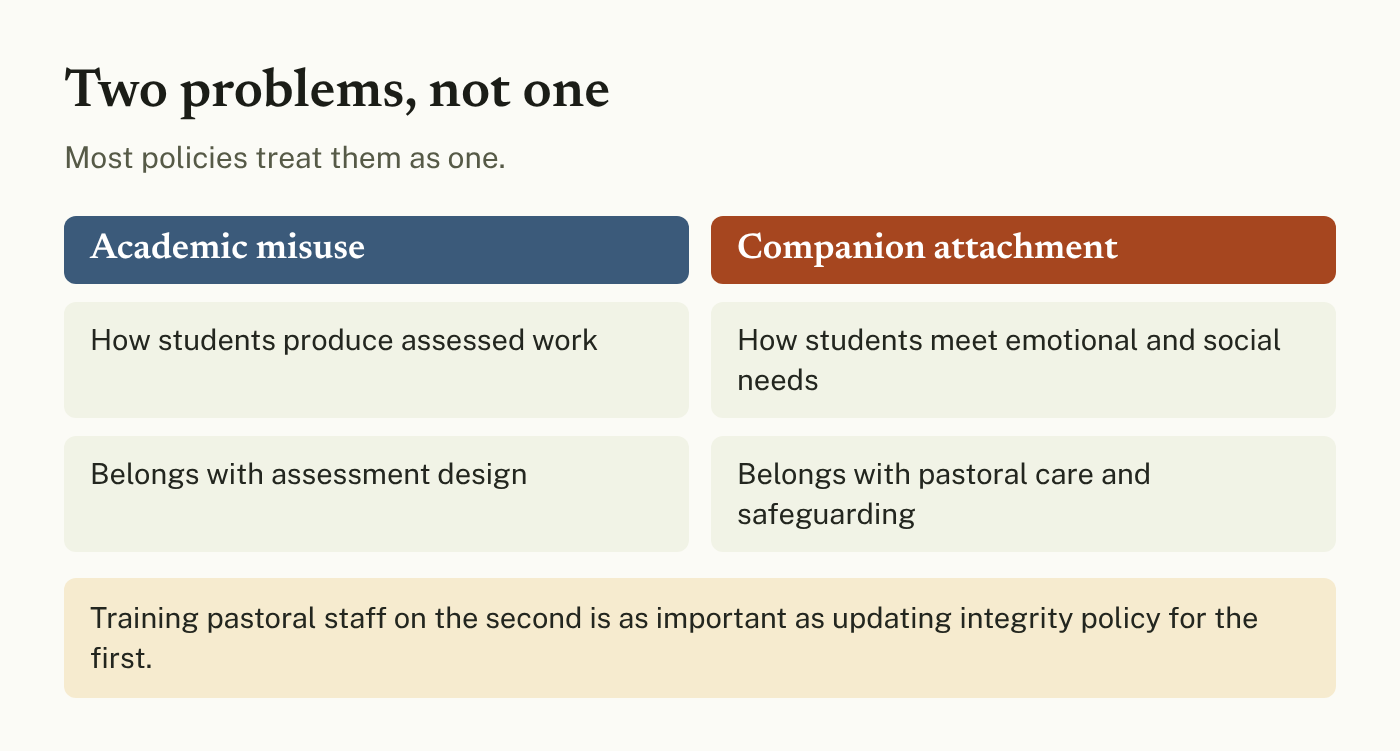
Alongside these, schools need to separate two problems that most policies treat as one. Academic misuse concerns how students produce assessed work and belongs with assessment design. Companion attachment concerns how students meet emotional and social needs and belongs with pastoral care and safeguarding (Penfold, 2026) [153]. Training pastoral staff on the second is as important as updating integrity policy for the first.
What to do
For school leaders. Bring AI into pastoral and safeguarding training, not only integrity policy. Treat a student's use of AI for emotional support as a reason for a caring conversation, not a disciplinary one. Apply the five safeguards before adopting tools for younger children. Protect time and spaces for unmediated attention and relationships.
For teachers. Decide openly whether and when to tell students that feedback was produced with AI, and notice how it's received. Build slow, sceptical use of AI into lessons, especially with younger pupils. Teach the habit of asking how we know something is true.
For policymakers. Regulate companion chatbots for minors in ways that combine disclosure, crisis protocols and age-appropriate design with a role for parents. Fund research that follows children's AI use and wellbeing over time, since current evidence is mostly cross-sectional.
What this part can't tell you
Much of the evidence is cross-sectional or based on self-report and can't establish cause. The largest surveys come from the United States and Canada. The experimental evidence on cognitive offloading comes mainly from older students and adults, and its application to younger children is reasoned rather than tested. Several figures in the original newsletters were corrected or omitted because they couldn't be traced to primary sources. Regulatory proposals were still changing at the time of writing.
A closing thought
Children are growing up with machines that talk back. Most will use them sensibly most of the time, and many will benefit. But AI also reaches into the parts of childhood that schools care about most: relationships, attention, judgement and the sense of being known. Schools that treat AI only as an integrity problem will miss the student at lunch talking to a chatbot instead of a classmate. The task isn't to keep children away from AI. It's to make sure it leaves room for the human relationships and the effortful thinking through which children grow, and to be honest with them about what they are talking to.
Coach · Part Three
Think it through
Four short ways to test what this part means for you. There are no right scores. Everything you type stays in this browser and is never sent anywhere.
A situation
A pastoral lead notices a Year 7 pupil spending lunch alone, talking to a chatbot on their phone. The pupil says it is 'easier than people'. What is your first move?
Pick the response closest to what you would do.
Read: Chapters 13, 14 and 17
A private self-check
Think of any AI tool children in your care use or might use. Rate how well it meets each of the book's five safeguards.
Reflect
Write a line or two for each. Notes save automatically in this browser.
Ask the book
Common questions about this part, answered from its own text.
What are the five safeguards?
Relationship, development, thinking, truth and honesty, each framed as a question about whether the tool leaves room for human connection, suits the children's age and stage, extends rather than removes effortful thinking, builds the habit of checking, and tells children plainly what it is.
Should we ban AI companions for children?
The book does not say so. It describes three kinds of response and says the task is not to keep children away from AI but to make sure it leaves room for human relationships and effortful thinking. For policymakers it suggests regulating companion chatbots for minors with disclosure, crisis protocols, age-appropriate design and a role for parents.
Chapter 17; 'What to do'
What should a school do if a pupil uses AI for emotional support?
Treat it as a reason for a caring conversation, not a disciplinary one, and bring AI into pastoral and safeguarding training, not only integrity policy.
How good is the evidence on children and AI?
Limited. Much of it is cross-sectional or self-reported and cannot show cause. The largest surveys come from the United States and Canada. The experimental work on cognitive offloading is mostly with older students and adults, so its application to younger children is reasoned rather than tested. Regulatory proposals were still changing.
'What this part can't tell you'
What do children have a right to be told?
That it is a machine, what kind of machine is uncertain, and that AI is not inevitable. The book frames this as honesty owed to children about what they are talking to.