Part Four
What Counts as AI Literacy
Based on the paper "What Counts as AI Literacy? A Comparative Analysis of International Frameworks and System-Level Policies, 2024–2026" by Paul Penfold (Proceedings of Future Science Archives, 2026).
Part Three asked what children are owed. This part asks what young people should be able to do. It compares the main international definitions of AI literacy, looks at three school systems that acted on them, and offers a model that schools can use.
Chapter 18 Everyone agrees it matters, nobody agrees what it is
Ask a room of teachers whether AI literacy matters and almost every hand goes up. Ask what it covers, or how you would know whether a student had it, and the agreement falls apart. Schools have been trying to answer that second question, often from scratch, while their students' use of AI ran ahead of them.
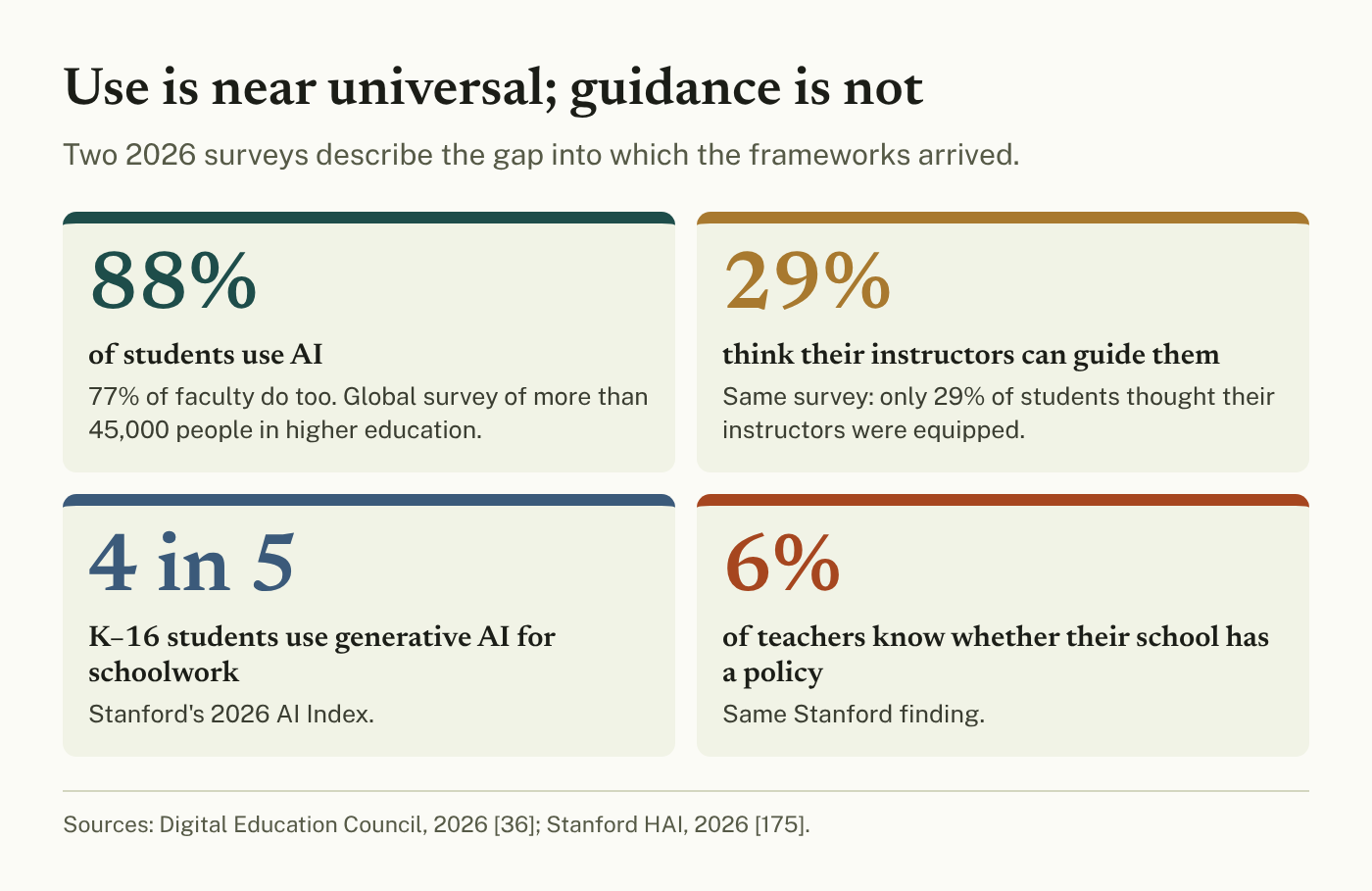
A 2026 global survey of more than 45,000 people in higher education found that 88% of students and 77% of faculty were already using AI, but only 29% of students thought their instructors were equipped to guide them (Digital Education Council, 2026) [36]. Stanford's 2026 AI Index found that four in five K–16 students used generative AI for schoolwork, while only 6% of teachers knew whether their school had a policy on it (Stanford HAI, 2026) [175]. Chapter 32 returns to these figures when it looks at teachers.
Into that gap came a wave of frameworks. Academic work on AI literacy goes back at least to Long and Magerko (2020) [71], who proposed 17 competencies and a set of design considerations, and to Ng et al. (2021) [81], whose review grouped the field around knowing and understanding AI, using and applying it, evaluating and creating with it, and AI ethics. What changed after 2024 is that intergovernmental and international bodies began issuing definitions with real policy weight, and one of them, the OECD, began building an international test.
Three questions run through this part:
- Where do the main international AI literacy frameworks agree, and where do they differ?
- What do early system-level policies show about putting those definitions into practice?
- What should schools and curriculum designers take from both?
How the comparison was done
This is a comparative document analysis. I examined five frameworks published or finalised between 2024 and 2026, chosen because each was issued by an international body or widely used network and each sets out a structured definition of AI literacy for education. I also looked at three system-level policies that came to prominence in 2026: China's national plans for AI education, Boston Public Schools' high school AI literacy programme, and New York City's moratorium on student-facing generative AI from kindergarten to grade 8.
The analysis began as a series of newsletters I wrote for school leaders (Penfold, 2026) [150, 157, 130, 109, 126, 106, 103, 120]. Each framework and policy was first read and discussed there as it was published. For this part, I went back to the primary documents and news sources and checked the claims against them. I coded each framework for its definition, its structure, whether it describes progression, how it treats ethics and human agency, whether it addresses creation and design, and whether it says anything about assessment.
Chapter 19 Five frameworks side by side
UNESCO: a human-centred competency framework
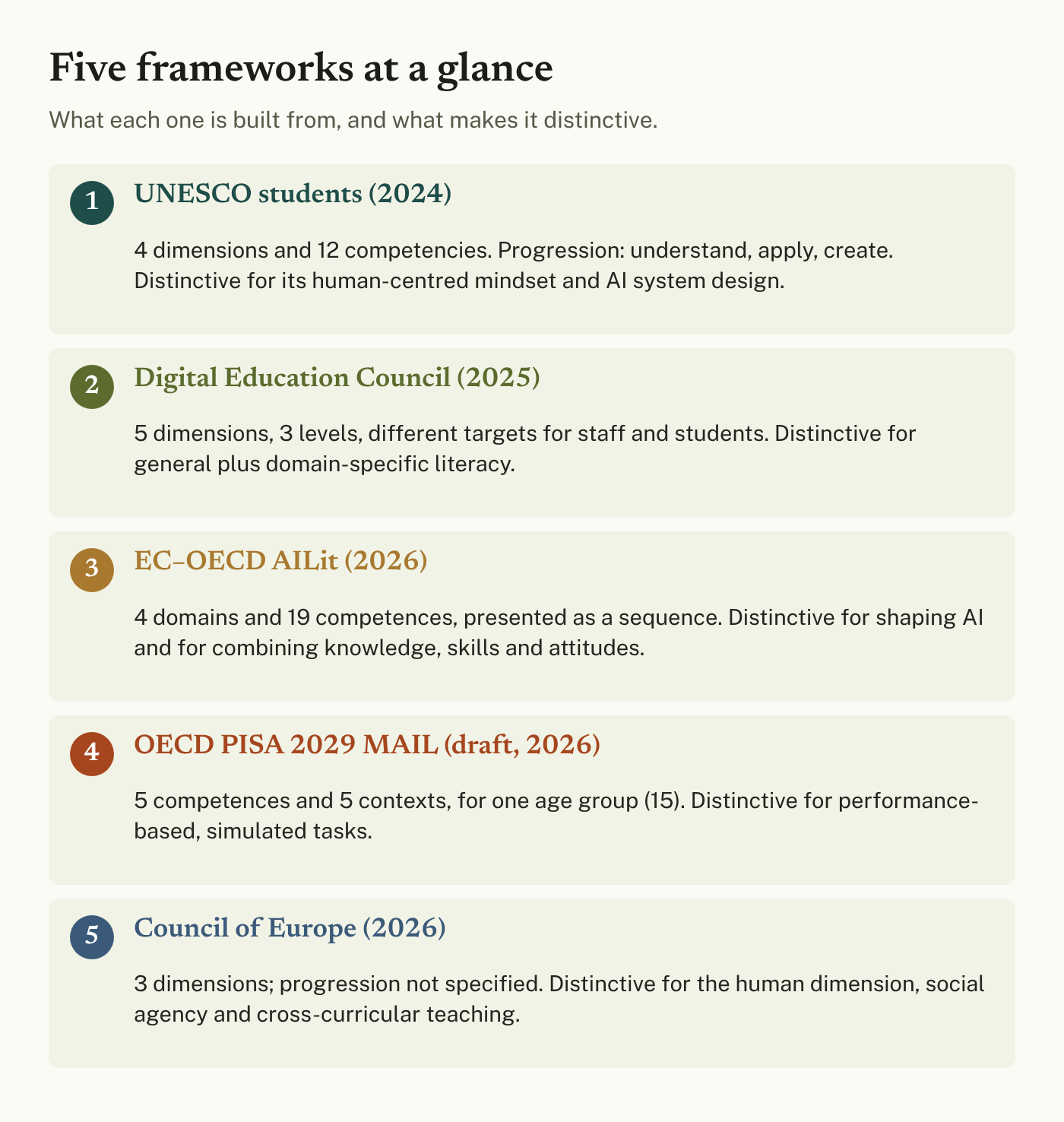
UNESCO's student framework sets out 12 competencies across four dimensions: a human-centred mindset, the ethics of AI, AI techniques and applications, and AI system design. Each runs across three levels of progression: understand, apply and create (UNESCO, 2024) [185]. The companion framework for teachers adds dimensions on AI pedagogy and on AI for professional development (UNESCO, 2024) [186]. UNESCO is explicit that AI should serve people and remain under human control, and its framework treats ethics as a strand in its own right rather than a footnote.
Digital Education Council: general and domain literacy
The Digital Education Council (DEC) framework defines AI literacy as the knowledge and skills needed to understand, interact with and critically assess AI. It has five dimensions: understanding AI and data; critical thinking and judgement; ethical and responsible use; human-centricity, emotional intelligence and creativity; and domain expertise (Digital Education Council, 2025) [34]. The first four are general and apply to everyone. The fifth is specific to a person's subject or profession. Each dimension runs across three levels. Critical thinking and judgement, for example, moves from questioning AI output, to evaluating it, to challenging it.
Two features stand out. The split between general and domain literacy is something most other frameworks leave out. And DEC sets different target profiles for staff and students: faculty are expected to reach level 2 across the general dimensions, students a level 1 baseline. The framework was built with universities in mind, and its domain dimension needs real translation work before it fits a primary classroom, where a teacher's "domain" is as much child development as any single subject (Penfold, 2026) [150].
European Commission and OECD: the AILit Framework
The AILit Framework, finalised in 2026 after a 2025 draft, organises AI literacy into four domains: Engage with AI, Create with AI, Manage AI and Shape AI (European Commission & OECD, 2026) [43]. Each competence combines knowledge, skills and attitudes, and the domains are presented in sequence to suggest a possible learning path. It is aimed at primary and secondary education, is designed to work across subjects, and contributes directly to the PISA 2029 assessment. Its inclusion of Shape AI, which covers understanding how AI systems are designed and how society can influence them, makes it the framework most willing to treat young people as future builders and governors of AI, not just users.
OECD PISA 2029: literacy as something measured
The PISA 2029 Media and Artificial Intelligence Literacy (MAIL) framework is the first attempt to measure AI and media literacy among 15-year-olds at international scale. Its first draft, dated January 2026, defines MAIL as the competences needed to engage effectively, ethically and responsibly with digital content, media platforms and AI systems (OECD, 2026) [91]. It names five competences: access and use; analyse and evaluate; participate and collaborate; create; and reflect and act ethically and responsibly. The last of these sits beneath the others rather than alongside them. Tasks are set in five contexts: relationships, learning, entertainment, persuasion and citizenship.
What makes MAIL distinctive is its format. The example task places students in a simulated desktop, with a chat tool, browser and search engine, and asks them to verify a news story before publication, with sources of varying credibility. That's assessment of performance, not of recall. The OECD is explicit that the draft will change after piloting and a field trial (Penfold, 2026) [157].
Council of Europe: protecting social agency
The Council of Europe's recommendation to its 46 member states, adopted on 2 September 2026, sets out a three-dimensional model: a human dimension, a technological dimension and a practical dimension (Council of Europe, 2026) [27]. It singles out the human dimension, covering ethics, psychology, culture and impact on human rights, democracy and the rule of law, as deserving particular attention. It is blunt that AI systems "do not think, understand, reason or learn in the way humans do", and that people should not hand over their agency, judgement or responsibility to them.
It frames the purpose of AI literacy as protecting social agency, the capacity to act autonomously and meaningfully in society. It asks for AI literacy to be woven across civics, digital and media literacy and STEM rather than taught as a separate subject, and for honest communication with learners and families about when AI is being used in their education. Like all Committee of Ministers recommendations, it isn't legally binding (Penfold, 2026) [130].
At a glance
- UNESCO students (2024) [185]: 4 dimensions and 12 competencies; progression through understand, apply and create; distinctive for its human-centred mindset and AI system design.
- DEC (2025) [34]: 5 dimensions; 3 levels, with different targets for staff and students; distinctive for general plus domain-specific literacy.
- EC–OECD AILit (2026) [43]: 4 domains and 19 competences; domains presented as a sequence; distinctive for shaping AI and for combining knowledge, skills and attitudes.
- OECD PISA 2029 MAIL (draft, 2026) [91]: 5 competences and 5 contexts; a single age group (15); distinctive for performance-based, simulated tasks.
- Council of Europe (2026) [27]: 3 dimensions; progression not specified; distinctive for the human dimension, social agency and cross-curricular teaching.
Chapter 20 Four points of agreement, five real differences
Where the frameworks agree
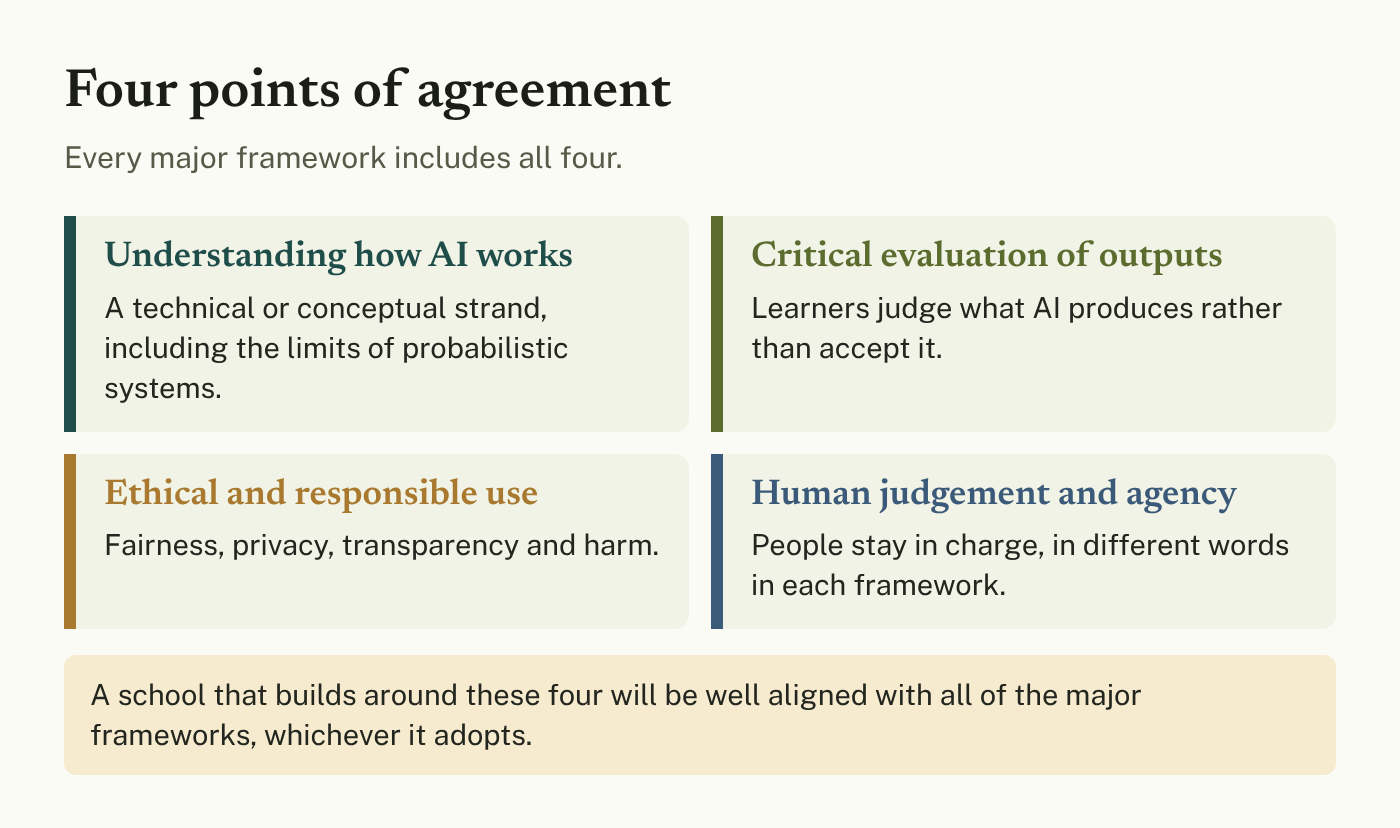
Despite different origins, the frameworks converge on four elements.
- Understanding how AI works. Every framework includes a technical or conceptual strand: how data, models and outputs relate, and what the limits of probabilistic systems are. None of them treats this as optional.
- Critical evaluation of outputs. Every framework asks learners to judge what AI produces rather than accept it. DEC makes this a dimension of its own. MAIL builds half of its assessment time around analysing, evaluating and creating.
- Ethical and responsible use. Every framework includes ethics, covering fairness, privacy, transparency and harm. In MAIL and the Council of Europe model, ethics is a layer that runs beneath everything else, not a separate topic.
- Human judgement and agency. Every framework insists, in different words, that people stay in charge: UNESCO's human-centred mindset, DEC's human-centricity, the Council of Europe's social agency, AILit's attention to attitudes and to shaping AI.
The practical implication is reassuring. A school that builds its AI literacy work around these four elements will be well aligned with all of the major frameworks, whichever it eventually adopts.
Where they differ
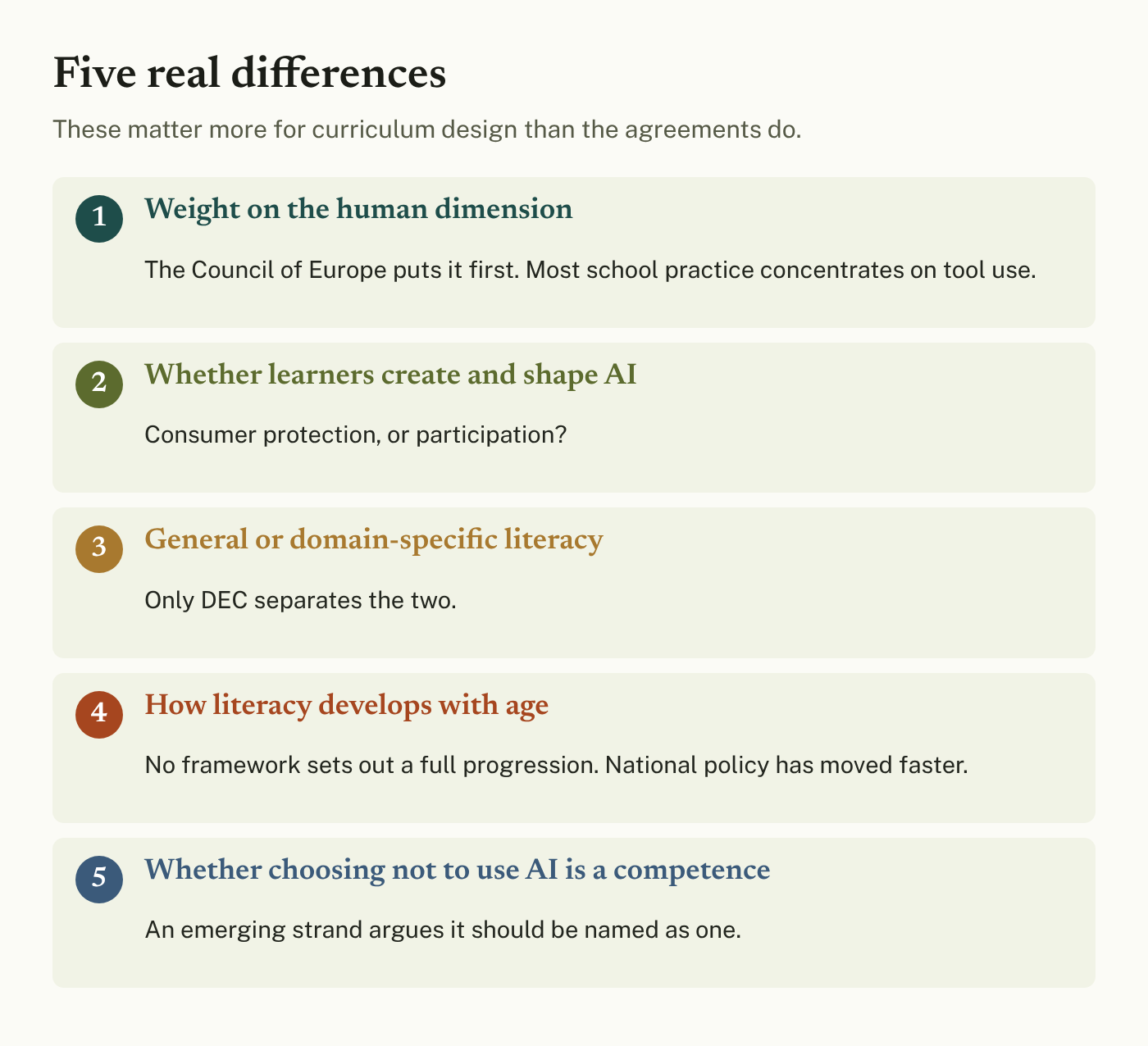
The differences matter more for curriculum design than the agreements do.
How much weight goes on the human dimension. The Council of Europe gives the human dimension priority. Most school practice does the opposite, concentrating on tool use, prompting and spotting deepfakes, which the recommendation would place in the practical dimension (Penfold, 2026) [130]. A curriculum that starts and ends with tool training has covered the easiest third and skipped the two parts that matter more.
Whether learners create and shape AI. UNESCO's AI system design dimension and AILit's Shape AI domain treat learners as potential designers of AI and citizens who can influence it. DEC and the Council of Europe say much less about this. The difference reflects a real choice about whether AI literacy is a form of consumer protection or a form of participation.
General or domain-specific literacy. DEC alone separates general literacy from domain expertise. This matters because AI literacy looks different for a historian, a nurse and a primary teacher, even when the underlying judgement and ethics are the same. The other frameworks assume general literacy is enough, or leave subject application to teachers.
How literacy develops with age. UNESCO and DEC describe levels, and AILit suggests a sequence, but none sets out a full developmental progression from early childhood to adulthood. National policy has moved faster here. China's plans tier AI education by age, with younger children experiencing AI in class and older students working up to creative projects with advanced tools (Bloomberg, 2026 [16]; Penfold, 2026 [109]). That's a claim about what AI literacy is at each stage, not just a rollout timetable.
Whether choosing not to use AI is a competence. The frameworks mostly describe competence as the ability to use AI well. An emerging strand of practice argues that the ability to decide not to use AI, for good reasons, should be named as a competence too. Teachers and school leaders at a 2026 UNESCO and European Union workshop made this case for teachers specifically (Penfold, 2026) [126]. A teacher who keeps a chatbot out of a writing unit because it would undermine the thinking she's trying to build is showing exactly the judgement AI literacy is meant to produce. Systems that measure success only by adoption can't tell her apart from someone who has been left behind.
Chapter 21 China, Boston and New York City
Three policies from 2026 show how differently school systems have acted on the same broad idea.
China: national mandate, tiered by age
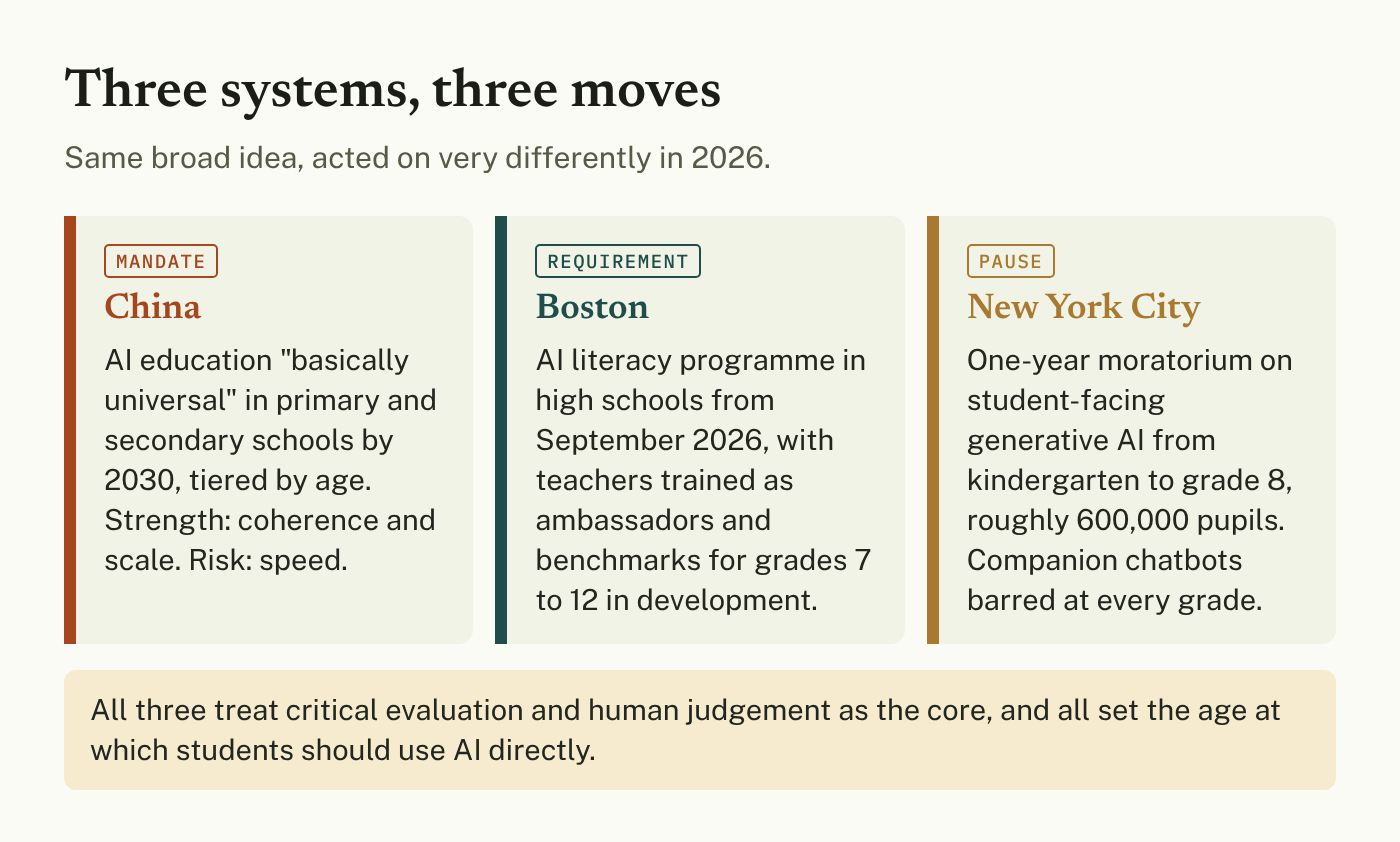
China's Ministry of Education set out its approach in a 2024 notice aiming to make AI education "basically universal" in primary and secondary schools by 2030, tiered so that younger pupils experience AI while older students work towards creative projects with advanced tools (Ministry of Education of the People's Republic of China, 2024) [73]. Beijing introduced compulsory AI lessons in primary and middle schools from autumn 2025 (NPR, 2026) [83], and in June 2026 the State Council issued a five-year plan to promote AI education throughout all stages of education (Bloomberg, 2026) [16].
The design is tiered by age and sits inside long-term planning. Its strength is coherence and scale. Its risk is speed: a mandate that runs ahead of settled pedagogy and trained teachers can produce box-ticking lessons rather than real judgement (Penfold, 2026) [109].
Boston: literacy for every high school graduate
Boston Public Schools launched an AI literacy programme in its high schools in September 2026, in partnership with the University of Massachusetts Boston, with teachers from each high school trained as AI ambassadors and district benchmarks for grades 7 to 12 under development (WBUR, 2026) [198]. It was widely reported as making AI fluency a graduation requirement, though the district's own framing has been closer to a proficiency goal for every graduate. The curriculum covers how AI systems work, their limits and biases, how to verify their outputs, and how to use AI as a thinking tool rather than an answer machine (Penfold, 2026) [106].
New York City: a pause for younger learners
In September 2026, New York City announced a one-year moratorium on student-facing generative AI from kindergarten to grade 8, roughly 600,000 pupils, after two years of encouraging classroom use (CNN, 2026 [24]; StateScoop, 2026 [176]). Companion chatbots were barred at every grade. Teachers could still use AI for planning and administration but not for grading. A limited number of supervised high school pilots continued, alongside new mandatory AI critical-thinking courses, and a named coalition was given a year to review the evidence (Penfold, 2026) [103].
What the three share
On the surface, these look like opposites: one system mandating, one requiring, one pausing. Underneath, they share more than it seems. All three treat critical evaluation and human judgement as the core of AI literacy. All three, in different ways, set the age at which students should use AI directly. And all three face the same two problems, which no framework solves on its own.
Chapter 22 What the definitions leave out, and a model for schools
Teacher capacity
Every policy depends on teachers who are themselves AI literate, and the data suggests most are not yet. The survey evidence in Chapter 18 points to the same gap: students' use is near universal, but confidence in teachers' ability to guide it is low, and policy is often invisible to the people meant to carry it out (Digital Education Council, 2026 [36]; Stanford HAI, 2026 [175]). China's attention to teacher standards, Boston's ambassador model and DEC's higher target level for staff than students are all attempts to address this. Teacher capacity is better treated as the first stage of any AI literacy programme, not a parallel workstream. You can't teach a child to weigh up something you're avoiding yourself (Penfold, 2026) [120]. Part Seven takes this up.
Assessment that measures doing, not knowing
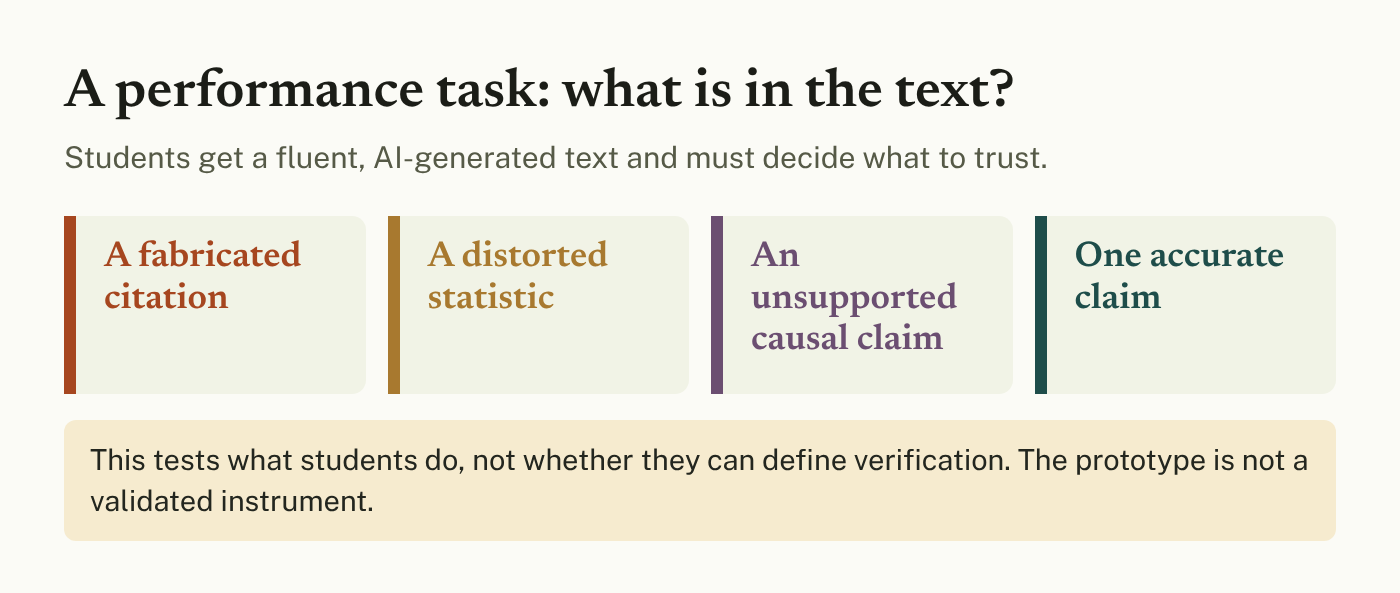
The hardest question for any AI literacy requirement is how to tell a student who can verify a convincing AI answer from one who can only describe verification. A multiple-choice question on hallucinations tests whether a student can define one, not what they'll do when a fluent, confident, wrong answer appears. This question was put directly in response to Boston's announcement, because a credential is only useful if employers can trust it (Penfold, 2026) [106].
The strongest existing basis for an answer comes from outside AI. Wineburg and McGrew's (2019) [200] research on how professional fact-checkers evaluate online information found that experts leave a page almost immediately to check who is behind it and what other sources say, a practice they call lateral reading. Unlike general advice to "think critically", this is a specific, teachable and testable method. PISA 2029's simulated verification task follows the same logic.
Performance-based tasks of this kind can be built for any subject. Students are given a fluent AI-generated text containing a fabricated citation, a distorted statistic, an unsupported causal claim and one accurate claim, and must decide what to trust. I've developed one such teaching prototype (Penfold, 2026) [106]. It isn't a validated instrument, but it shows what the shift from describing a skill to practising it looks like.
A synthesis model
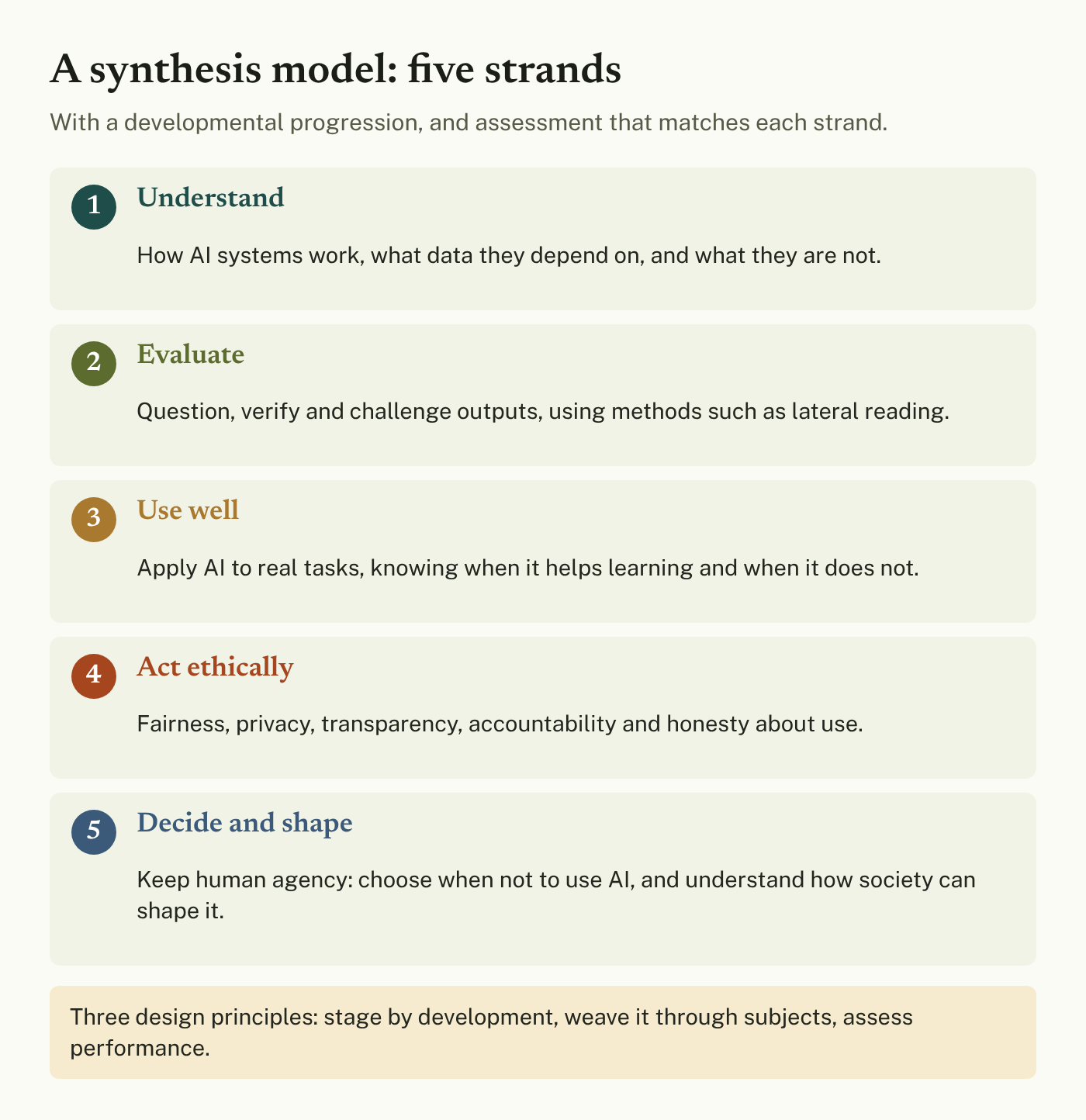
Drawing the frameworks and policies together, I propose that a school AI literacy programme needs five strands, a developmental progression, and assessment that matches each strand.
- Understand. How AI systems work, what data they depend on, and what they are not. (Roots: all five frameworks.)
- Evaluate. Question, verify and challenge AI outputs using methods such as lateral reading. (Roots: all five; DEC and MAIL especially.)
- Use well. Apply AI to real tasks in a subject or field, including knowing when it helps learning and when it doesn't. (Roots: DEC domain expertise; AILit Engage and Create.)
- Act ethically. Fairness, privacy, transparency, accountability, and honesty about use. (Roots: all five; the Council of Europe's human dimension.)
- Decide and shape. Keep human agency: choose when not to use AI, and understand how society can shape AI. (Roots: the Council of Europe's social agency; AILit Shape; UNESCO system design.)
Three design principles follow.
- Stage by development, not by when the software arrived. Younger children should experience and question AI with an adult, while older students can build and create with it. China's tiered model and New York City's age-based pause both reflect this, from opposite directions.
- Weave it through subjects. The Council of Europe and AILit both favour cross-curricular integration. Evaluation and ethics belong in history, science and English as much as in computing.
- Assess performance. Use tasks that require students to verify, judge and decide, not just define.
What to do
For curriculum designers. Build around the four elements on which every framework agrees, then make explicit choices on the five areas where they differ. Hold the curriculum loosely: the PISA framework is still a draft, and systems that build too tightly around today's version may need to rebuild after 2029 (Penfold, 2026) [157].
For school leaders. Start with teachers. Audit staff and student literacy against a named framework rather than guessing from anecdote. Give teachers room for a well-reasoned "no", and measure judgement rather than adoption. Whatever you decide about classroom AI, name who reviews the evidence and when, and tell your community (Penfold, 2026) [103].
For assessment bodies and credentialing systems. If AI literacy becomes a requirement for graduation or certification, invest in performance-based assessment before scaling the requirement. A credential that measures knowledge about verification won't tell employers what they need to know.
What this part can't tell you
This analysis covers frameworks and policies published in English or reported in English-language sources, and it draws on a newsletter series that selected topics for their relevance to school leaders, not through a systematic search. The PISA framework is a draft and will change. The status of Boston's requirement was still being settled at the time of writing, and reports of China's plans rely partly on secondary coverage. These policies are moving quickly, and some of what is described here may already have been revised. Finally, I work in school leadership and curriculum design, which shapes the questions I ask.
A closing thought
The international effort to define AI literacy has been more successful than it might appear. The major frameworks agree on what matters most: understanding the technology, evaluating what it produces, using it ethically and keeping human judgement in charge. Their differences, on the human dimension, on creation, on domain knowledge, on development and on the right to say no, are real choices that schools should make deliberately rather than by default. The harder problems now lie outside the definitions, in teachers who are confident enough to teach AI literacy and in assessment that can tell knowing from doing.
Coach · Part Four
Think it through
Four short ways to test what this part means for you. There are no right scores. Everything you type stays in this browser and is never sent anywhere.
A situation
Your school wants to launch an AI literacy programme. A colleague has downloaded a framework and proposes teaching it unit by unit as a new subject. How do you respond?
Pick the response closest to what you would do.
Read: Chapters 20 and 22
A private self-check
Rate your school's AI literacy work on each of the book's five strands.
Reflect
Write a line or two for each. Notes save automatically in this browser.
Ask the book
Common questions about this part, answered from its own text.
What do the main frameworks agree on?
Four things: understanding the technology, evaluating what it produces, using it ethically, and keeping human judgement in charge. They differ on five areas: the human dimension, creation, domain knowledge, development and the right to say no.
Chapter 20; closing thought
Which frameworks does the part compare?
UNESCO, the Digital Education Council, the European Commission and OECD AILit Framework, the OECD PISA 2029 draft, and the Council of Europe, followed by national and city examples from China, Boston and New York City.
Why is New York City's pause for younger learners mentioned?
It is one of two contrasting examples of staging literacy by development. China's tiered model and New York City's age-based pause both reflect the idea of staging by development, from opposite directions.
What does the synthesis model propose?
Five strands (understand, evaluate, use well, act ethically, decide and shape), a developmental progression, and assessment that matches each strand. Its design principles: stage by development, weave through subjects, and assess performance.
How reliable is this comparison?
It covers frameworks published in English or reported in English-language sources, and the newsletter series behind it was selected for relevance to school leaders, not through a systematic search. The PISA framework is a draft, Boston's requirement was still being settled and reports on China rely partly on secondary coverage. Some of it may already have been revised.
'What this part can't tell you'