Part Five
When the Artefact Is No Longer Evidence
Based on the paper "When the Artefact Is No Longer Evidence: Assessment Validity and Academic Integrity in the Age of Generative AI" by Paul Penfold (Proceedings of Future Science Archives, 2026).
Part Four asked what young people should be able to do with AI. This part asks how we would ever know. It looks at why the essay and the take-home task have stopped working as proof, why detection can't repair them, and what schools can build in their place.
Chapter 23 The quiet assumption behind most assessment
A lot of school assessment rests on an assumption nobody says out loud: that producing the work proves you can do the thinking. Write the essay and you must have understood the argument. Solve the problems at home and you must have grasped the method. For a long time the assumption held, because producing the work required the thinking. It no longer does.
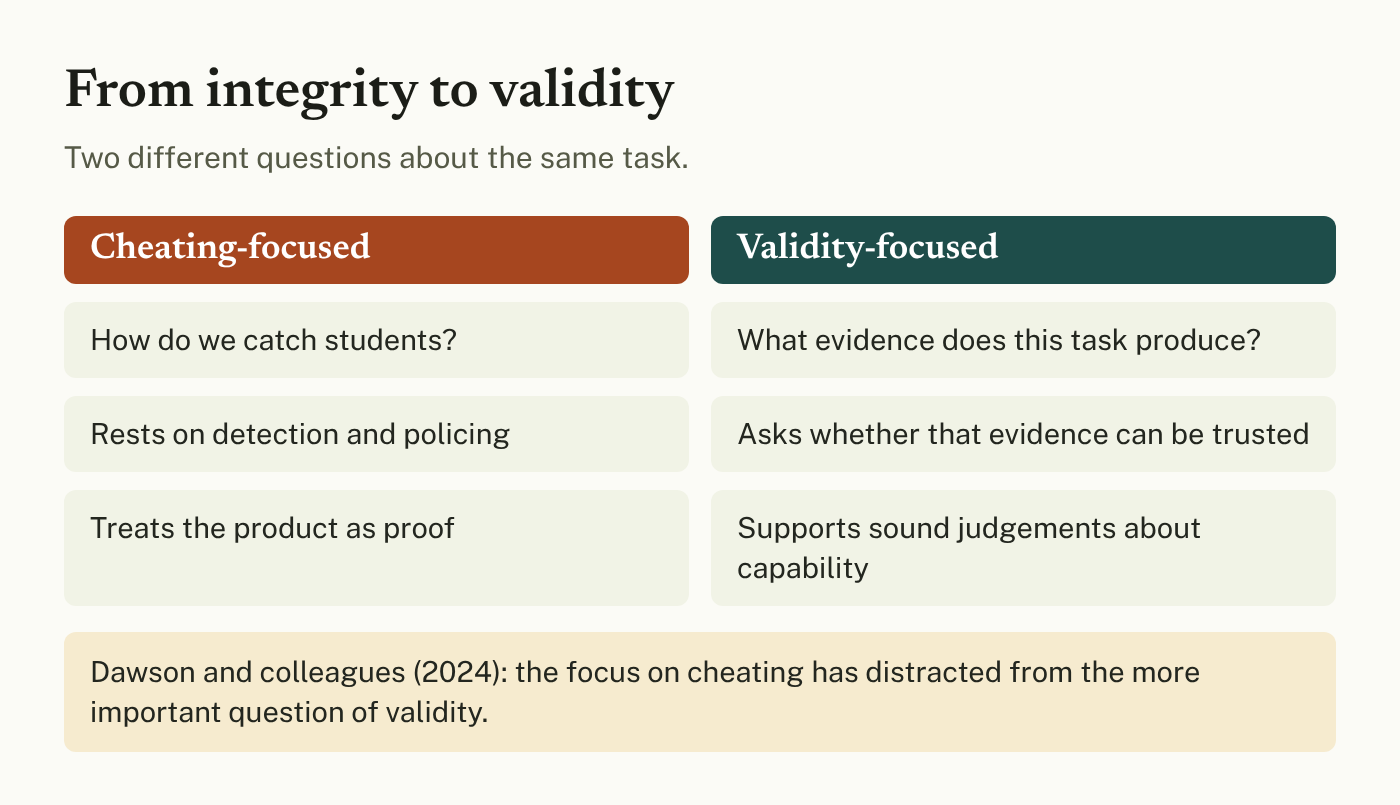
This is often described as a cheating crisis, and the first reflex of many institutions has been to reach for detectors, bans and locked-down conditions. I think the reflex misreads the problem. The essay was always a proxy for the understanding behind it. If AI can now produce the proxy without the understanding, the proxy has stopped working, and no amount of policing will bring it back. The more useful question, put plainly by Dawson and colleagues (2024) [31], is about validity rather than cheating: does this assessment still let us make a trustworthy judgement about what a learner knows and can do?
Three questions guide this part:
- What does the evidence say about how students use AI in assessed work, and how teachers see it?
- Why is detection an inadequate response?
- What assessment designs give more trustworthy evidence, and what are their risks?
Where the material comes from
This is a practitioner-informed synthesis. Its starting point is a set of newsletter articles on assessment and integrity that I wrote for school leaders between June and October 2026 (Penfold, 2026) [113, 128, 159, 105, 96, 114]. They include accounts of assessment redesign at an international school in Chiang Mai, Thailand, where I worked, and summaries of reports from UNESCO, the OECD and the World Economic Forum. For this book I went back to the primary sources and checked them, and corrected figures where the newsletters had misreported them. The school practice is described as I reported it. It hasn't been independently evaluated.
Chapter 24 How big is the problem?
How students use AI
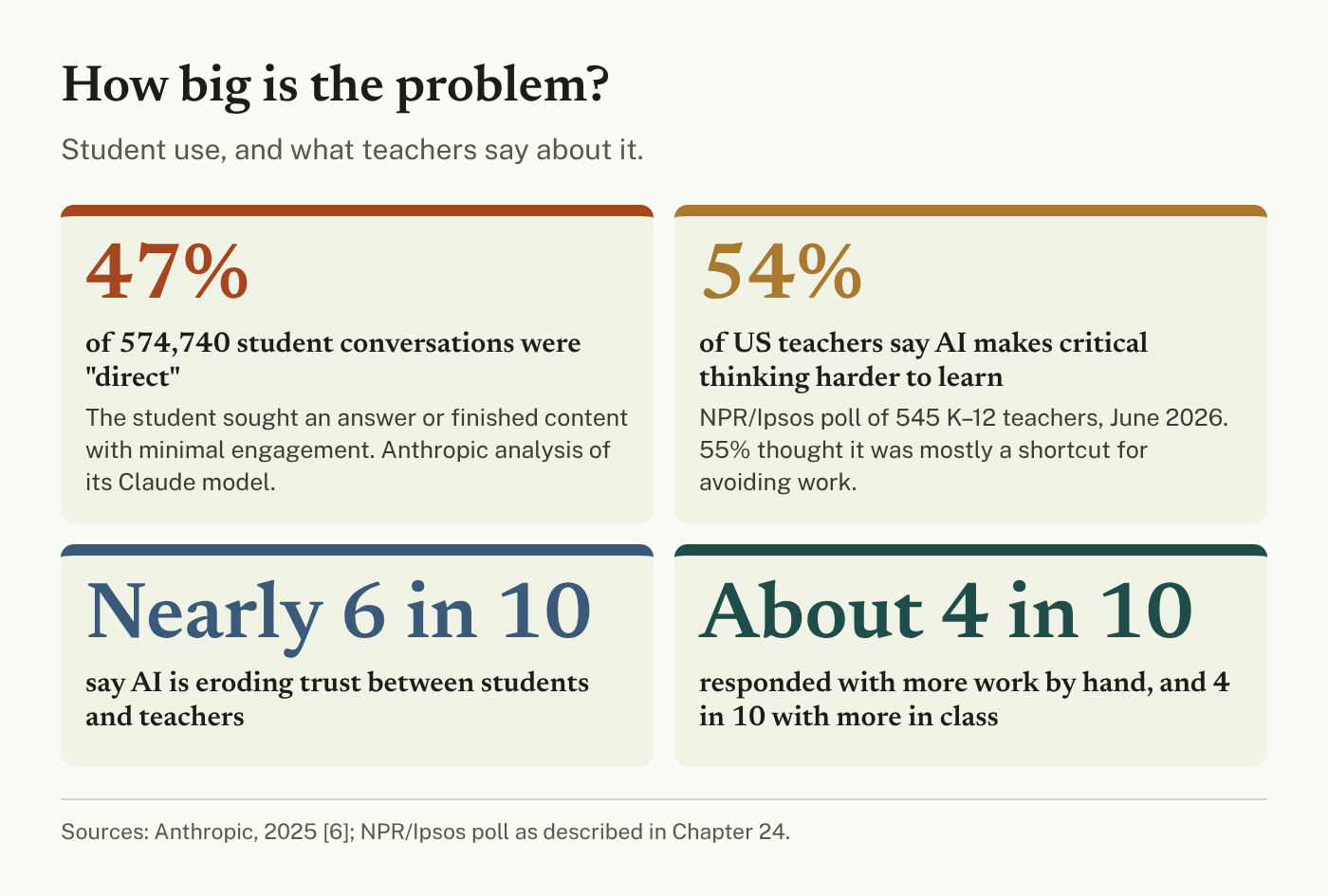
Anthropic analysed 574,740 anonymised student conversations with its Claude model. Nearly half, about 47%, were "direct" conversations, in which the student sought an answer or finished content with minimal engagement. Some students explicitly asked for help avoiding plagiarism detection (Anthropic, 2025) [6]. Not all direct use is dishonest. But the pattern shows how easily assessed work can now be produced without the thinking it is meant to evidence.
How teachers see it
A nationally representative NPR/Ipsos poll of 545 US K–12 teachers, published in June 2026, found that 54% believed AI makes it harder for students to learn critical thinking skills, and 55% thought it was mostly a shortcut for avoiding work. Nearly six in ten said AI was eroding trust between students and teachers. About four in ten had responded by requiring more work to be done by hand, and four in ten by requiring more work to be done in class. Among teachers whose school provided AI software, only 35% said there was a formal policy on teacher use (NPR, 2026) [84]. Teachers are already redesigning assessment, mostly on their own and without guidance.
From shortcuts to automation
In February 2026, a tool called Einstein was released that could log into the Canvas learning platform, watch lectures, write essays and submit coursework from start to finish (Inside Higher Ed, 2026) [56]. Cease-and-desist letters took it offline within weeks, but Canvas's owner then launched its own agentic AI feature, framed as support for teaching (Inside Higher Ed, 2026) [57].
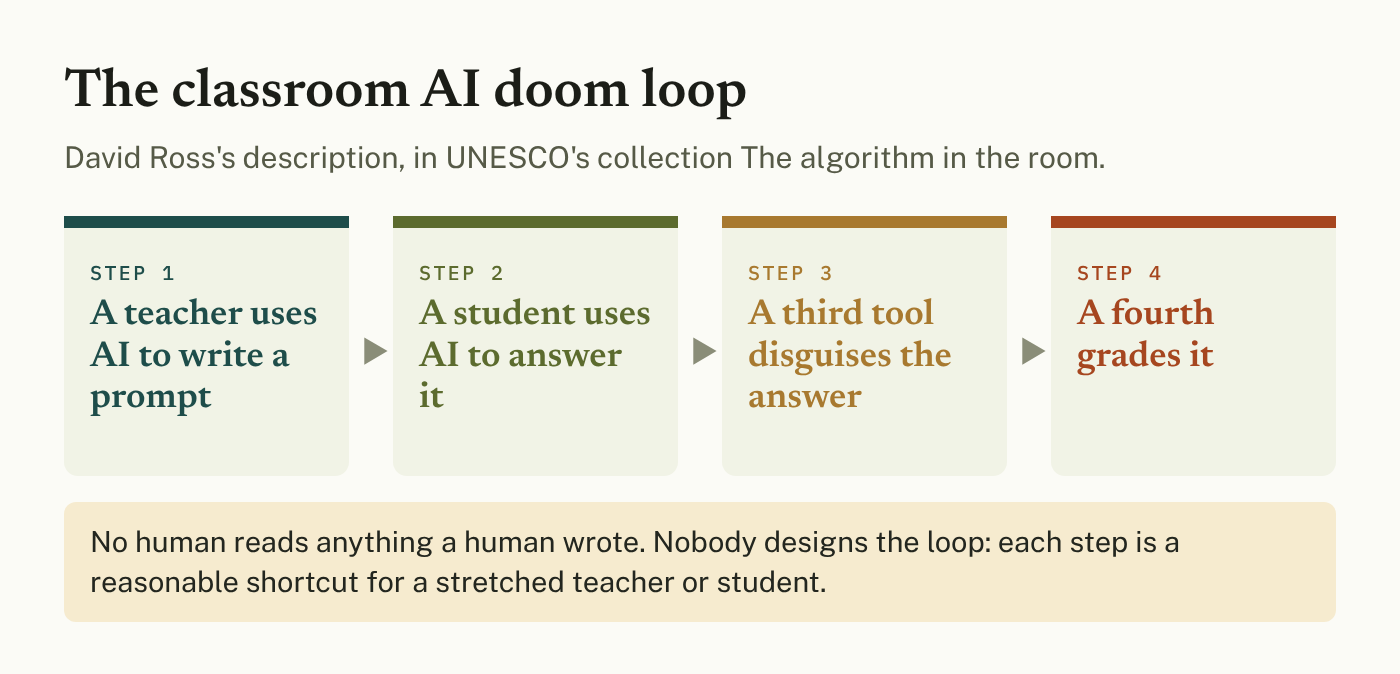
David Ross, writing in UNESCO's collection The algorithm in the room, describes where this leads: the "classroom AI doom loop". A teacher uses AI to write a prompt, a student uses AI to answer it, a third tool disguises the answer, a fourth grades it, and no human reads anything a human wrote (UNESCO, 2026 [189]; Penfold, 2026 [128]). Nobody designs the loop. Each step is a reasonable shortcut for a stretched teacher or student, which is why it's so hard to stop.
Chapter 25 Why detection is the wrong answer
Detectors are unreliable
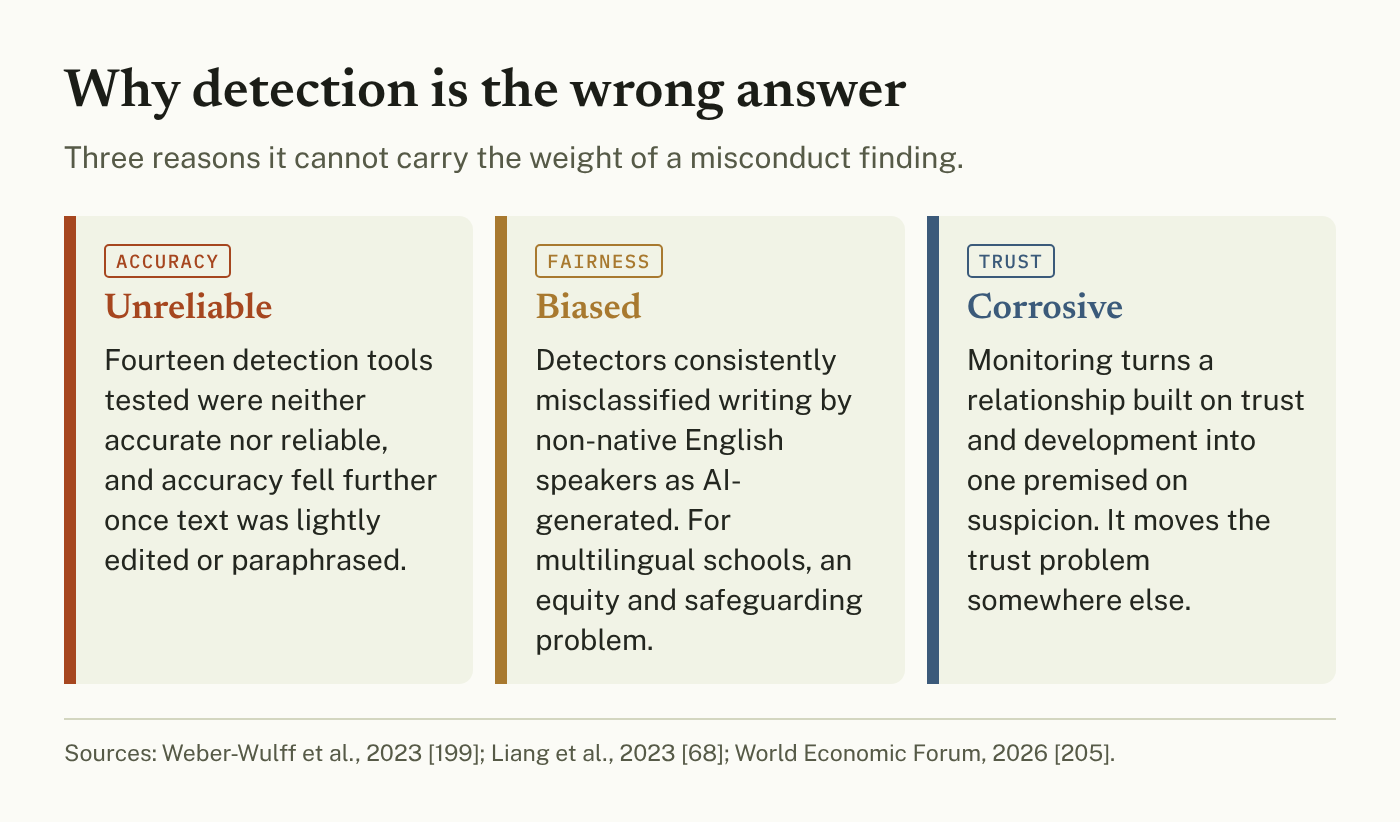
Weber-Wulff and colleagues (2023) [199] tested fourteen AI detection tools, including commercial products, and concluded that they were neither accurate nor reliable. Accuracy fell further when AI-generated text had been lightly edited or paraphrased, which is exactly what a student trying to avoid detection would do. A detector whose result can be changed by a paraphrasing tool can't carry the weight of a misconduct finding.
Detectors are biased
Liang and colleagues (2023) [68] found that GPT detectors consistently misclassified writing by non-native English speakers as AI-generated, while classifying writing by native speakers correctly. The likely reason is that detectors treat simpler, more predictable language as a sign of machine authorship, and second-language writers often write that way. For international and multilingual schools, this turns a technical weakness into an equity and safeguarding problem. An integrity policy that rests on detection will fall hardest on the students with the least power to contest it (Penfold, 2026) [159]. Part Ten comes back to what this means for fairness.
Surveillance damages the relationship it's meant to protect
The World Economic Forum's 2026 report on education readiness for AI warns that monitoring tools risk turning the student–teacher relationship from one built on trust and development into one premised on monitoring and suspicion (World Economic Forum, 2026 [205]; Penfold, 2026 [105]). Answering a trust problem with surveillance moves the trust problem somewhere else. It doesn't solve it.
Chapter 26 From integrity to validity
Grades as a social contract
The same WEF report reframes academic integrity as being clear about what students did themselves, what AI helped with, and whether the assignment still lines up with its intended learning outcome. It describes grades as a kind of social contract: institutions attest that a grade reflects real understanding, and employers, universities and the public act on that attestation. When the contract breaks, the damage spreads beyond the classroom to employer confidence and belief in merit (World Economic Forum, 2026) [205].
A different question
Dawson and colleagues (2024) [31] argue that the focus on cheating has distracted from the more important question of validity: whether assessment supports sound judgements about student capability. A cheating-focused response asks how to catch students. A validity-focused response asks what evidence a task produces and whether that evidence can be trusted.
Australia's higher education regulator took a similar line in guidance commissioned in 2023, arguing that trustworthy judgements about learning in a time of AI need multiple, inclusive and contextualised approaches to assessment rather than a single secure point of measurement (Lodge et al., 2023) [70].
What the learning research adds
The learning research makes the same point from another side. Chapter 10 describes a field experiment with nearly a thousand high school mathematics students, in which those who practised with an unrestricted chatbot performed far better during practice but worse than a no-AI control group on an exam taken without it (Bastani et al., 2025) [11]. Their practice scores were real, but they weren't valid evidence of what the students could do alone. Any assessment that measures performance with AI available, without also checking what the learner can do without it, risks recording the tool's capability as the student's.
The single sitting is fragile too
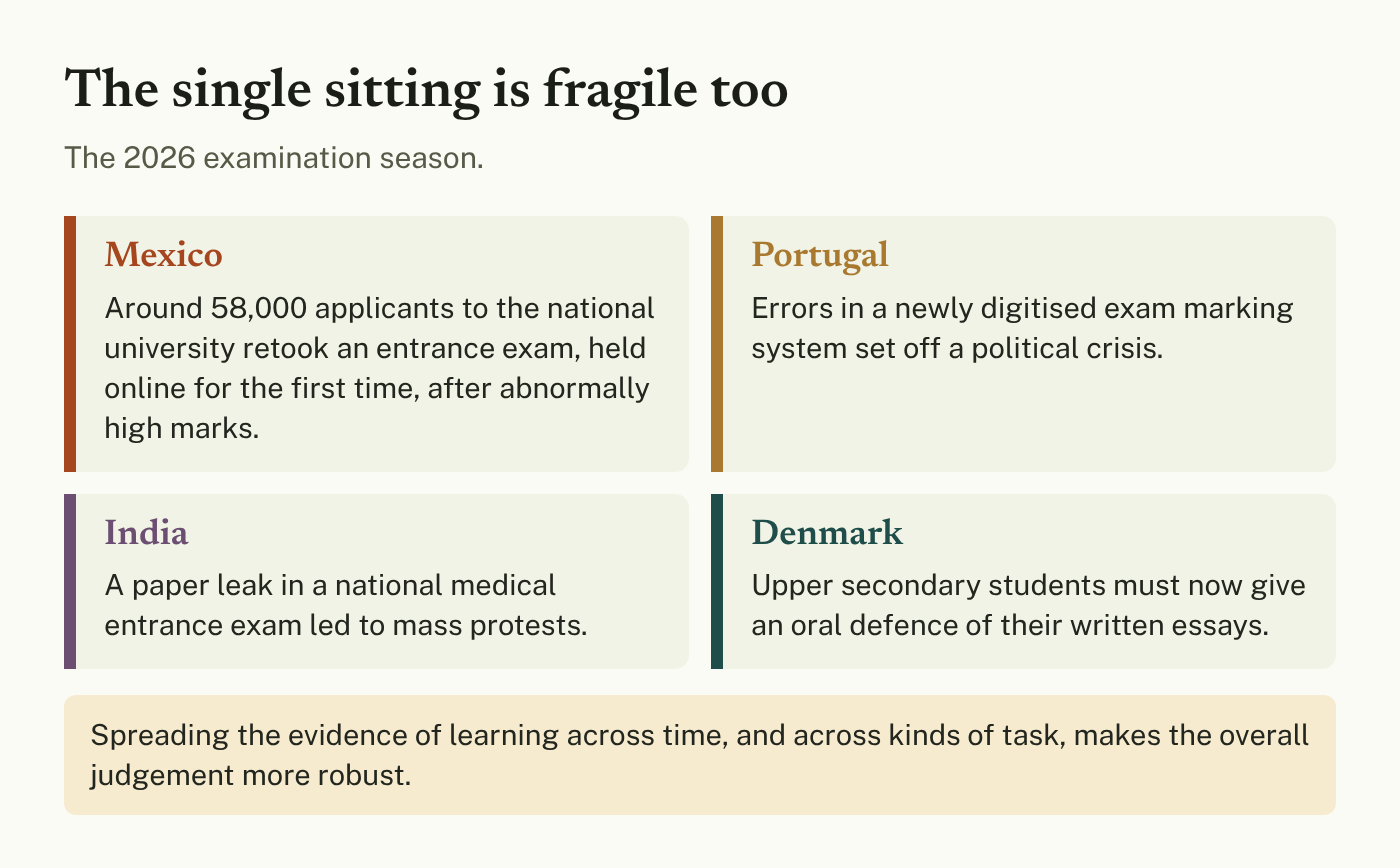
The 2026 examination season showed that the problem isn't only coursework. In Mexico, around 58,000 applicants to the national university had to retake an entrance exam, held online for the first time, after abnormally high marks raised suspicions of widespread cheating (CNN, 2026 [25]; Solomon & Holmes, 2026 [171]). In Portugal, errors in a newly digitised exam marking system set off a political crisis. In India, a paper leak in a national medical entrance examination led to mass protests and the resignation of the education minister. Thomas Lancaster of Imperial College London described how cheating has moved from hidden notes to earpieces, hidden cameras and AI tools that supply answers in real time (Solomon & Holmes, 2026) [171].
Denmark responded by requiring upper secondary students to give an oral defence of their written essays from the new school year. The academic integrity researcher Sarah Eaton argued that, because AI can generate a perfect essay in seconds, the essay is no longer a viable way to demonstrate learning and should be allowed to "die with dignity" (Solomon & Holmes, 2026) [171]. Her wider point is that when one examination decides a young person's future, the pressure on students and the incentive to cheat both become extreme.
The lesson for school systems is that a single sitting at the end of a course is now a weak point in its own right, exposed to leaks, marking errors and real-time AI. Spreading the evidence of learning across time, and across different kinds of task, makes the overall judgement more robust (Penfold, 2026) [96].
Chapter 27 What schools can build, and the risks of building it
Six moves from one school
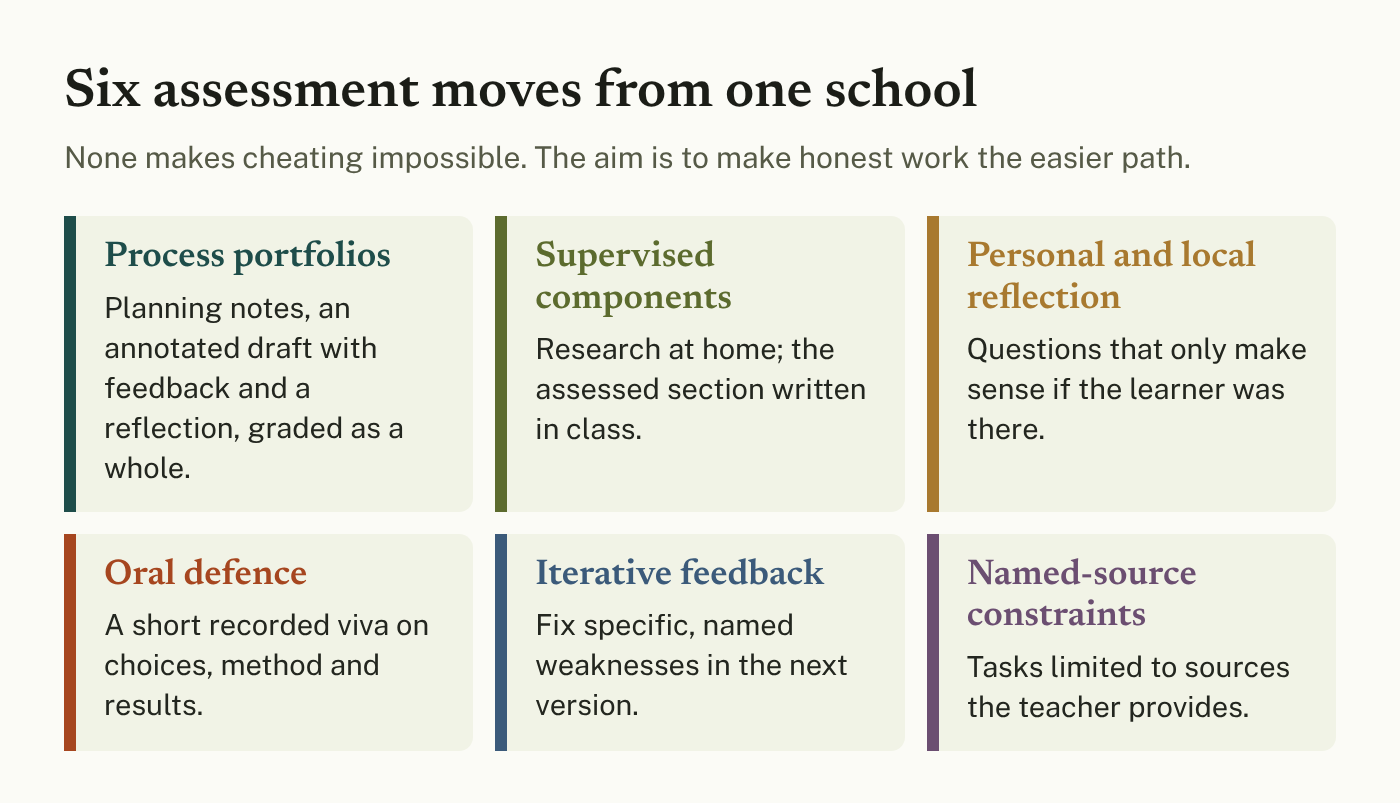
At the international school in Chiang Mai described in my newsletters, secondary teachers adopted six assessment moves across subjects (Penfold, 2026) [113]. None makes cheating impossible. The aim is to make honest work the easier path, and to require anyone faking it to keep up the deception across several kinds of evidence.
- Process portfolios. Learners submit planning notes, an annotated draft with teacher feedback, and a short reflection with the final piece, and the package is graded as a whole. In Year 10 English, the finished essay arrives with a visible history.
- Supervised components. Research happens at home, but the assessed section is written in class where a teacher can see it happen. In Year 9 History, sources were gathered across a week and the analysis written in a protected lesson.
- Personal and local reflection. Questions that only make sense if the learner was there, such as explaining how a soil test the class ran supported or contradicted a hypothesis. No AI attended that lesson.
- Oral defence. A short recorded viva in which learners explain their choices and answer follow-up questions, built into normal assessment so it doesn't feel like an extra hurdle. Year 11 science investigations included a five-minute viva on method and results.
- Iterative feedback. A draft is marked and the learner must fix specific, named weaknesses in the next version.
- Named-source constraints. Tasks are limited to sources the teacher provides, framed in a way a general model hasn't seen: "Using only Sources A, B and C from our lesson pack, evaluate…"
Conversations, not accusations
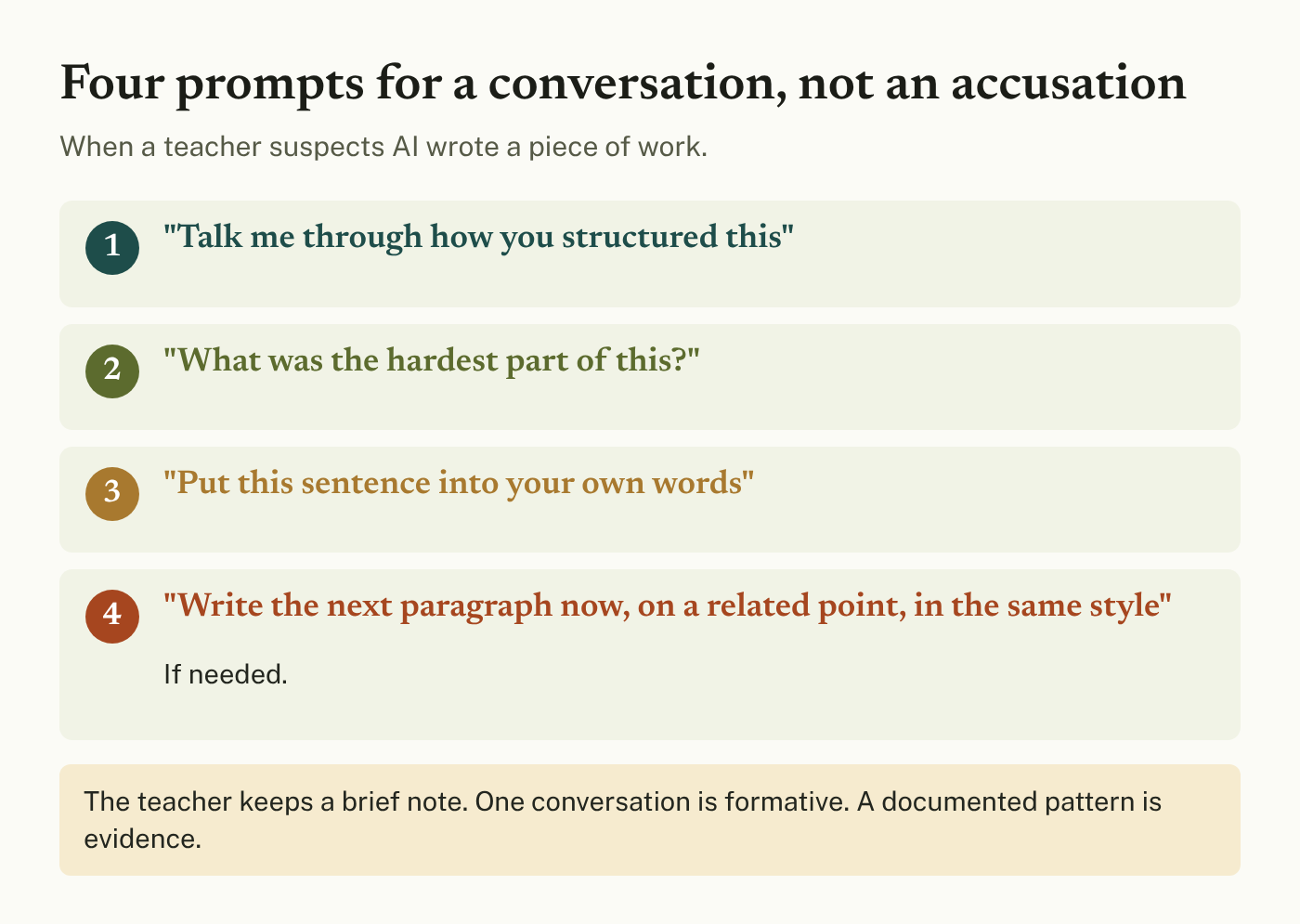
When a teacher suspects that AI wrote a piece of work, the school's approach was a conversation rather than an accusation. The conversation finds out what the learner understands, and is useful as feedback either way (Penfold, 2026) [113]. Four prompts do most of the work: "Talk me through how you structured this"; "What was the hardest part of this?"; "Put this sentence into your own words"; and, if needed, "Write the next paragraph now, on a related point, in the same style." The teacher keeps a brief note. One conversation is formative. A documented pattern is evidence.
Learners as producers
A further approach turns students from consumers of assessment into producers of learning materials. In a Year 10 co-creation model, students wrote concept chapters from the examination specification, built their own banks of exam-style questions and produced podcasts and infographics, all checked by their teacher against the syllabus (Penfold, 2026) [96]. This draws on the protégé effect: learners who prepare to teach material tend to work harder to understand it than learners who prepare only to be tested (Chase et al., 2009) [22]. It also leaves a running record of understanding that is hard to fake.
Old practice, newly relevant
None of this is new. Vocational and professional education has long relied on work-based and practical assessment, in which competence is observed in a real setting rather than inferred from a written product. Early-years traditions such as Reggio Emilia have long treated documentation of a child's thinking as evidence of learning. What AI has changed is that these approaches now matter in every subject, not just those where performance was always the point (Penfold, 2026) [114].
Equity and cultural risks
Moving away from written products isn't risk-free, and schools shouldn't assume the alternatives are fairer by default.
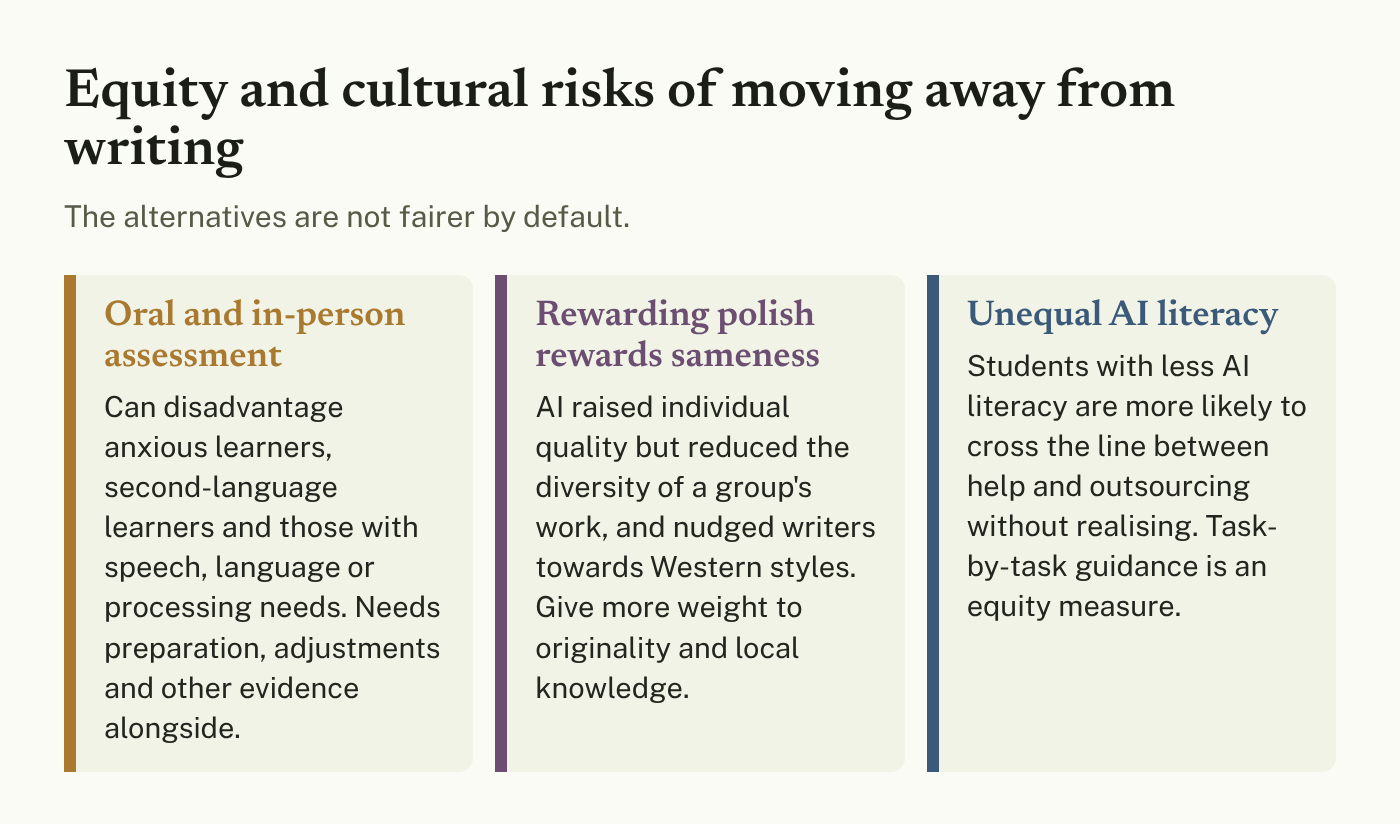
Oral and in-person assessment can disadvantage some learners. Students who are anxious, who are working in a second language, or who have speech, language or processing needs may show less of what they know in a viva than in writing. Oral defence needs preparation time, familiar formats and reasonable adjustments, and should sit alongside other evidence rather than replace it.
Assessment that rewards polish may reward sameness. Doshi and Hauser (2024) [38] found that generative AI raised the quality of individual creative writing while reducing the diversity of what a group produced. Agarwal and colleagues (2025) [3] found that AI writing suggestions nudged writers towards Western styles and reduced cultural nuance. Rubrics that reward fluency and finish may end up rewarding the voice of the model rather than the voice of the learner, so criteria may need to give more weight to originality, local knowledge and the learner's own reasoning (Penfold, 2026) [114]. Chapter 48 returns to this in the context of language and culture.
Unequal AI literacy creates unequal integrity risk. The WEF report notes that AI can give every student the kind of tutoring once available only to wealthier families, but that the line between getting help and outsourcing work is unclear, and students with less AI literacy are more likely to cross it without realising (World Economic Forum, 2026) [205]. Clear, task-by-task guidance on acceptable use is an equity measure as well as an integrity one.
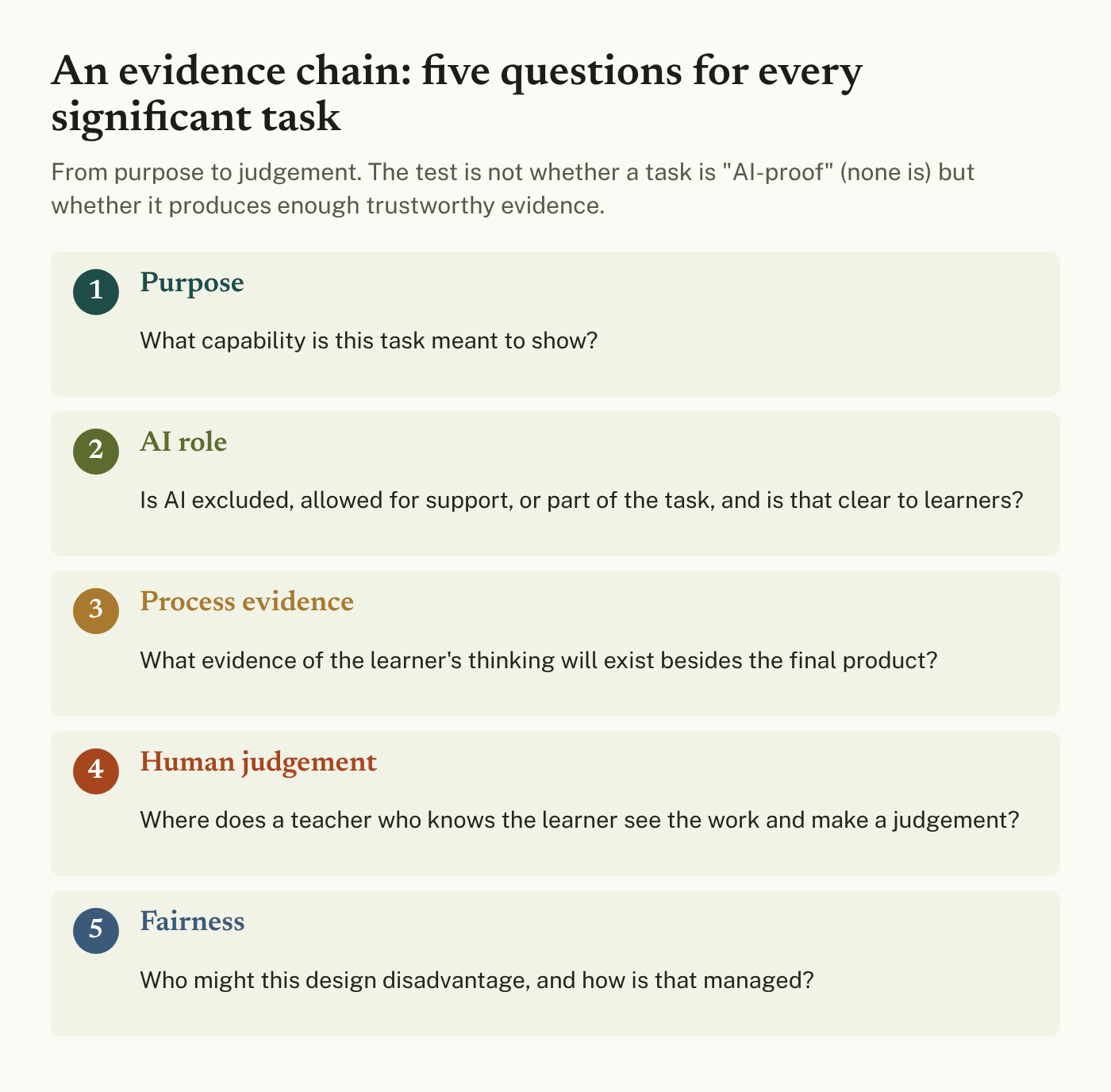
An evidence chain
Drawing these threads together, I propose that every significant assessment task should be able to answer five questions. Together they form an evidence chain from purpose to judgement.
- Purpose. What capability is this task meant to show? (Weighing historical evidence, say, not producing a tidy essay.)
- AI role. Is AI excluded, allowed for support, or part of the task, and is that clear to learners? (AI allowed for feedback on a draft, not for the final analysis.)
- Process evidence. What evidence of the learner's thinking will exist besides the final product? (Planning notes, an annotated draft, a reflection.)
- Human judgement. Where does a teacher who knows the learner see the work and make a judgement? (A short viva or conversation on key choices.)
- Fairness. Who might this design disadvantage, and how is that managed? (Preparation time and adjustments for second-language learners.)
The framework doesn't ask whether a task is "AI-proof". No task is. It asks whether the task produces enough trustworthy evidence, from enough sources, for a teacher to make a sound judgement. It also gives schools a way to trace an assignment from the moment it's set to the moment it's graded, and mark every point where a human looks at the work. That's the most direct test of whether a doom loop is already running (Penfold, 2026) [128].
What to do
For teachers. Decide what each task is for before deciding the AI rule. Sequence work so learners attempt first and bring AI in second. Keep a regular task done without tools, so you can see what learners can do alone. Treat suspected AI use as a conversation about understanding.
For school leaders. Don't build an integrity policy on detection tools, and review any existing use of them for bias against multilingual learners. Map the assessment pipeline and find where human judgement happens. Give teachers time and guidance to redesign tasks, and agree acceptable use with learners and families task by task.
For examination boards and systems. Reduce reliance on a single high-stakes sitting by combining it with evidence gathered over time. Build oral and practical components with adjustments for learners who need them. Invest in moderation of teacher judgement, since that judgement is becoming the main source of trustworthy evidence.
What this part can't tell you
The school practice here comes from my own account and hasn't been independently evaluated, so its effectiveness isn't established. The survey and news sources reflect particular countries and moments. Some figures in the original newsletters were corrected, and readers should rely on the cited primary sources. Research on oral and process-based assessment in the context of AI is still limited, especially in schools rather than universities.
A closing thought
Generative AI hasn't created a new problem for assessment so much as exposed an old one. Much school assessment measured production because production was easy to mark and usually required thinking. That link has gone. Detection tries to restore it by policing the product, and it fails, unfairly. The better path is to ask what each task is meant to show, collect evidence of the thinking as well as the product, and keep a teacher who knows the learner at the point of judgement. The machine writing the essay may be the push schools needed to assess what they always claimed to value.
Coach · Part Five
Think it through
Four short ways to test what this part means for you. There are no right scores. Everything you type stays in this browser and is never sent anywhere.
A situation
A teacher receives an essay that is far better than the student's usual work. A detection tool gives it a high AI score. The deadline for reporting grades is tomorrow. What do you advise?
Pick the response closest to what you would do.
Read: Chapters 25 to 27
A private self-check
Think of one assessment task. Rate it against the five links of the book's evidence chain.
Reflect
Write a line or two for each. Notes save automatically in this browser.
Ask the book
Common questions about this part, answered from its own text.
Do AI detectors work?
The book says no, not reliably. It devotes a chapter to why: they are unreliable, they are biased (particularly against multilingual writers) and surveillance damages the relationship it is meant to protect. It advises not building an integrity policy on detection tools.
What are the six assessment moves?
Process portfolios; supervised components; personal and local reflection; oral defence; iterative feedback; and named-source constraints. They come from secondary teachers at one international school in Chiang Mai and none makes cheating impossible. The aim is to make honest work the easier path.
What does 'from integrity to validity' mean?
Instead of asking whether the student cheated, ask whether the assessment still shows what it claims to show. Production used to be a proxy for thinking because production usually required thinking. That link has gone.
Chapter 26; closing thought
Is a single high-stakes exam the safer alternative?
The book says the single sitting is fragile too. For examination boards it suggests combining it with evidence gathered over time, adding oral and practical components with adjustments, and investing in moderation of teacher judgement.
Chapter 26; 'What to do'
How strong is the evidence for these assessment moves?
Limited. The school practice comes from the author's own account and has not been independently evaluated. Research on oral and process-based assessment in the context of AI is still limited, especially in schools rather than universities.
'What this part can't tell you'