Part Six
The Broken Bottom Rung
Based on the paper "The Broken Bottom Rung: Entry-Level Work, Durable Capability and What Schools Should Prepare Young People For" by Paul Penfold (Proceedings of Future Science Archives, 2026).
Part Five asked how we can trust evidence of learning. This part turns to what young people are learning for. It looks at what AI is doing to the first rung of working life, why that matters to schools, and how education might help rebuild it.
Chapter 28 The place where people learn to work
Most of what we hear about AI and work points one way: fewer jobs, smaller teams, doing more with less. The evidence is more varied than that, and more useful to educators. AI doesn't affect all work equally. Its effects are showing up first in particular tasks, particular occupations and, most importantly for schools, at a particular stage of working life.
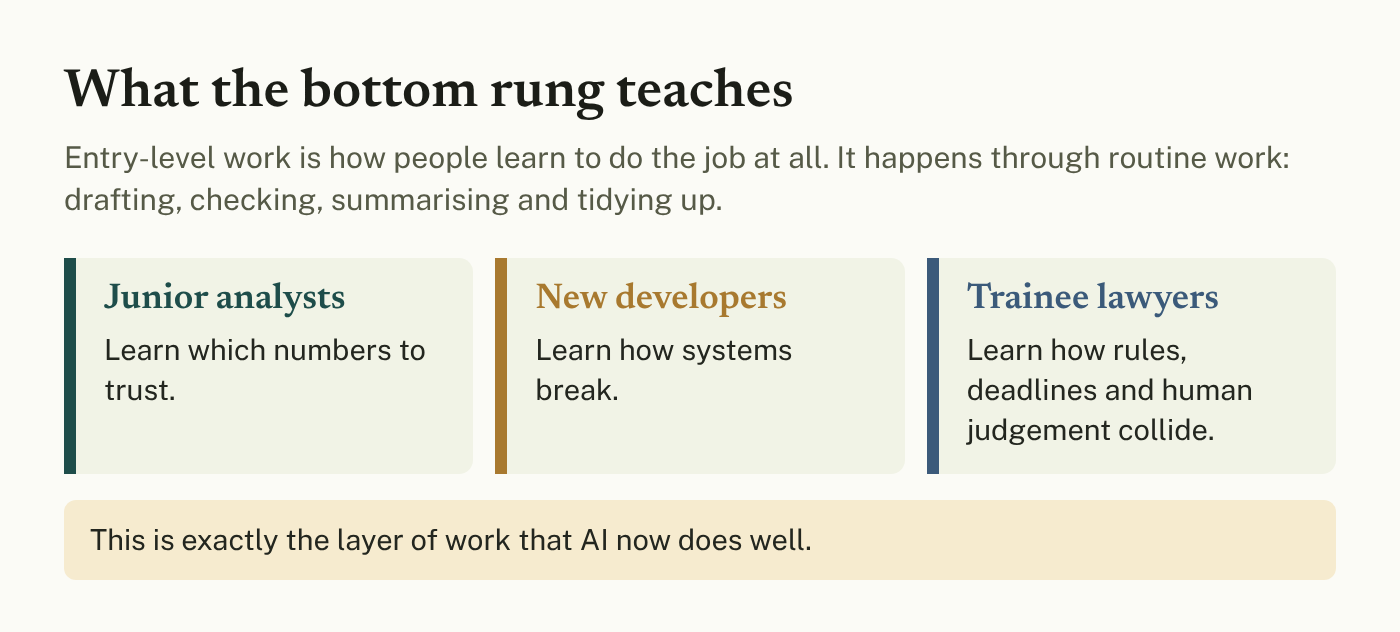
Entry-level work has always been more than a job. It's how people learn to do the job at all. Junior analysts learn which numbers to trust. New developers learn how systems break. Trainee lawyers learn how rules, deadlines and human judgement collide. That learning happens through routine work: drafting, checking, summarising and tidying up. This is exactly the layer of work that AI now does well (Penfold, 2026) [142].
Three questions guide this part:
- What does recent evidence say about how AI is affecting work, especially entry-level work?
- What does that mean for the skills and pathways schools should prioritise?
- How should schools prepare young people for a labour market whose entry points are changing?
Where the material comes from
This part draws on newsletters on skills and the future of work that I wrote for school leaders in 2026 (Penfold, 2026) [142, 125, 144, 99, 154, 132, 108, 143, 149]. They summarised reports from the World Economic Forum, PwC, the International Labour Organization, the Digital Education Council and others. I checked the figures against primary sources and updated them where newer versions of a study had been released. The analysis uses the task-based approach to technological change in labour economics, which treats jobs as bundles of tasks, some of which technology can perform and some of which it complements (Autor et al., 2003) [10].
Chapter 29 What the labour market is signalling
Skills are shifting quickly
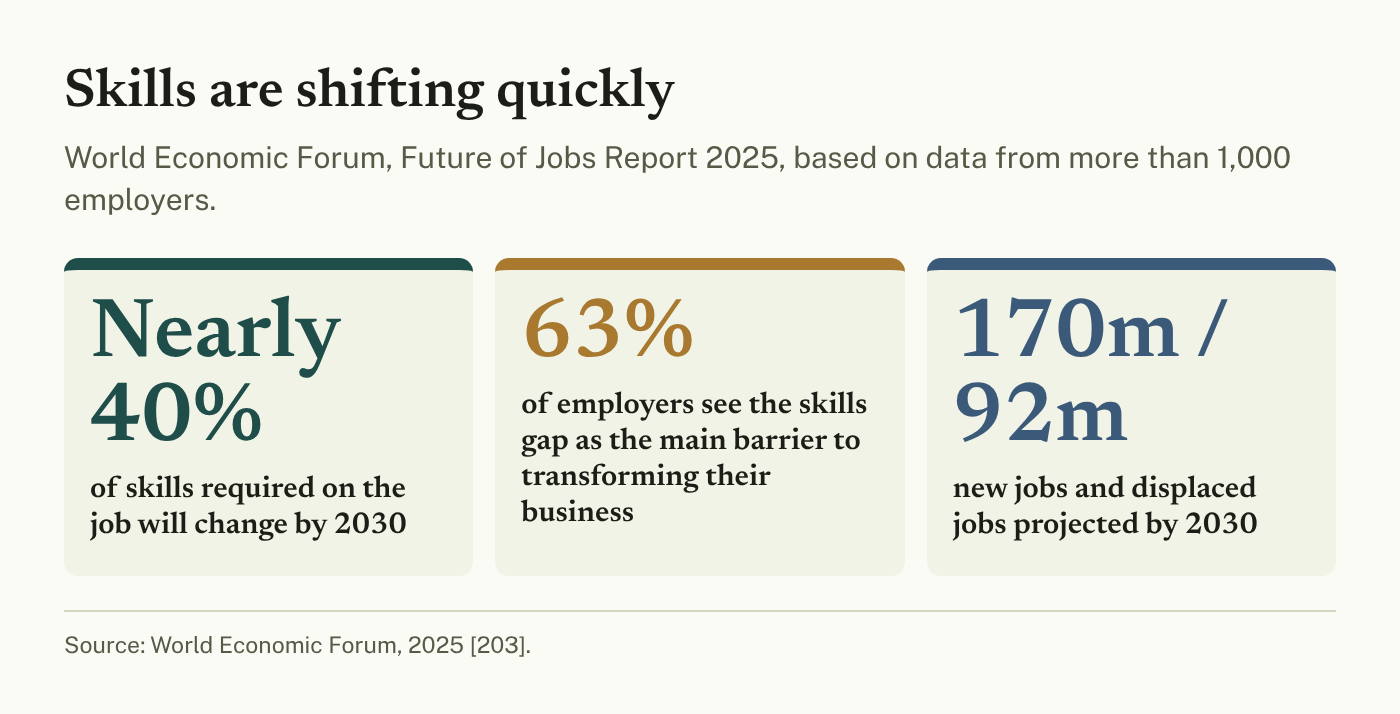
The World Economic Forum's Future of Jobs Report 2025, based on data from more than 1,000 employers, projected that nearly 40% of the skills required on the job will change by 2030, and that 63% of employers already see the skills gap as the main barrier to transforming their businesses (World Economic Forum, 2025) [203]. Technology skills such as AI, big data, and networks and cybersecurity were expected to grow fastest. Human skills such as analytical thinking, creative thinking, resilience, flexibility and leadership stayed critical. The report projected 170 million new jobs and 92 million displaced by 2030, a net gain of 78 million, with significant growth in care and education roles as well as technology (Penfold, 2026 [125], 2026 [144]).
The squeeze is on the young
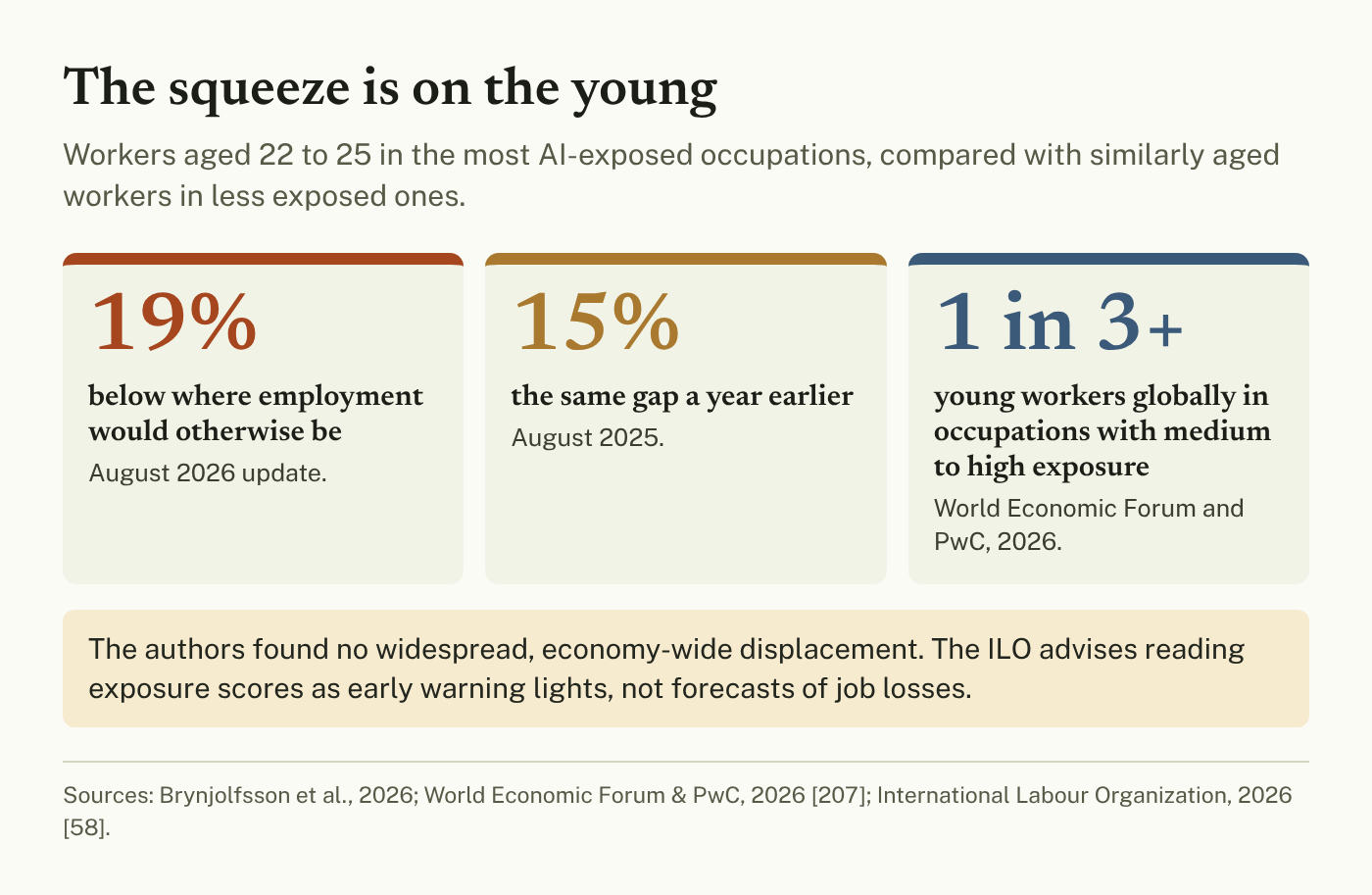
The most striking evidence concerns early-career workers. Using payroll data, Brynjolfsson, Chandar and Chen found that employment for workers aged 22 to 25 in the most AI-exposed occupations fell relative to their peers after generative AI became widespread, while older workers in the same occupations didn't see the same decline. Their August 2026 update found employment for this group about 19% below where it would have been had it kept pace with similarly aged workers in less exposed occupations, up from 15% a year earlier. The authors found no widespread, economy-wide displacement (Brynjolfsson et al., 2026) [19]. Their estimates have changed between versions of the study, so treat the exact percentages with care and check the latest update.
A 2026 report by the World Economic Forum and PwC found that more than one in three young workers globally are in occupations with medium to high exposure to AI-driven change in their tasks (World Economic Forum & PwC, 2026 [207]; Penfold, 2026 [142]). Entry-level workers surveyed by PwC said AI had made them more productive, but many also said they were working longer because of it.
Exposure is not the same as job loss
The International Labour Organization warns against reading AI "exposure" scores as forecasts of job losses. Exposure measures what AI could do to a set of tasks, not whether firms will automate them or how work will be reorganised. The ILO advises treating such measures as early warning lights, to be read alongside real data on hiring, wages and job moves (International Labour Organization, 2026 [58]; Penfold, 2026 [142]). It also notes that newer, AI-specific measures reverse an older assumption: it's now higher-skilled cognitive work, in business, finance, computing and education, that scores as most exposed.
Growth, and a premium for skill
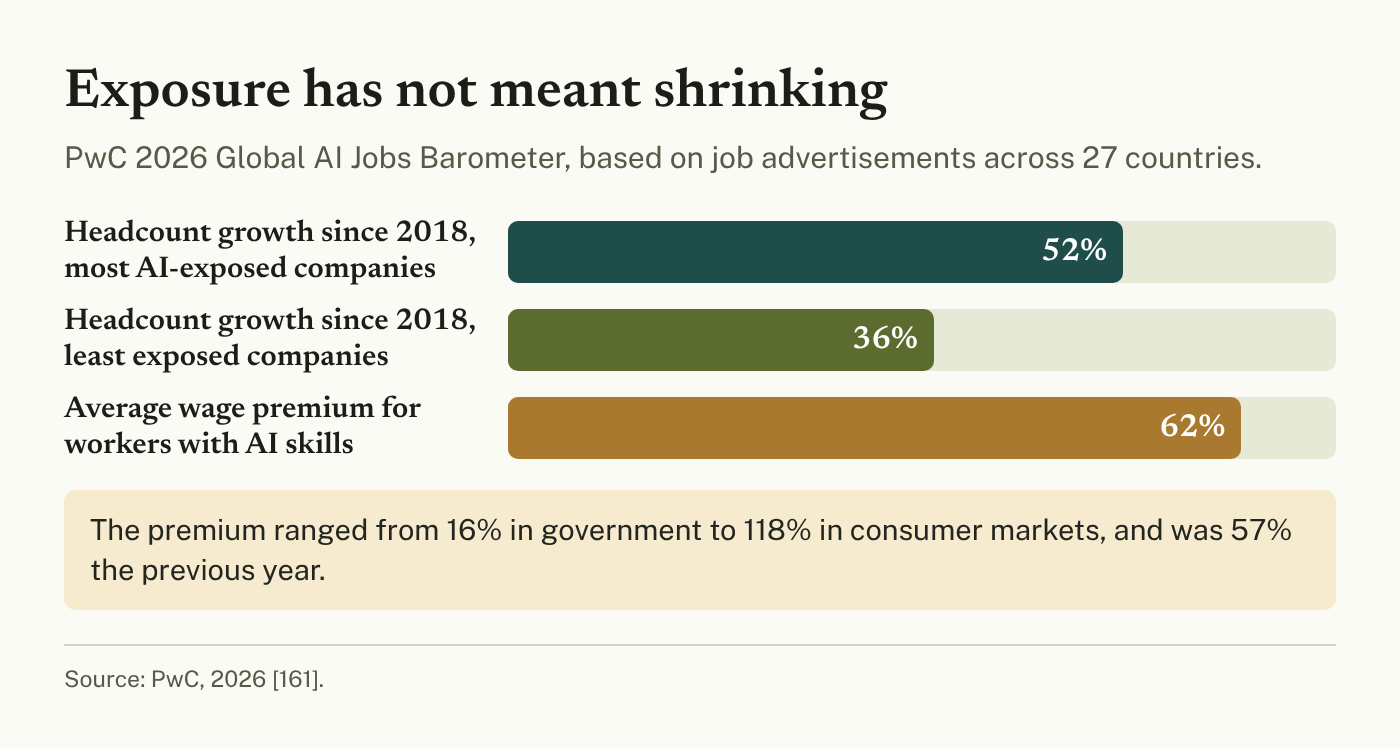
Exposure hasn't meant shrinking. PwC's 2026 Global AI Jobs Barometer, based on job advertisements across 27 countries, found that headcount at the companies most exposed to AI grew by 52% from 2018 levels, compared with 36% at the least exposed (PwC, 2026 [161]; Penfold, 2026 [99]). Workers with AI skills commanded an average wage premium of 62%, up from 57% the previous year, ranging from 16% in government to 118% in consumer markets.
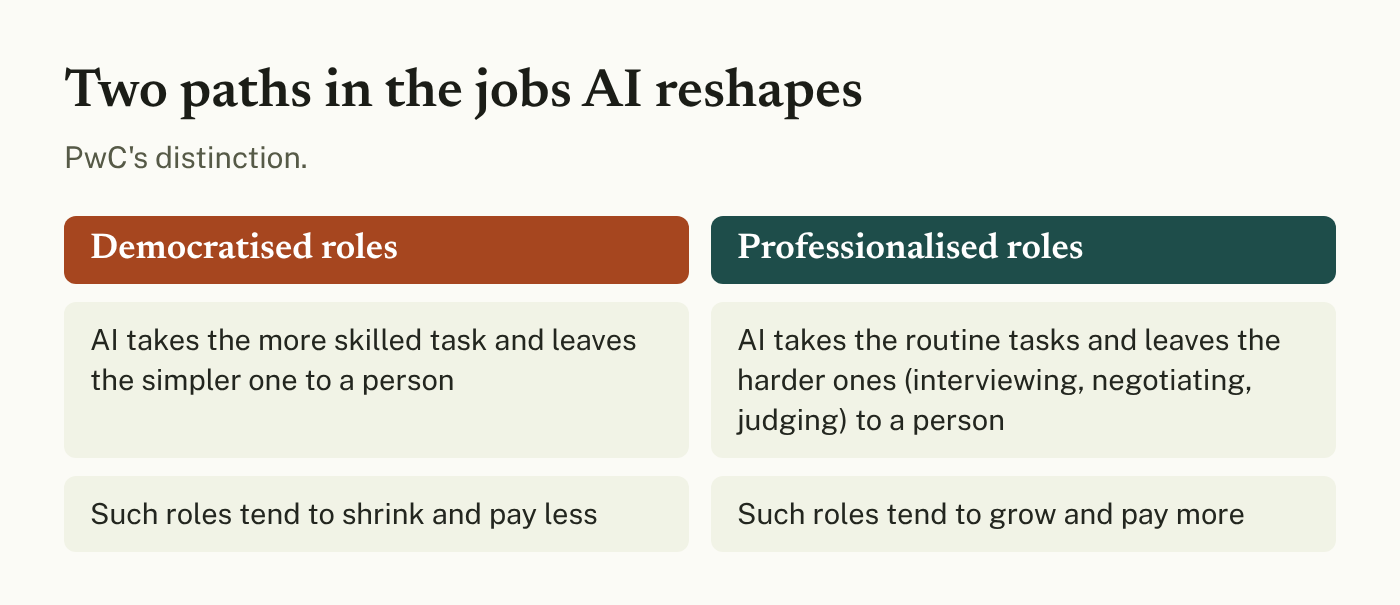
PwC also identified two paths in the jobs AI reshapes. In "democratised" roles, AI takes on the more skilled task and leaves the simpler one to a person, and such roles tend to shrink and pay less. In "professionalised" roles, AI takes the routine tasks and leaves the harder ones, such as interviewing, negotiating and judging, and such roles tend to grow and pay more (PwC, 2026) [161]. The jobs AI had reshaped also placed more weight on distinctly human capabilities such as empathy, judgement and creativity (Penfold, 2026) [99].
Chapter 30 The expertise paradox
The Digital Education Council analysed tasks across eleven job families. It found that automation is densest in structured, rule-based work, while banking and healthcare keep the largest share of human-led tasks because accountability creates a ceiling: when someone must answer for a decision, a person stays in the loop (Digital Education Council, 2026 [37]; Penfold, 2026 [154]).
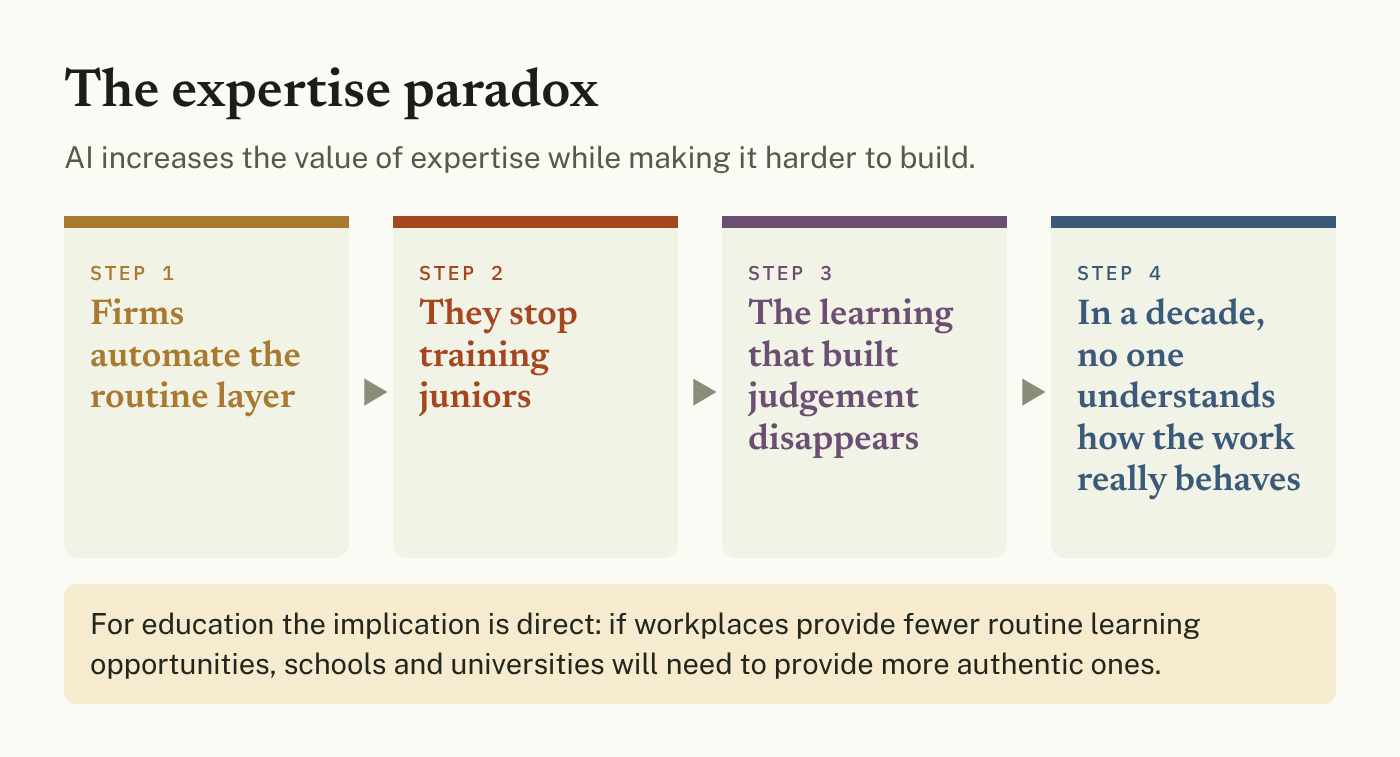
Its most important finding for education is what I call the expertise paradox: AI increases the value of expertise while making it harder to build.
The people best placed to judge where and how AI should be used are those with deep domain knowledge, and that knowledge has traditionally come from doing the entry-level work AI is now absorbing. If firms automate the routine layer and stop training juniors, they may look more efficient this year and find in a decade that no one understands how the work really behaves (Penfold, 2026) [142].
The Council also found that the management skills of coordinating, overseeing and evaluating work, which people used to grow into over years, are becoming early-career skills. A junior employee working alongside AI has to manage its output from the first day (Penfold, 2026) [154].
Some employers are choosing to protect the pipeline. The WEF and PwC framework argues that entry-level hiring should be a deliberate part of workforce planning, not a cost to cut when AI makes it look easy (World Economic Forum & PwC, 2026) [207]. For education, the implication is direct: if workplaces provide fewer routine learning opportunities, schools and universities will need to provide more authentic ones.
Chapter 31 Credentials, caring work and a three-layer model
The weakening signal
Spence's (1973) [173] account of job market signalling explains why credentials carry value: they let employers infer qualities they can't observe directly. That only works while employers and graduates broadly agree on what a credential represents. The WEF's 2026 education readiness report notes growing scepticism that academic credentials lead to economic opportunity, as skills change faster than qualification frameworks can track (World Economic Forum, 2026 [205]; Penfold, 2026 [132]). Goldin and Katz's (2008) [50] history of the "race between education and technology" shows that inequality widens whenever education falls behind technological change.
Rapid restructuring
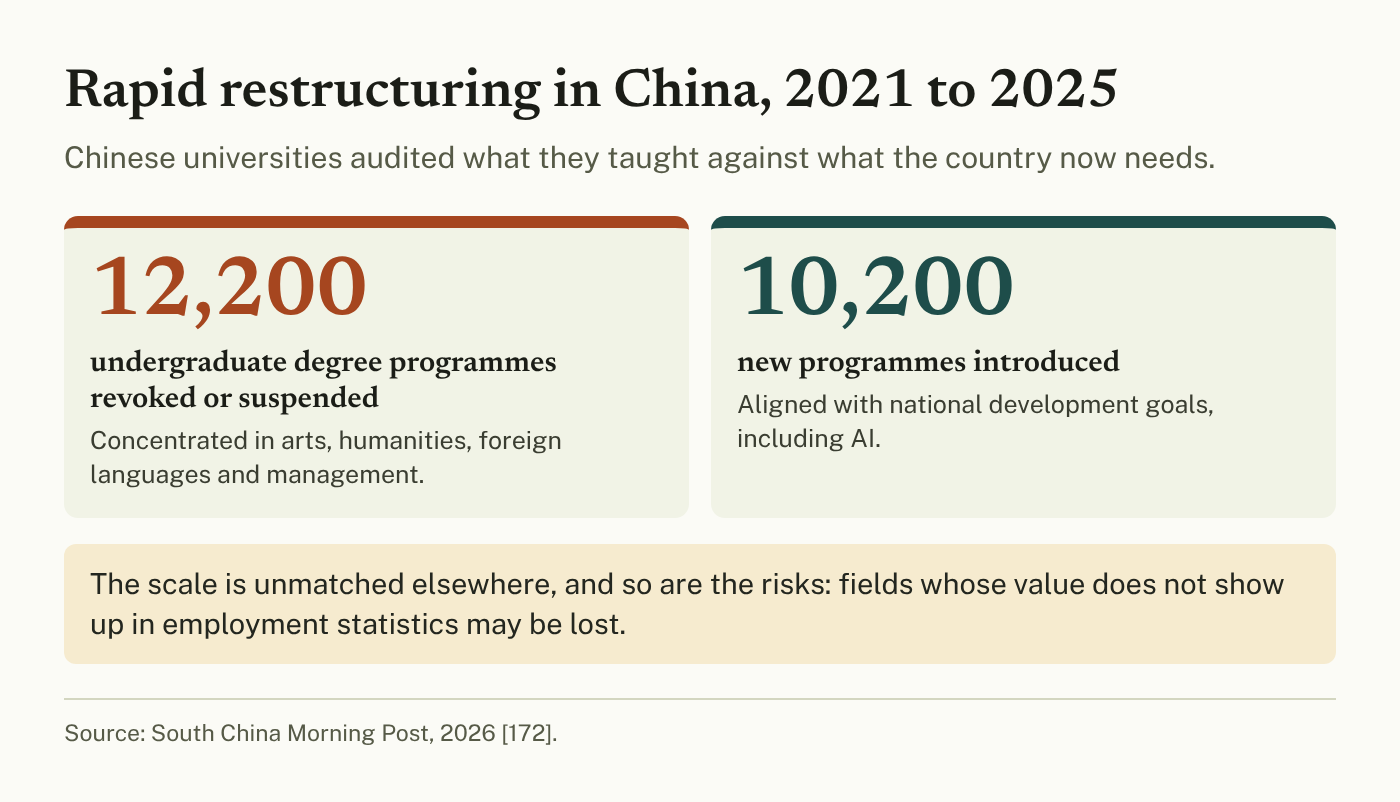
Some systems are responding at scale. Between 2021 and 2025, Chinese universities revoked or suspended 12,200 undergraduate degree programmes and introduced 10,200 new ones. The cuts were concentrated in arts, humanities, foreign languages and management, and the new programmes were aligned with national development goals, including AI (South China Morning Post, 2026 [172]; Penfold, 2026 [108]). The scale is unmatched elsewhere, and so are the risks: fields whose value doesn't show up in employment statistics may be lost. But the underlying discipline of auditing what is taught against what the world now needs is one that other systems could borrow at their own pace.
Caring and vocational work
The WEF projects significant growth in care roles such as nursing, as well as in education roles (World Economic Forum, 2025) [203]. As machines take over routine tasks, the work that remains leans harder on what machines can't do, and caring for another person is near the top of that list. Yet schools often steer their highest-achieving students towards academic routes and treat caring and vocational pathways as a fallback (Penfold, 2026) [143]. That's a moral mistake and, increasingly, an economic one.
Writers in UNESCO's collection make a parallel point about vocational education: craftsmanship rests on judgement developed through the hands over years, which AI can support but not shortcut (Haarsbjerg, 2026 [55]; Penfold, 2026 [149]).
A three-layer model of preparation
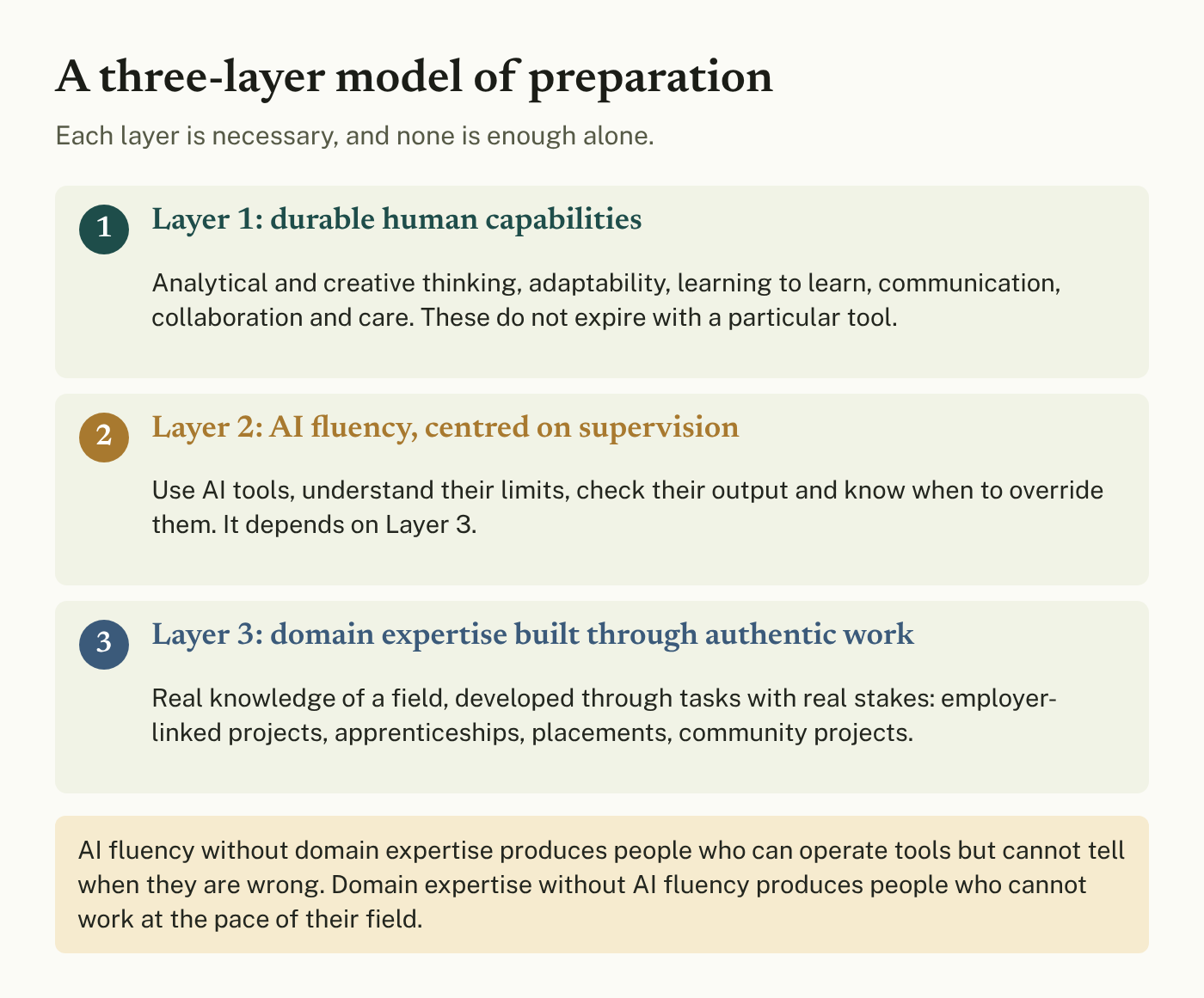
Drawing these strands together, I propose that schools prepare young people in three layers. Each is necessary, and none is enough alone.
- Layer 1: durable human capabilities. Analytical and creative thinking, adaptability, learning to learn, communication, collaboration and care. These don't expire with a particular tool, and employers consistently rank them highly (World Economic Forum, 2025) [203]. Schools often claim to value them while their timetables and assessments still reward content recall (Penfold, 2026) [125].
- Layer 2: AI fluency, centred on supervision. Not "learn to code" or "learn to prompt", both of which date quickly, but the ability to use AI tools, understand their limits, check their output and know when to override them. This is the early-career management skill that the Digital Education Council describes, and it depends on Layer 3 (Penfold, 2026 [142], 2026 [154]).
- Layer 3: domain expertise built through authentic work. Real knowledge of a field, developed through tasks with real stakes: employer-linked projects, apprenticeships, work placements, community projects and co-operative education. If the workplace's bottom rung is weakening, education needs to rebuild some of it, because judgement is built in real settings (Penfold, 2026 [142], 2026 [144]).
The layers depend on each other. AI fluency without domain expertise produces people who can operate tools but can't tell when they're wrong. Domain expertise without AI fluency produces people who can't work at the pace of their field. Both depend on durable capabilities that let a person keep learning as the tools and the market change.
What to do
For school leaders. Audit where the curriculum still rewards recall over reasoning, and give teachers time to teach durable capabilities explicitly. Build live links with employers through projects, mentoring and placements, especially for students without family networks, who depend most on school to build the bridge to work (Penfold, 2026) [144]. Present caring and vocational pathways as ambitious choices, not consolation prizes.
For curriculum designers and universities. Teach AI fluency as supervision and verification within subjects, not as a standalone tool course. Review programmes regularly against what graduates now need, with care not to discard fields whose value isn't captured by employment data.
For employers and policymakers. Treat entry-level hiring and training as an investment in the future workforce, not a cost to automate away. Recognise evidence of capability, such as portfolios and observed work, alongside traditional credentials.
What this part can't tell you
Much of the evidence comes from the United States and from advanced economies. Exposure measures describe potential task change, not outcomes. The strongest evidence on young workers comes from a single, repeatedly updated study using payroll data, and its estimates have changed between versions. Several figures in the original newsletters were updated or omitted where primary sources couldn't confirm them. The three-layer model is a synthesis and hasn't been tested empirically.
A closing thought
AI isn't simply taking jobs. It's changing which tasks people do, and it's doing so first at the point where people have always learned to work. That creates an expertise paradox: deep judgement is worth more than ever, while the routine work that built it is disappearing. Schools can't solve that alone, but they can stop preparing young people to compete with machines at the tasks machines do best. The better preparation is to build durable human capabilities, teach young people to supervise and check AI rather than defer to it, and give them real experience of work in which judgement is formed. That's a different education from one built around content recall, and it's closer to what schools have always said they value.
Coach · Part Six
Think it through
Four short ways to test what this part means for you. There are no right scores. Everything you type stays in this browser and is never sent anywhere.
A situation
A Year 12 student asks whether it is still worth studying a subject whose entry-level jobs seem to be shrinking. How do you answer?
Pick the response closest to what you would do.
Read: Chapters 29 to 31
A private self-check
Rate your school's preparation for work against the book's three layers.
Reflect
Write a line or two for each. Notes save automatically in this browser.
Ask the book
Common questions about this part, answered from its own text.
What is the expertise paradox?
Deep judgement is worth more than ever, while the routine work that used to build it is disappearing. AI is changing which tasks people do, first at the point where people have always learned to work.
Chapter 30; closing thought
What is the three-layer model?
Layer 1: durable human capabilities such as analytical and creative thinking, adaptability, learning to learn, communication, collaboration and care. Layer 2: AI fluency centred on supervision. Layer 3: domain expertise built through authentic work. Each is necessary and none is enough alone.
Is AI taking entry-level jobs?
The part says AI is not simply taking jobs; it is changing which tasks people do. It also says exposure is not the same as job loss. See the chapter for the evidence it uses and the cautions about it.
Chapter 29; closing thought
Why does the part treat caring and vocational work seriously?
It recommends presenting caring and vocational pathways as ambitious choices, not consolation prizes, and warns against discarding fields whose value is not captured by employment data.
Chapter 31; 'What to do'
What should employers and policymakers do?
Treat entry-level hiring and training as an investment in the future workforce, not a cost to automate away, and recognise evidence of capability such as portfolios and observed work alongside traditional credentials.
Chapter 31; 'What to do'