Part Seven
Teachers at the Centre
Based on the paper "Teachers at the Centre: Closing the Teacher AI Gap through Professional Learning, Time and Agency" by Paul Penfold (Proceedings of Future Science Archives, 2026).
Part Six looked at what young people are preparing for. This part looks at the adults who prepare them. It argues that the gap between students' use of AI and teachers' confidence with it is the main bottleneck for everything else schools hope to do.
Chapter 32 A mismatch at the heart of school AI
There's a mismatch in how schools are handling AI. Students use it constantly. Teachers, on average, use it less, feel less confident with it, and have had little support to learn it. Yet teachers are the people schools rely on to help young people use AI well.
That matters because the most important AI skill for students isn't operating the tools, which they already do, but judging what the tools produce. Students are confident users and often poor critics: they trust output they should question and rarely check it. The only people in a position to teach that judgement are the adults in the room, and a teacher can't easily teach students to think critically about a tool they avoid themselves (Penfold, 2026) [158].
This part treats the teacher AI gap as the central constraint on AI in schools. Three questions guide it:
- How large is the gap between students' and teachers' use of and confidence with AI, and what causes it?
- What can AI realistically offer teachers, and what should happen to the time it saves?
- What kind of professional learning, and what conditions of agency, close the gap?
Where the material comes from
This part draws on newsletters on teacher development that I wrote for school leaders in 2026 (Penfold, 2026) [104, 134, 110, 126, 158], including summaries of the World Economic Forum's report on education readiness for AI. I read them alongside international survey data on teachers and AI, trial evidence on teacher workload, and research on effective professional development. I checked the figures from the newsletters against their original sources and corrected them where they differed.
Chapter 33 How big is the gap?
Students are already there
Students' use of AI is near universal in many systems. A 2026 global survey of more than 45,000 students and staff in higher education found that 88% of students used AI, but only 29% believed their instructors were equipped to guide them (Digital Education Council, 2026) [36]. Stanford's 2026 AI Index reported that four in five K–16 students in the United States used generative AI for schoolwork (Stanford HAI, 2026) [175]. Chapter 18 gave these figures in the context of AI literacy.
Teachers are partly there
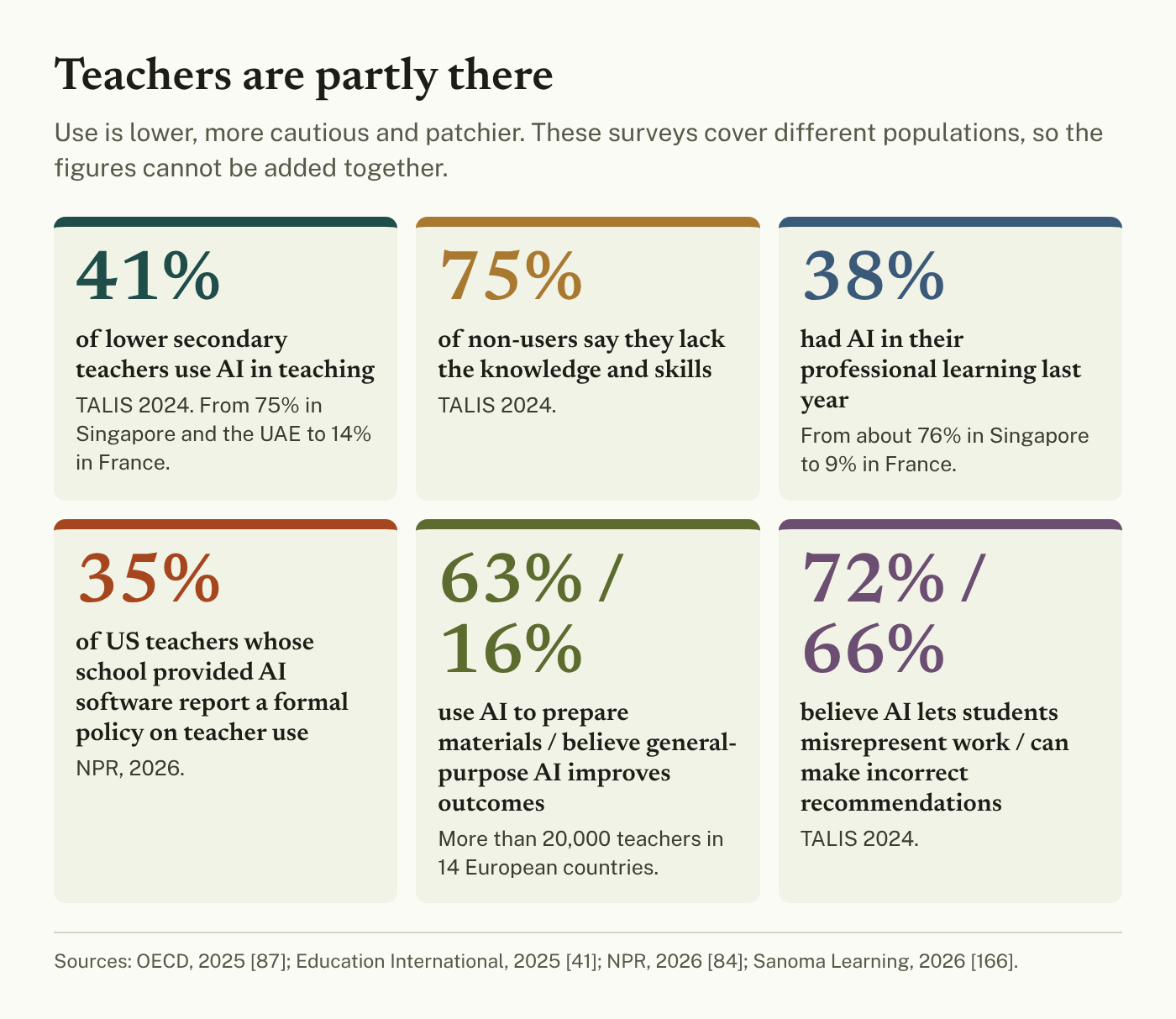
Teachers' use is lower, more cautious and patchier.
- Use. In the OECD's 2024 Teaching and Learning International Survey (TALIS), about 41% of lower secondary teachers across the OECD reported using AI in their teaching, ranging from 75% in Singapore and the United Arab Emirates to 14% in France (OECD, 2025 [87]; Education International, 2025 [41]). Among those who used it, the most common uses were learning about and summarising a topic (68%) and generating lesson plans or activities (64%).
- Barriers. Among non-users, 75% said they lacked the knowledge and skills to use AI (Education International, 2025) [41].
- Preparation. Only about 38% of teachers reported that AI had been part of their professional learning in the previous year, from about 76% in Singapore to 9% in France (Education International, 2025) [41]. In a US poll, only about four in ten teachers said their school offered AI-related training (NPR, 2026) [84].
- Guidance. Among US teachers whose school provided AI software, only 35% reported a formal policy on teacher use (NPR, 2026) [84]. In a 2025 survey of university faculty, 80% reported a lack of clarity about how AI could be applied in teaching at their institution, and only 4% were fully aware of their institution's guidelines and felt they were comprehensive (Digital Education Council, 2025) [35].
- Belief in benefit. A survey of more than 20,000 teachers in 14 European countries found that 63% used AI to prepare learning materials, but only 16% believed general-purpose AI improves learning outcomes. Confidence in using generative AI had risen from 28% to 42% in a year (Sanoma Learning, 2026) [166].
These surveys cover different populations and use different questions, so they can't be added together into a single figure. Together, though, they show a consistent pattern: teachers' use is growing, but it's unevenly supported, often unguided, and accompanied by doubts about whether general-purpose tools help students learn.
Why the gap exists
My newsletters suggest the causes are human more than technical (Penfold, 2026) [158]. Teachers are stretched for time. The tools arrived quickly, with no manual and a great deal of hype. For a year, many were told that AI was mainly a cheating problem to be policed. And there's a less spoken fear of looking less than expert in front of a class that may know the tools better.
Teachers' concerns are also well founded. In TALIS 2024, 72% of teachers believed AI enables students to misrepresent their work, and 66% believed it can make inappropriate or incorrect recommendations (Education International, 2025) [41]. Among university faculty, 83% were concerned about students' ability to critically evaluate AI outputs (Digital Education Council, 2025) [35]. Caution is a reasonable response to a technology that is powerful, unreliable and poorly governed.
Why the gap matters
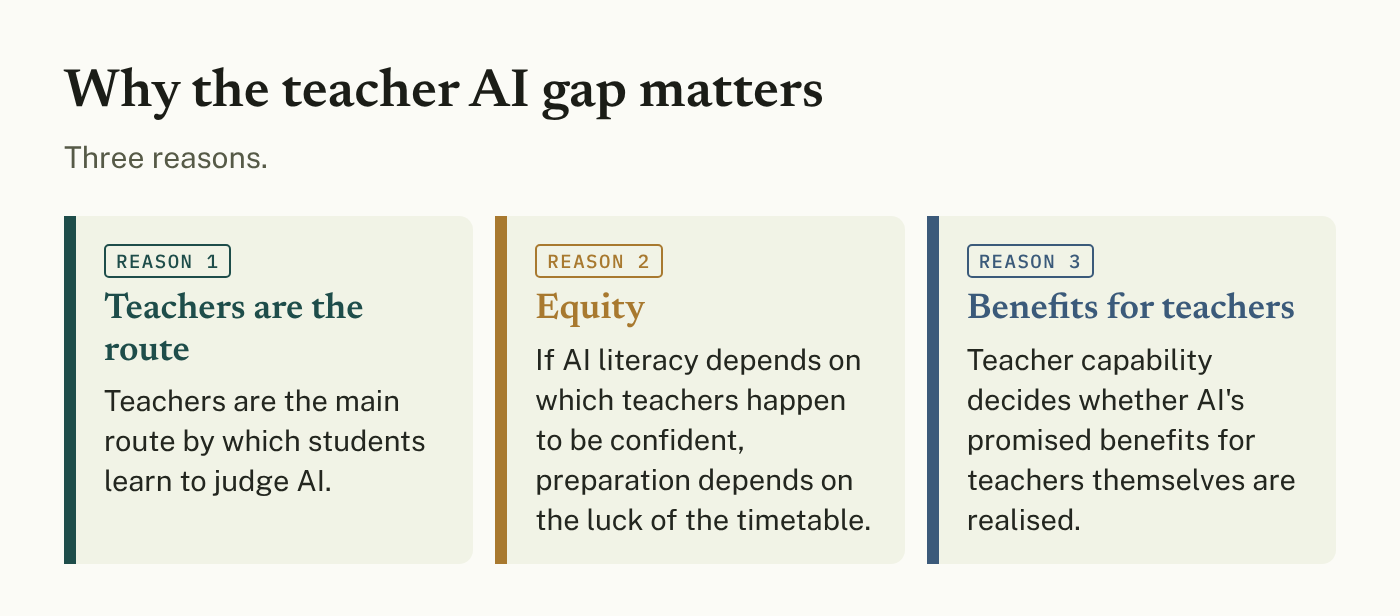
The gap matters for three reasons. First, teachers are the main route by which students learn to judge AI. Second, it affects equity: if AI literacy depends on which teachers happen to be confident, students' preparation will depend on the luck of their timetable (Penfold, 2026) [158]. Third, teacher capability decides whether AI's promised benefits for teachers themselves are realised.
Chapter 34 What AI can offer teachers, and what the time is for
Time
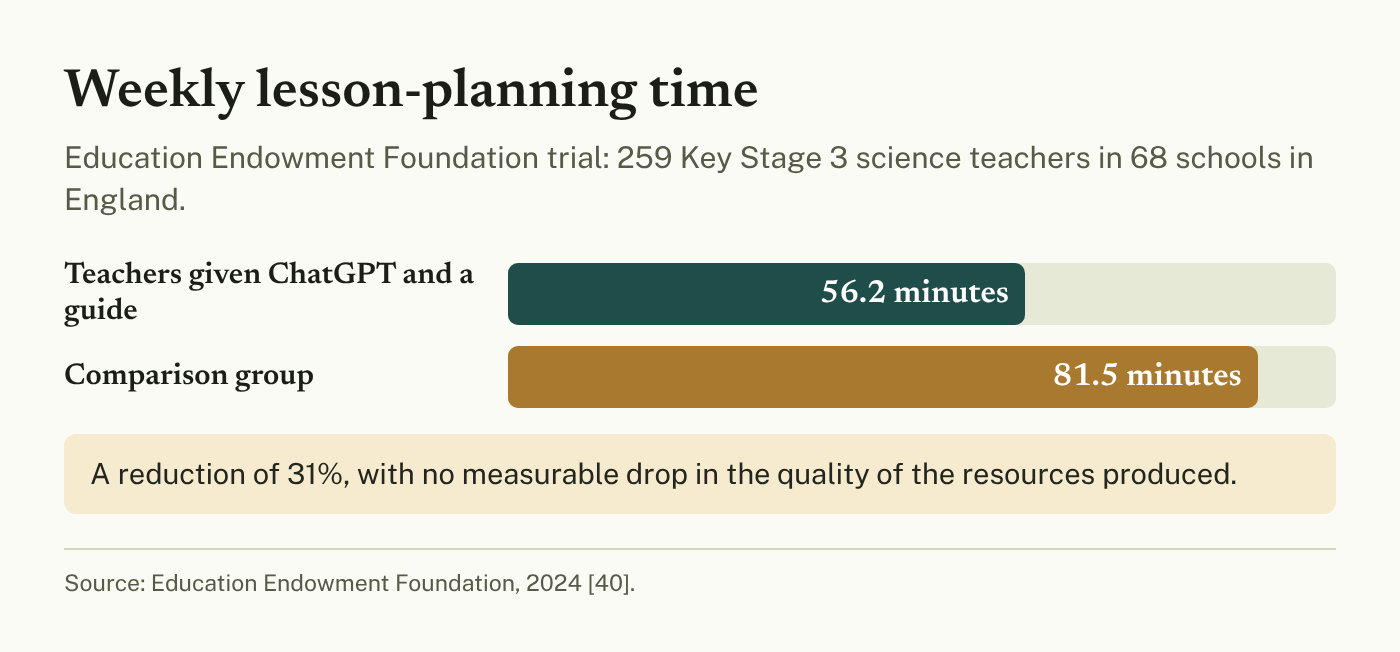
The strongest current evidence for AI in schools concerns teachers' time rather than students' learning. In a trial run by the Education Endowment Foundation in England, 259 Key Stage 3 science teachers in 68 schools were given ChatGPT and a guide to using it. They spent an average of 56.2 minutes a week on lesson planning, compared with 81.5 minutes in a comparison group, a reduction of 31%, with no measurable drop in the quality of the resources produced (Education Endowment Foundation, 2024) [40]. Stanford's AI Hub for Education review similarly found that AI tools can reduce time spent on grading, planning and feedback by as much as 30% without lowering lesson quality (GovTech, 2026) [52]. In the US poll, most teachers who used AI said it saved them time, although 63% said the saving was two hours a week or less (NPR, 2026) [84].
Scale
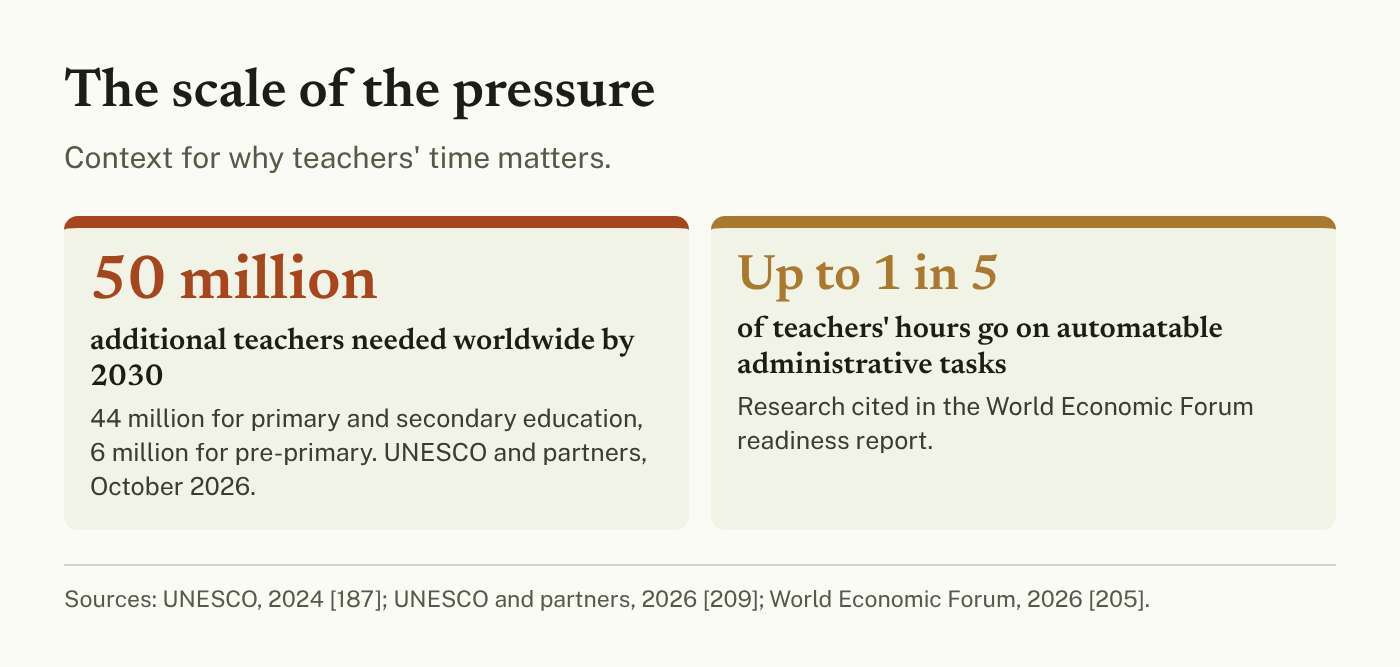
The wider context is a global teacher shortage. UNESCO estimates that the world needs 50 million additional teachers by 2030: 44 million for primary and secondary education (UNESCO, 2024) [187] and a further 6 million for pre-primary education, added in UNESCO's October 2026 update (UNESCO and partners, 2026) [209]. The World Economic Forum's readiness report argues that AI's administrative support could help relieve the pressure, citing research suggesting that up to a fifth of teachers' time goes on automatable administrative tasks (World Economic Forum, 2026 [205]; Penfold, 2026 [104]). It also links personalisation to Bloom's (1984) [15] "two sigma problem": one-to-one tutoring produces much better outcomes than group instruction but has never been affordable at scale.
What the time is for
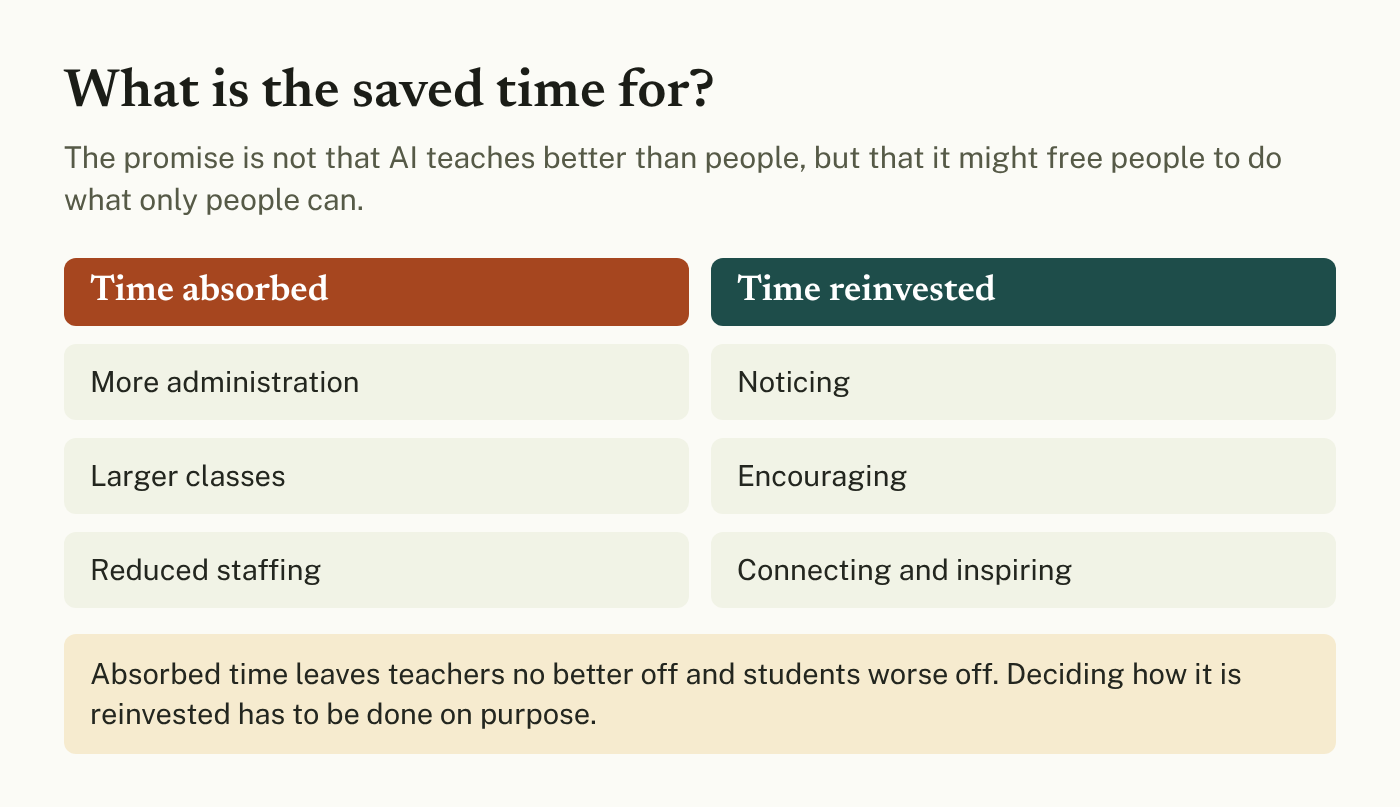
The WEF report is careful to say that none of these opportunities will be realised automatically (World Economic Forum, 2026) [205]. The conclusion I drew in the newsletters is that the promise of AI isn't that it teaches better than people, but that it might free people to do the parts of teaching that only people can do, such as noticing, encouraging, connecting and inspiring (Penfold, 2026) [104]. Time saved that gets absorbed into more administration, larger classes or reduced staffing leaves teachers no better off and students worse off. Deciding deliberately how saved time is reinvested is part of any responsible use of AI by teachers.
Chapter 35 Professional learning that works
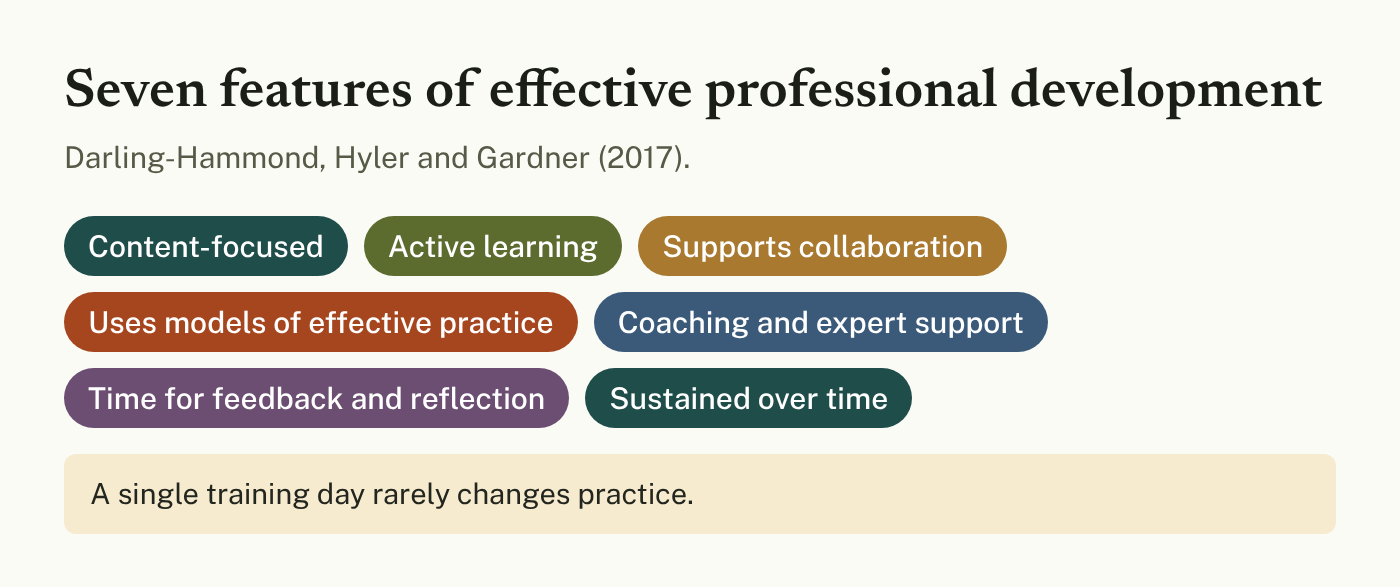
The usual institutional response to the teacher AI gap is a single training day. The research on teacher professional development suggests why that rarely changes practice.
What the research already shows
Kennedy's (2016) [61] review of professional development programmes found that programmes which help teachers understand and adapt ideas to their own context, rather than prescribing procedures, are more likely to improve teaching. Darling-Hammond, Hyler and Gardner (2017) [30] identified seven features of effective professional development: it is content-focused, involves active learning, supports collaboration, uses models of effective practice, provides coaching and expert support, offers time for feedback and reflection, and is sustained over time. Kraft, Blazar and Hogan's (2018) [65] meta-analysis of causal studies found that coaching had substantial positive effects on teachers' instruction and smaller positive effects on student achievement.
What schools that are closing the gap do
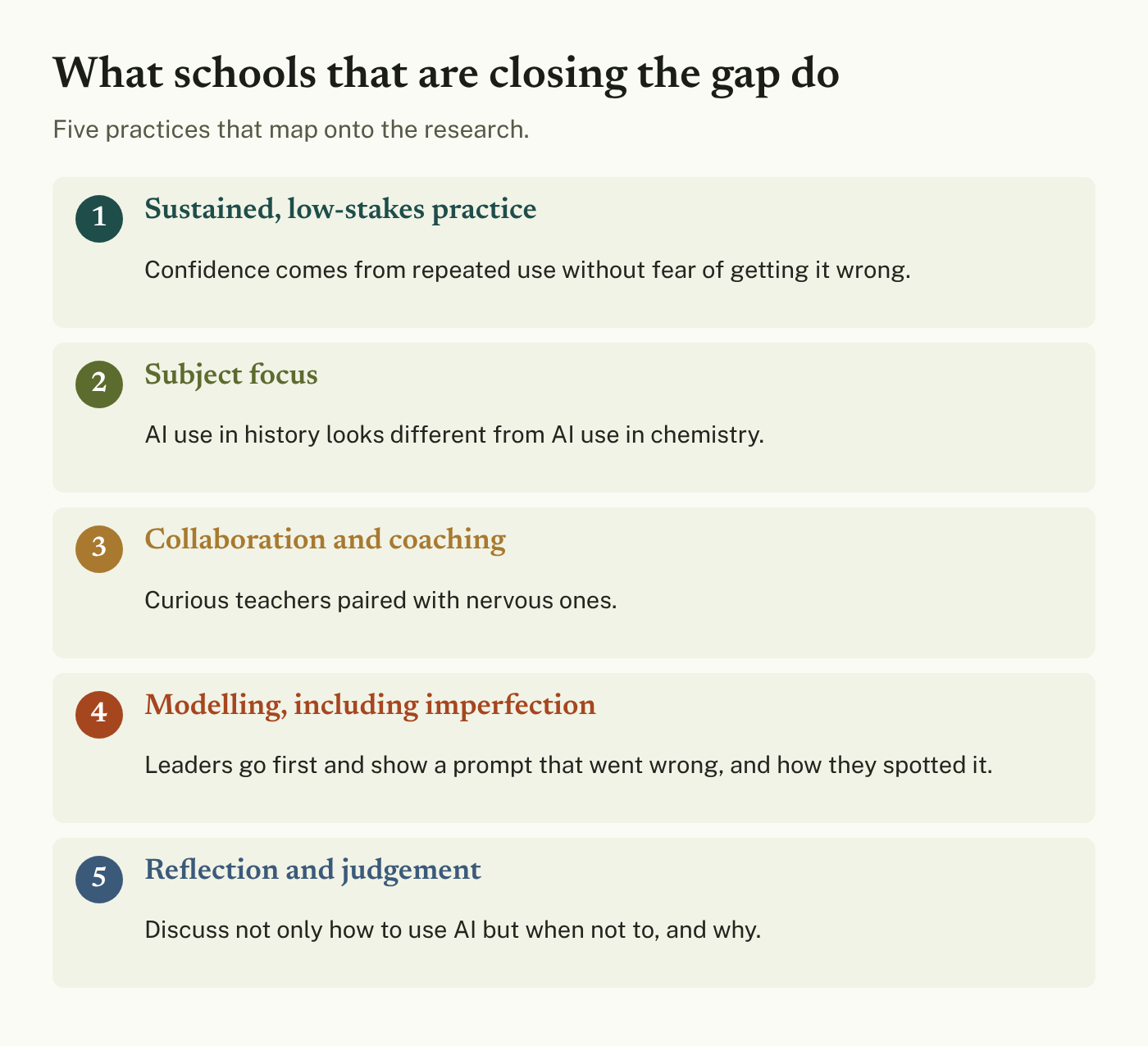
The practices described in my newsletters, in schools that are closing the AI gap, map closely onto these findings (Penfold, 2026) [158].
- Sustained, low-stakes practice. Confidence with a new tool comes from repeated use without fear of getting it wrong, not from one dramatic session.
- Subject focus. Staff share what actually worked in their own subject, because AI use in history looks different from AI use in chemistry.
- Collaboration and coaching. Curious teachers are paired with nervous ones, and peer coaching replaces one-off lectures.
- Modelling, including imperfection. Leaders go first and are visibly imperfect. Showing a prompt that produced a poor answer, and how they spotted it, does more for a culture of critical use than any handbook.
- Reflection and judgement. Teachers discuss not only how to use AI but when not to, and why.
Chapter 36 Agency, the right to say no, and a capability pathway
Teachers in the room
In May 2026, the Council of the European Union adopted conclusions on teachers in the era of AI. They warn against AI that undermines teachers' autonomy and sustainable working conditions, and call for teachers to help design and evaluate the AI tools used in their classrooms (Council of the European Union, 2026 [28]; Penfold, 2026 [134]). The WEF readiness report makes the same argument: AI's value in a classroom depends on the skill and intention of the teacher using it, and top-down rollouts in which tools are chosen centrally are associated with lower trust and lower uptake (World Economic Forum, 2026 [205]; Penfold, 2026 [110]). Research on teacher agency describes it as something teachers achieve in particular conditions, not a fixed personal trait (Priestley et al., 2015) [160]. The practical implication is that schools create or remove the conditions for teacher agency through their decisions about AI. Chapter 43 returns to the Council conclusions.
Informed refusal as a competence
A further step was proposed at a 2026 workshop of teachers and school leaders convened by UNESCO and the European Union: that teachers need the freedom not to use AI, and that this should be named as a competence (Penfold, 2026) [126]. A teacher who decides to keep a chatbot out of a writing unit because it would undermine the thinking she's trying to build is showing exactly the judgement AI literacy is meant to produce. Most systems measure success by adoption and can't tell her apart from a teacher who has simply been left behind. Professional learning that only ever teaches how to use AI builds a one-way ratchet, in which teachers can move towards more use but can't credibly choose less.
A three-stage pathway
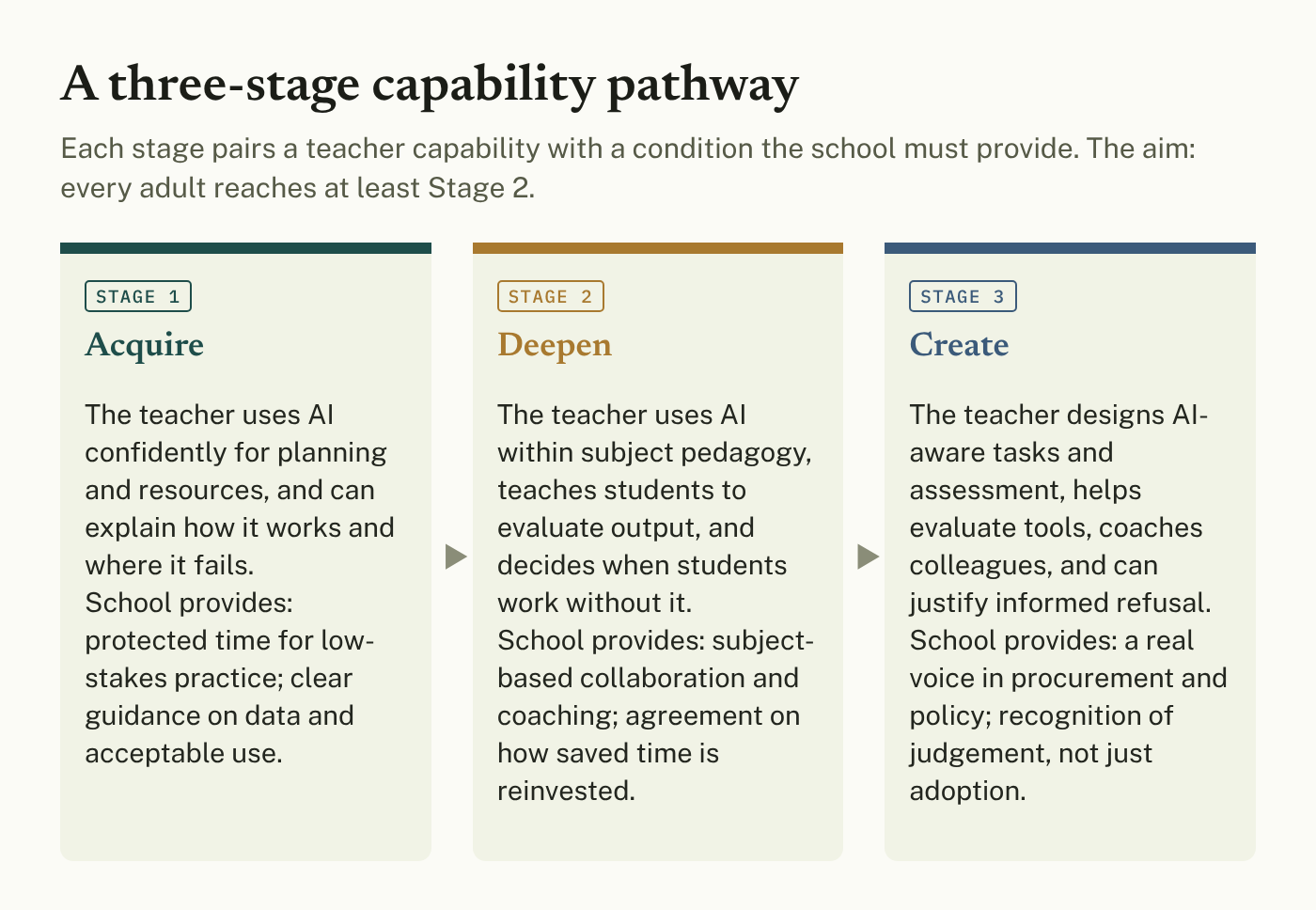
UNESCO's AI competency framework for teachers sets out five dimensions (a human-centred mindset, the ethics of AI, AI foundations and applications, AI pedagogy, and AI for professional development) across three progression levels: acquire, deepen and create (UNESCO, 2024) [186]. Drawing on that framework and on the evidence above, I propose a three-stage pathway for schools. Each stage pairs a capability with a condition the school must provide.
- Stage 1, acquire. The teacher uses AI confidently for personal productivity, such as planning and resource creation, and can explain how it works and where it fails. The school provides protected time for low-stakes practice, and clear guidance on data and acceptable use.
- Stage 2, deepen. The teacher uses AI within subject pedagogy, teaches students to evaluate AI output, and decides when students should work without it. The school provides subject-based collaboration and coaching, and agreement on how saved time is reinvested.
- Stage 3, create. The teacher designs AI-aware tasks and assessment, helps evaluate tools before adoption, coaches colleagues, and can justify informed refusal. The school provides a real voice in procurement and policy, and recognition of judgement, not just adoption.
The aim is that every adult in a school reaches at least Stage 2: able to use AI competently in their own subject, see where it falls short, and help students do the same (Penfold, 2026) [158]. That's a reachable bar. It doesn't require teachers to become computer scientists.
What to do
For school leaders. Treat teacher AI capability as the first stage of any AI strategy, not a parallel workstream. Replace the single training day with sustained, subject-based professional learning that includes coaching. Go first and be visibly imperfect. Decide explicitly how time saved by AI will be reinvested, and protect it from being absorbed by other demands. Map staff confidence so that students' preparation doesn't depend on the luck of their timetable.
For systems and ministries. Fund AI professional learning on the scale of the gap revealed by TALIS, where most non-users cite lack of skills and fewer than four in ten teachers had relevant training. Embed AI in initial teacher education and induction, as the EU Council conclusions recommend. Involve teachers in the evaluation and procurement of AI tools.
For teacher educators and researchers. Evaluate AI professional learning against changes in teachers' practice and students' learning, not just teacher satisfaction or tool adoption. Develop ways of recognising informed refusal as professional judgement.
What this part can't tell you
The survey data come from different populations, years and question wordings and can't be combined. The TALIS figures refer to lower secondary teachers, the Digital Education Council faculty figures to higher education, and the NPR figures to US K–12 teachers. The strongest trial evidence on teacher workload comes from one subject in one country. The links drawn between general research on professional development and professional learning for AI are reasoned rather than tested, and the capability pathway hasn't been evaluated.
A closing thought
Students have already decided that AI is part of their lives. Whether their use becomes wise or lazy, honest or hidden, critical or credulous depends largely on the adults around them, and many of those adults have been given neither the time, the training nor the authority to lead. Closing the teacher AI gap isn't mainly a matter of better tools. It's a matter of sustained professional learning, time that's protected and reinvested in human work, and the agency to decide, including the agency to say no. There's no route to AI-ready students that skips the teachers.
Coach · Part Seven
Think it through
Four short ways to test what this part means for you. There are no right scores. Everything you type stays in this browser and is never sent anywhere.
A situation
A school leader has budget for one thing this year: either a licence for an AI planning tool for every teacher, or sustained subject-based professional learning with coaching. Which do you back?
Pick the response closest to what you would do.
Read: Chapters 35 and 36
A private self-check
Rate your school against the book's three-stage teacher pathway.
Reflect
Write a line or two for each. Notes save automatically in this browser.
Ask the book
Common questions about this part, answered from its own text.
What is the teacher AI gap?
A mismatch at the heart of school AI: students are already using it, teachers are only partly there, and many adults have been given neither the time, the training nor the authority to lead.
What is the three-stage pathway?
Acquire, deepen and create. Each pairs a teacher capability with a condition the school provides: protected time and clear guidance; subject-based collaboration and coaching with agreement on reinvesting saved time; and a real voice in procurement and policy with recognition of judgement. The aim is that everyone reaches at least Stage 2.
What is informed refusal?
The idea, proposed at a 2026 workshop of teachers and school leaders convened by UNESCO and the European Union, that teachers need the freedom not to use AI and that this should be named as a competence. Choosing to keep a chatbot out of a unit because it would undermine the thinking being built is the judgement AI literacy is meant to produce.
What should leaders do about time saved by AI?
Decide explicitly how it will be reinvested and protect it from being absorbed by other demands. The book says the time is for human work.
What works in professional learning?
Sustained, subject-based learning that includes coaching, with leaders who go first and are visibly imperfect, in place of a single training day. The book also recommends evaluating it against changes in practice and student learning, not teacher satisfaction or tool adoption.