Part Eight
Leading the Redesign
Based on the paper "Leading the Redesign: Purpose, Ecosystems and Sequencing in School Leadership for AI" by Paul Penfold (Proceedings of Future Science Archives, 2026).
Part Seven put teachers at the centre. This part looks at the people who set the conditions teachers work in. It treats AI in schools as a leadership problem rather than a purchasing one, and sets out an order in which leaders might act.
Chapter 37 Buying the tool is the easy part
Buying an AI tool is easy. Building an institution that uses it well is hard, and schools keep skipping straight to the easy part (Penfold, 2026) [124].
The pattern is familiar to anyone who has led change in schools. A framework arrives, well argued and full of good intentions, and then sits unread while timetables, behaviour and budgets carry on as before. Frameworks rarely fail because they're badly designed. They fail because nobody works out how to use them on a Tuesday morning (Penfold, 2026) [112].
This part asks three questions:
- What pressures does AI place on school leadership?
- Why do well-designed changes so often fail to reach classrooms?
- In what order should leaders act?
Where the material comes from, and a declaration
The part draws on newsletters on educational leadership that I wrote for school leaders in 2026 (Penfold, 2026) [124, 112, 145, 152, 141, 95, 131, 140, 148], including summaries of reports from the World Economic Forum, the OECD and UNESCO. I checked figures against primary or authoritative secondary sources, and several were corrected or omitted. I've led international schools, and I'm connected to Brave Generation Academy, an organisation discussed in Chapter 41. Both shape the questions I ask. The Brave Generation Academy connection is a possible conflict of interest in that chapter, and I flag it there.
Chapter 38 The speed gap
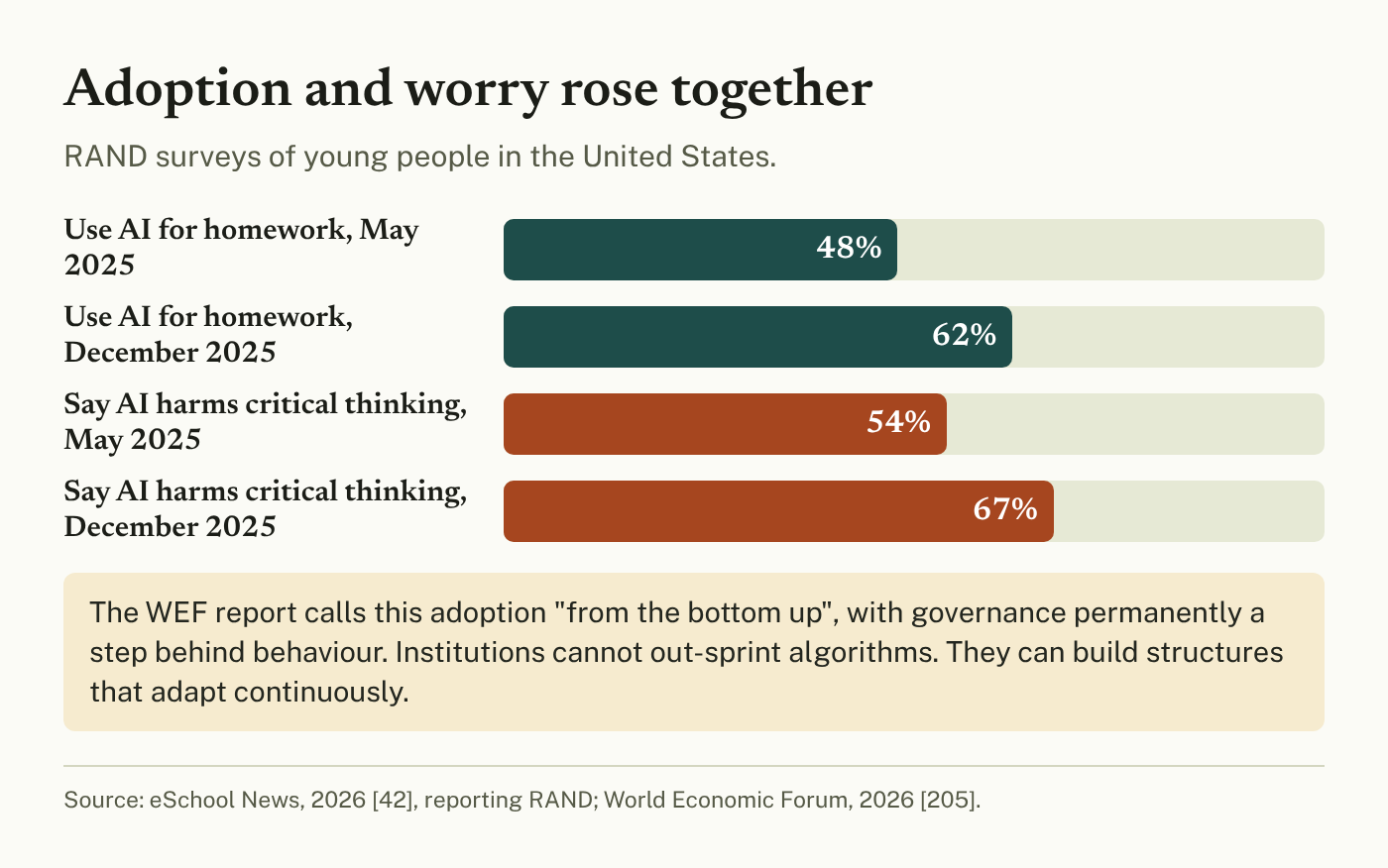
The World Economic Forum's 2026 education readiness report describes AI as no longer an emerging trend in education but a routine part of how millions of learners find information, complete academic tasks and make sense of the world (World Economic Forum, 2026 [205]; Penfold, 2026 [145]). Adoption has been fast. In RAND's surveys of young people in the United States, the share using AI for homework rose from 48% in May 2025 to 62% in December 2025, while the share who said AI harms critical thinking rose from 54% to 67% (eSchool News, 2026) [42]. Students are adopting a tool they themselves are increasingly worried about.
The WEF report describes the resulting pattern as adoption "from the bottom up": teachers reacting to students and institutions reacting to teachers, with governance permanently a step behind behaviour (World Economic Forum, 2026) [205]. Its conclusion is that institutions can't out-sprint algorithms and shouldn't try. The realistic response is to build structures that let an institution adapt continuously.
That's a different kind of leadership from drawing up a policy once and defending it. It asks leaders to get comfortable with reviewing their own decisions in public, which is the thread that runs through the rest of this part.
Chapter 39 What is school for?
Knowledge as material, not destination
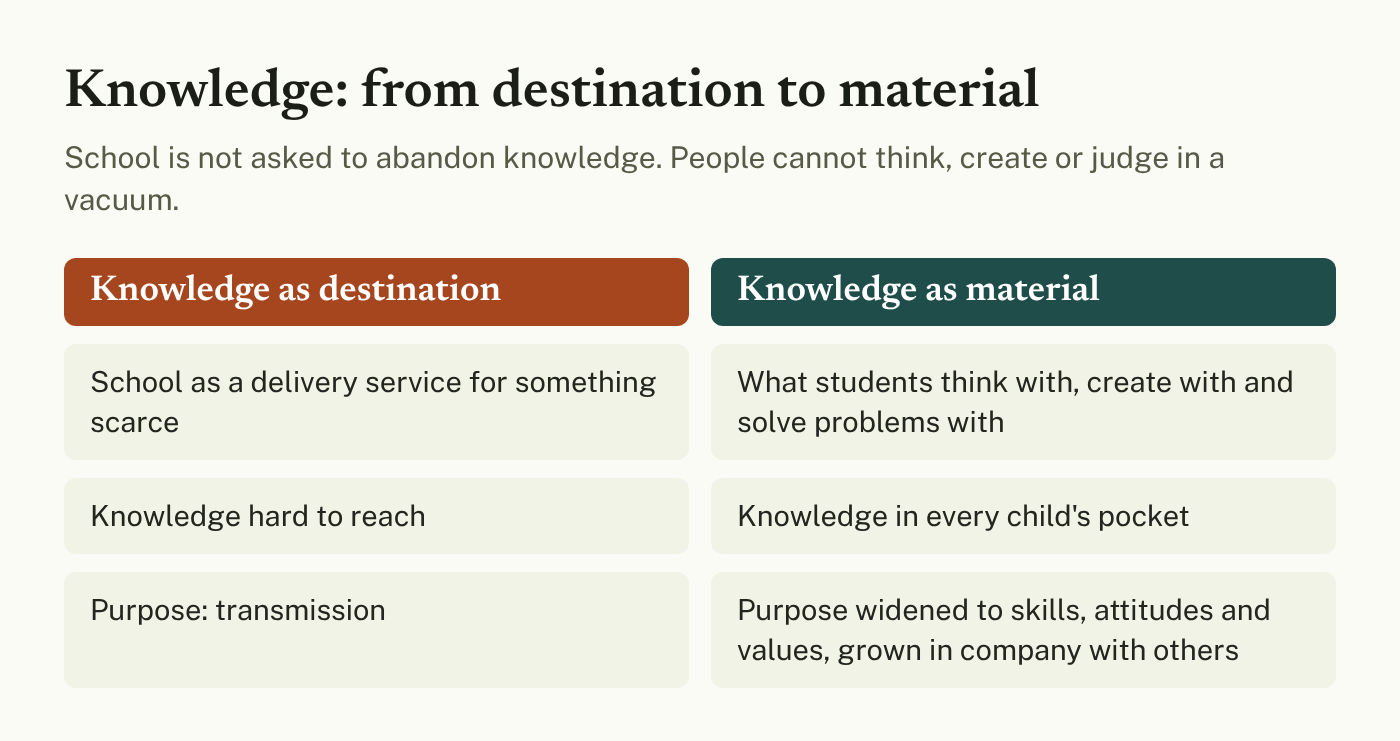
For more than a century, much of school's practical purpose was to transmit knowledge, because knowledge was scarce and hard to reach. That assumption no longer holds. Knowledge is in every child's pocket, and AI can recall, combine and apply it faster than most people (Penfold, 2026) [152]. A school still organised mainly around transmission is running a delivery service for something that no longer needs delivering.
The answer isn't to abandon knowledge. People can't think, create or judge in a vacuum. The shift is that knowledge moves from being the destination to being the material: what students think with, create with and solve problems with. The World Economic Forum's Education 4.0 framing widens the purpose of school to include skills, attitudes and values as well as knowledge (World Economic Forum, 2026) [205]. Those things have to be grown in the company of other people, which puts relationships, character and community closer to the centre of what school is for.
Relational capability
That argument is gaining support from outside education. In July 2026 the Yidan Prize Foundation and Yonsei University convened a conference in Seoul on relational intelligence: the capacity to build trust, bridge differences, resolve conflict and make meaning together (Yidan Prize Foundation, 2026 [208]; Penfold, 2026 [141]). If AI increasingly handles routine cognitive work, the capabilities that remain distinctly human, and increasingly valuable, are relational ones. Schools that treat them as soft extras are reading the evidence backwards. Chapter 31 made a similar point from the labour market.
What students need to be able to judge
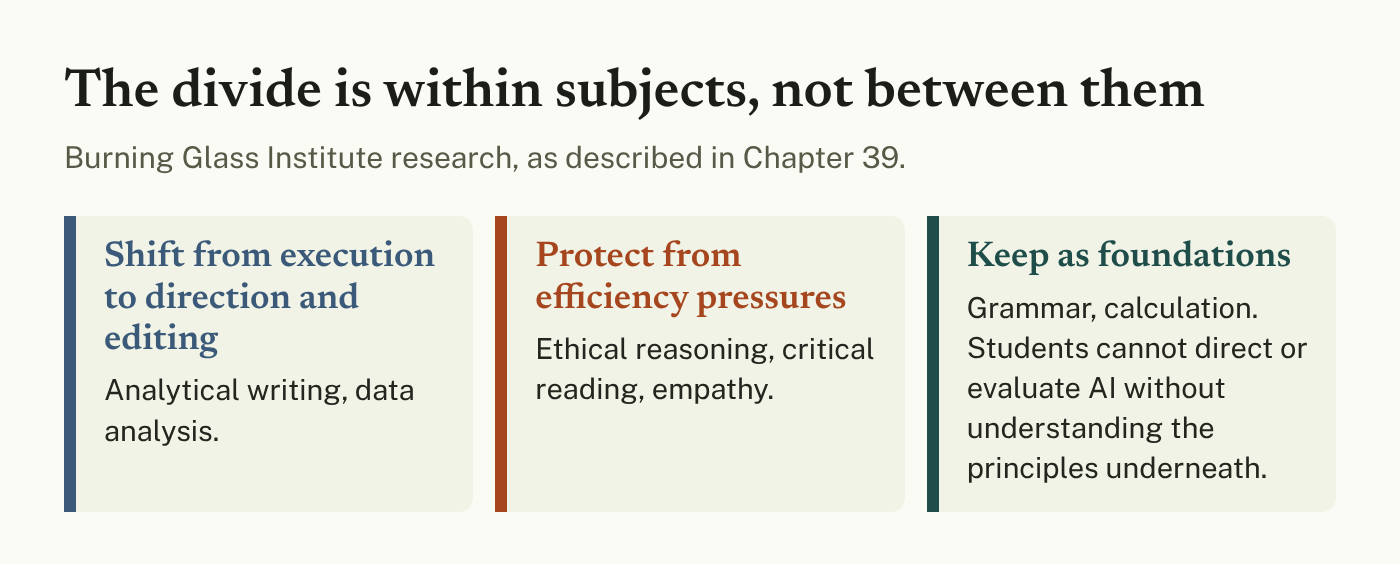
Purpose also shapes curriculum within subjects. Research by the Burning Glass Institute argues that the divide isn't between subjects but within them. Some skills, such as analytical writing and data analysis, shift from execution to direction and editing of AI output. Others, such as ethical reasoning, critical reading and empathy, must be protected from efficiency pressures. And foundational skills such as grammar and calculation remain necessary, because students can't direct or evaluate AI without understanding the principles underneath (Burning Glass Institute, 2026 [20]; Penfold, 2026 [95]).
Chapter 40 Why good changes fail: the system around the classroom
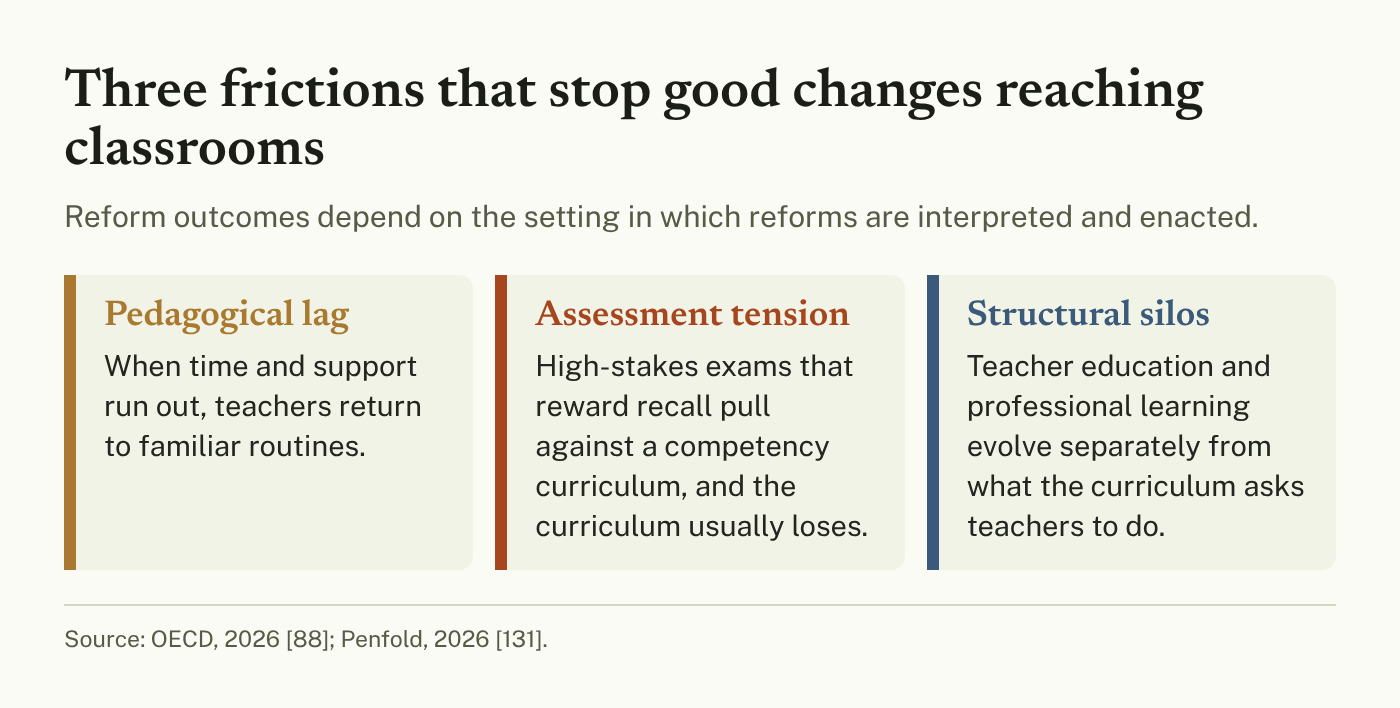
The OECD's 2026 paper on an ecosystems approach to curriculum change argues that reform outcomes depend not only on good design but on the setting in which reforms are interpreted and enacted: a web of actors, relationships, routines, resources and infrastructures that is always present, whether or not it's acknowledged (OECD, 2026) [88]. Although the paper doesn't focus on AI, it may be one of the most useful documents for leaders introducing AI, because the same forces that undermine curriculum reform also neutralise new tools.
Three frictions
In my reading, three recurring frictions stand out (Penfold, 2026) [131].
- Pedagogical lag. When time and support run out, teachers return to familiar routines.
- Assessment tension. High-stakes examinations that reward recall pull against a curriculum built around competencies, and the curriculum usually loses.
- Structural silos. Teacher education and professional learning evolve separately from what the curriculum asks teachers to do.
Four strategies
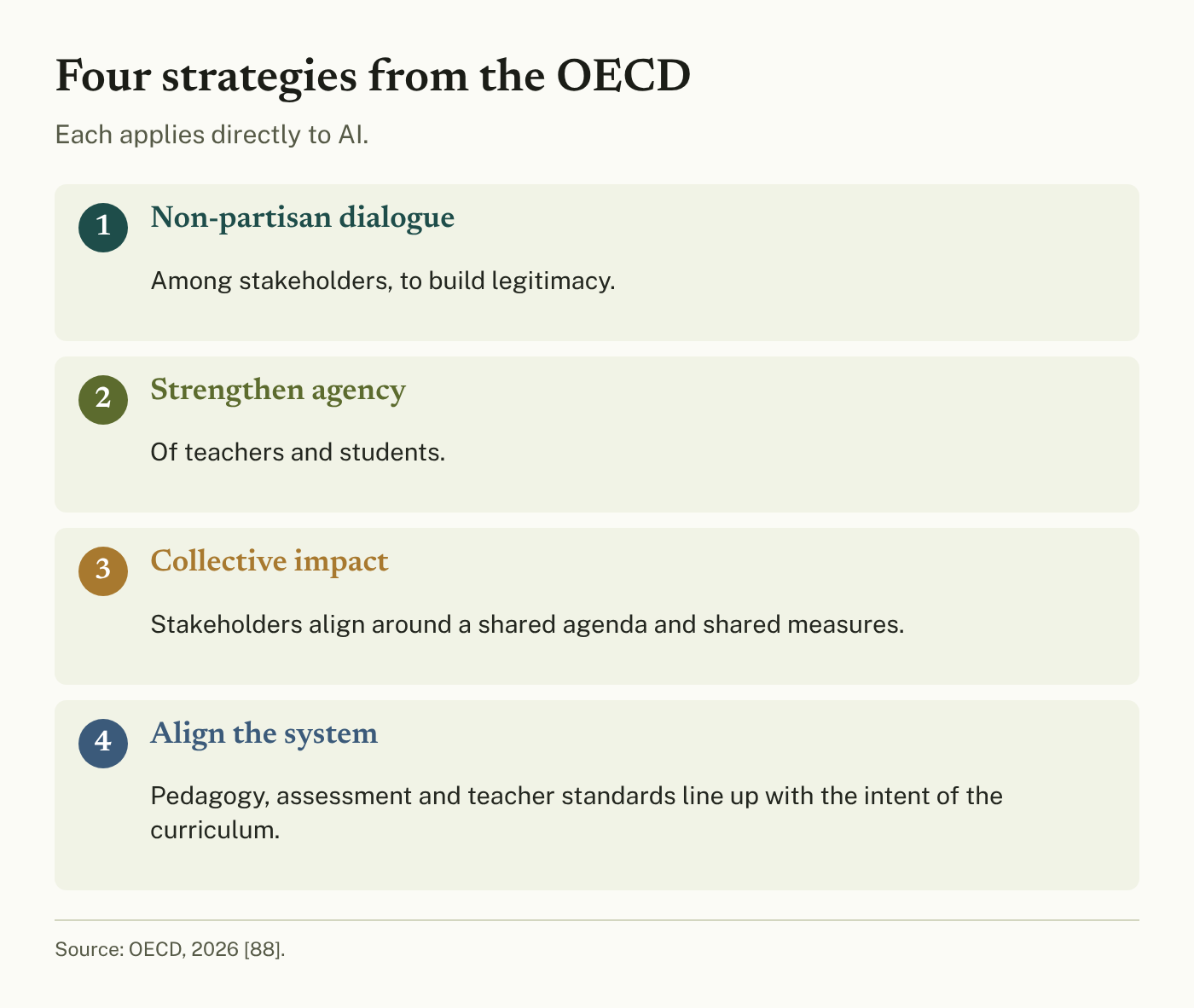
The OECD proposes four strategies: non-partisan dialogue among stakeholders to build legitimacy; strengthening the agency of teachers and students; collective impact, in which stakeholders align around a shared agenda and shared measures; and aligning pedagogy, assessment and teacher standards with the intent of the curriculum (OECD, 2026) [88]. Each applies directly to AI. An AI policy that changes what students do but not how they're assessed will lose to the assessment, which is the lesson of Part Five. A tool introduced without professional learning will be absorbed into old routines, which is the lesson of Part Seven.
Chapter 41 Sequencing, unbundling and a leadership sequence
Institution before tool
UNESCO-UNEVOC's 2026 practical guide for technical and vocational institutions treats AI as a multistakeholder, institution-wide process, embedded across teaching, curriculum, assessment and operations, with educational purpose, human agency, equity and safety at the centre (UNESCO-UNEVOC, 2026 [190]; Penfold, 2026 [124]). That's a long way from licensing an app. The OECD's Digital Education Outlook 2026 explains why the difference matters: successfully completing tasks with generative AI doesn't necessarily translate into learning (OECD, 2026 [90]). A tool that raises output can erode learning if the institution around it hasn't been redesigned to protect thinking.
Conversation before policy
Before deploying tools, writing policy or booking training, leaders need to ask their community what they actually want AI to do, which is a different question from what it can do (Penfold, 2026) [140]. Teacher readiness, parent trust and student understanding are shaped by dialogue, not by documents issued after decisions have been made.
Red lines before rollout
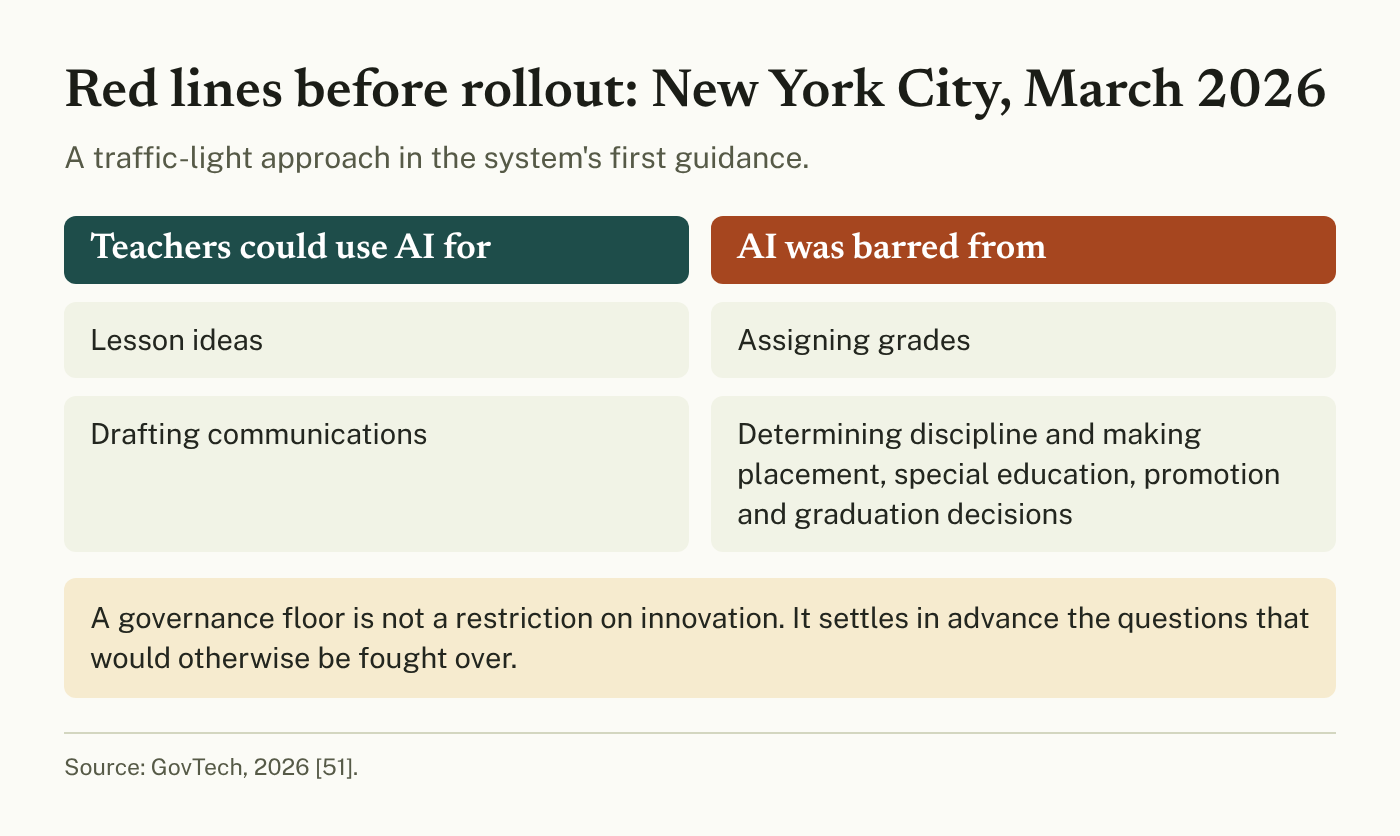
Clear limits make sustainable adoption possible. New York City's first system-wide guidance, issued in March 2026, used a traffic-light approach. Teachers could use AI for lesson ideas and drafting communications, but AI was barred from assigning grades, determining discipline, and making placement, special education, promotion and graduation decisions (GovTech, 2026 [51]; Penfold, 2026 [140]). Such a governance floor isn't a restriction on innovation. It's a condition for it, because it settles in advance the questions that would otherwise be fought over after an incident. (Chapter 21 describes what New York did next.)
Two decisions, not one
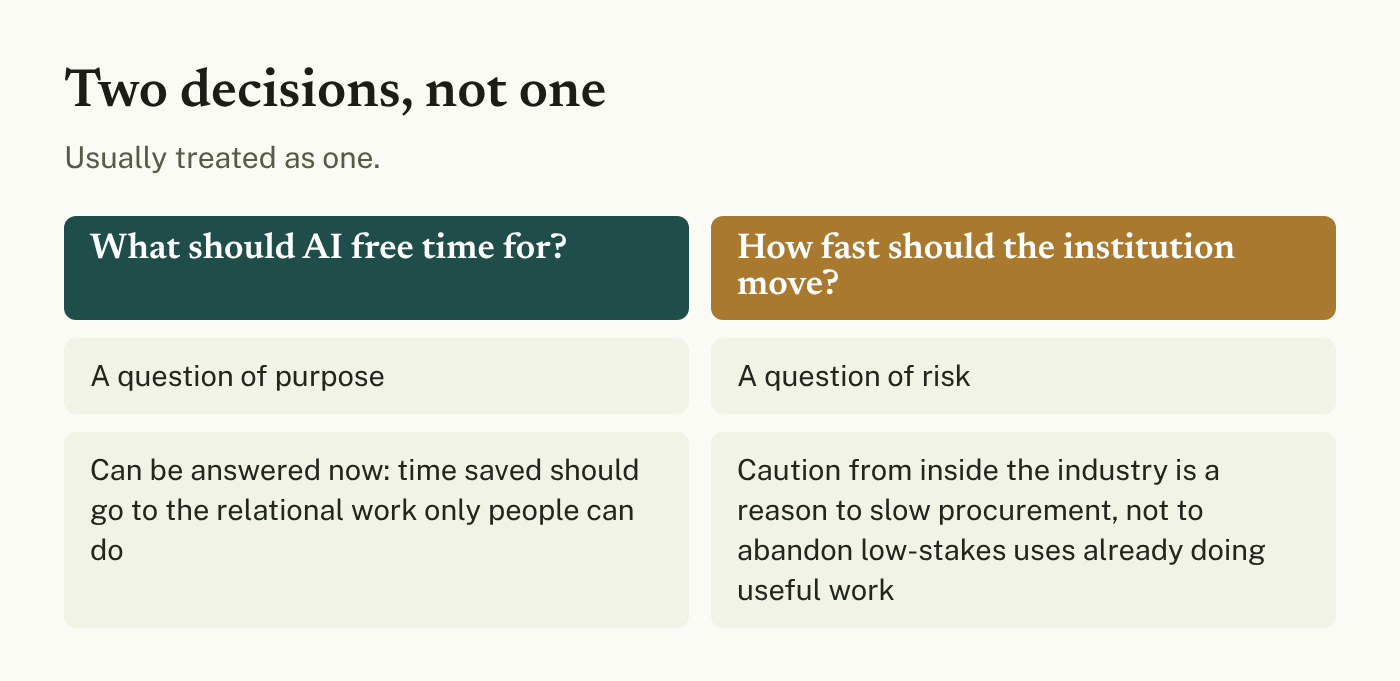
In September 2026, leaders of two of the largest AI developers publicly called for slowing the pace of AI development, and AI-linked shares fell (CNN, 2026 [23]; Penfold, 2026 [141]). That creates a real tension for school leaders, who are often encouraged to use AI to free teachers' time for human connection. In the newsletters I suggested separating two questions that are usually treated as one: what AI should free time for, and how fast the institution should move (Penfold, 2026) [141]. The first is a question of purpose and can be answered now: time saved should go towards the relational work only people can do. The second is a question of risk, and caution from inside the industry is a reason to slow procurement, not to abandon low-stakes uses already doing useful work. One of those industry leaders is the chief executive of Anthropic, which makes Claude, the AI that co-wrote this book.
The changing shape of school
Leaders also face a structural shift: families increasingly unbundle schooling, buying the parts that suit their child rather than the whole package (Penfold, 2026) [148]. In several US states, education savings accounts give families a share of public funding to spend on tuition, tutoring, curriculum or therapies (World Economic Forum, 2026) [206]. Elsewhere the same instinct operates without public funding. Tooley's (2009) [179] research documented low-cost private schools serving large numbers of poor families across Africa and Asia. In England, local authorities reported 126,000 children in elective home education in autumn 2025, up from 111,700 a year earlier, with mental health the most common reason given (16%) and philosophical or preferential reasons cited by 12% (Department for Education, 2026) [32].
Hybrid learning hubs, such as those run by Brave Generation Academy, let teenagers study for international qualifications around sport, performance or disruption to conventional schooling. I'm connected to Brave Generation Academy, so weigh what I say about it accordingly.
Some of this is less new than it looks. Montessori education has grouped children by their capacity to direct their own learning, rather than strictly by age, since 1907. AI doesn't invent learner-centred models. It gives families and leaders new reasons to notice them. For leaders of conventional schools, the lesson is that families will judge the bundle against its parts. What a school offers that can't be bought separately (community, relationships, belonging and the formation of character) is likely to become its strongest case.
A five-step leadership sequence
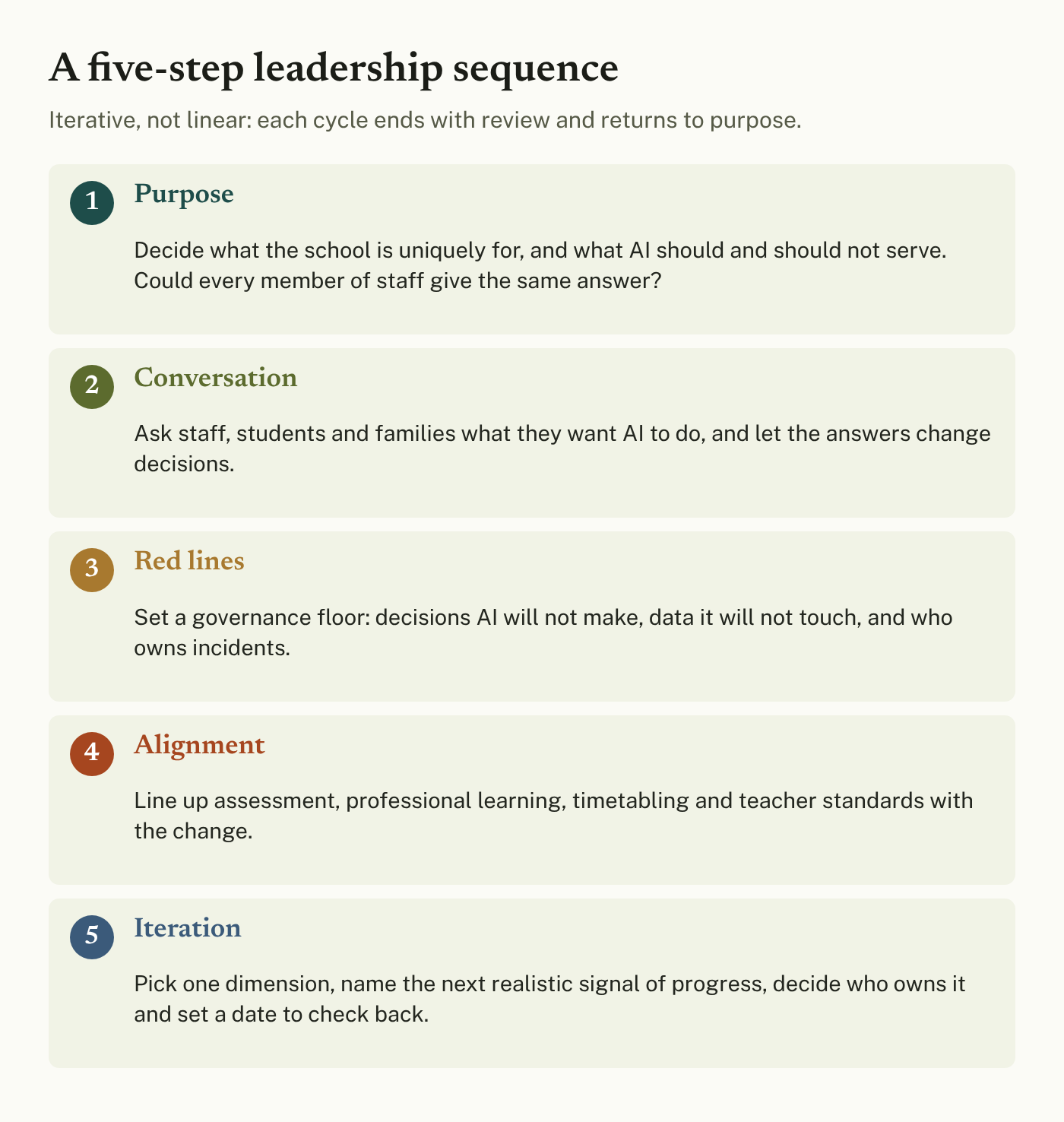
Drawing these strands together, I propose a five-step leadership sequence. It's iterative, not linear: each cycle ends with review and returns to purpose.
- Purpose. Decide what the school is uniquely for, and what AI should and shouldn't serve. Could every member of staff give the same answer?
- Conversation. Ask staff, students and families what they want AI to do, and let the answers change decisions.
- Red lines. Set a governance floor: decisions AI won't make, data it won't touch, and who owns incidents.
- Alignment. Line up assessment, professional learning, timetabling and teacher standards with the change, so that the system supports it rather than neutralising it.
- Iteration. As the WEF readiness report recommends, pick one dimension, name the next realistic signal of progress, decide who owns it and set a date to check back (World Economic Forum, 2026 [205]; Penfold, 2026 [112]).
What to do
For school leaders. Start with purpose and conversation, not procurement. Set red lines before rolling out tools. Look for the frictions in your own school, especially where assessment rewards what the curriculum is trying to move beyond. Separate the decision about what AI should free time for from the decision about how fast to move. Be clear about what your school offers that families can't assemble from parts.
For boards and owners. Judge AI strategy by the quality of the human work around it, not by the number of tools adopted. Fund sustained professional learning, not one-off training. Protect time saved by AI from being absorbed into cost-cutting, especially where ownership is focused on growth and margins rather than on teachers and learning.
For system leaders. Align assessment and teacher standards with the curriculum and AI policy you expect schools to implement, as the OECD recommends. Provide governance floors that individual schools can adopt rather than leaving each to invent its own.
What this part can't tell you
This part reflects a practitioner perspective and is based on reports and surveys rather than original empirical research. Much of the evidence comes from the United States and Europe. The leadership sequence is a synthesis and hasn't been evaluated. My connection to Brave Generation Academy is a potential conflict of interest in the section on unbundling. Several figures in the original newsletters were corrected or omitted where they couldn't be confirmed.
A closing thought
AI in schools is often treated as a technology decision. It's more usefully treated as a test of leadership. The tools will keep changing. What lasts is an institution's clarity about what it's for, its relationships with the people it serves, the limits it sets, the coherence of the system around its classrooms, and its habit of honest review. Leaders who sequence the human work first will find that the technology questions become much easier. Those who start with the tools may find that the system around them quietly decides.
Coach · Part Eight
Think it through
Four short ways to test what this part means for you. There are no right scores. Everything you type stays in this browser and is never sent anywhere.
A situation
A vendor offers every pupil a free AI tutor starting next term. Your governors like the price. Where do you start?
Pick the response closest to what you would do.
Read: Chapters 40 and 41; try the leadership decision tree
A private self-check
Rate your school against the book's five-step leadership sequence.
Reflect
Write a line or two for each. Notes save automatically in this browser.
Ask the book
Common questions about this part, answered from its own text.
What is the five-step leadership sequence?
Purpose, conversation, red lines, alignment and iteration. It is iterative, not linear: each cycle ends with review and returns to purpose.
Why do good changes fail?
The book names three frictions: pedagogical lag (teachers return to familiar routines when time and support run out), assessment tension (high-stakes exams that reward recall pull against competency curricula) and structural silos (teacher education and professional learning evolve separately from the curriculum).
What are the four OECD strategies?
Non-partisan dialogue among stakeholders to build legitimacy; strengthening the agency of teachers and students; collective impact, with shared agenda and measures; and aligning pedagogy, assessment and teacher standards with the intent of the curriculum.
What does 'two decisions, not one' mean?
Separate the decision about what AI should free time for from the decision about how fast to move. The book also asks leaders to be clear about what their school offers that families cannot assemble from parts.
Chapter 41; 'What to do'
What should boards and owners do?
Judge AI strategy by the quality of the human work around it, not the number of tools adopted; fund sustained professional learning; and protect time saved by AI from being absorbed into cost-cutting. The part includes a declaration of the author's own interests in this area.