Part Ten
Close the Gap or Widen It?
Based on the paper "Close the Gap or Widen It? AI, Equity and Learning at the Weakest Link" by Paul Penfold (Proceedings of Future Science Archives, 2026).
Part Nine showed how thinly AI in education is governed. This part asks who benefits. It looks at how AI could narrow or widen educational gaps, and then goes to the place where the stakes are highest: learners in crisis and displacement.
Chapter 47 Two plausible futures
Every major change in education carries a hidden danger: that it works well for children who already have advantages and quietly leaves the rest further behind. New technologies, methods and resources tend to reach the well-resourced first, and by the time they reach everyone else the head start has compounded (Penfold, 2026) [97].
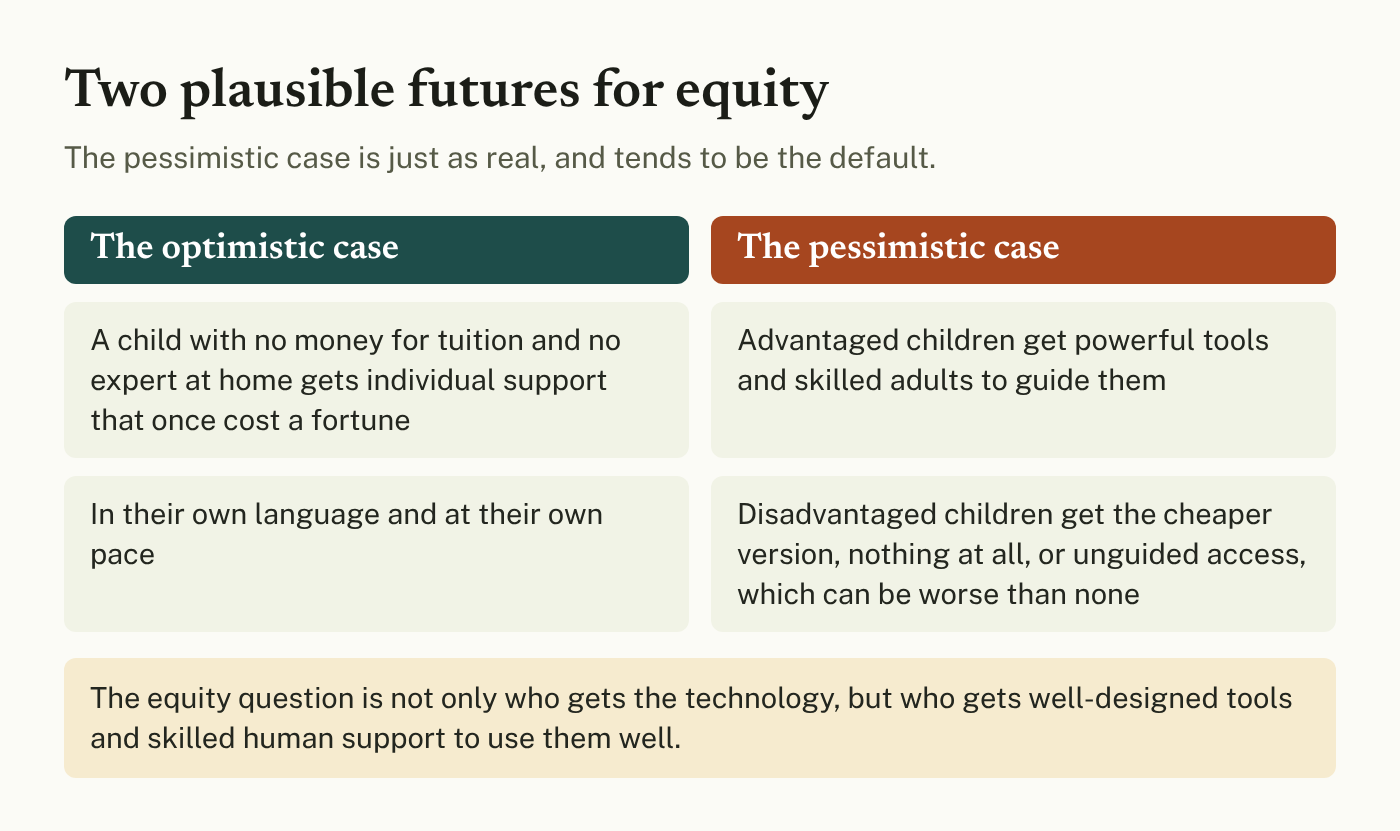
AI is the most powerful version of this pattern education has faced. The optimistic case is real: a child with no money for private tuition and no expert at home could, in principle, get individual support that once cost a fortune, in their own language and at their own pace. The pessimistic case is just as real and tends to be the default. Advantaged children get powerful tools and skilled adults to guide them, while disadvantaged children get the cheaper version, nothing at all, or unguided access, which can be worse than none.
Three questions guide this part:
- What determines whether AI narrows or widens educational inequality?
- What does the situation look like for the learners furthest from the frontier, those in crisis and displacement?
- What should schools, systems and organisations ask of every AI decision?
Where the material comes from, and a declaration
This part draws on newsletters I wrote for school leaders in 2026 (Penfold, 2026 [97], 2026 [119]), together with data on connectivity, refugee education, aid and AI for development. I checked figures against primary or authoritative secondary sources. Claims that organisations make about their own programmes are reported as their claims. I work for Brave Generation Academy (BGA), and its work with displaced learners is mentioned in Chapter 50. That's an interest I want you to know about.
Why access isn't enough
Evidence on learning helps explain why access alone isn't enough. In a large field experiment with high school mathematics students, unrestricted access to a chatbot improved performance during practice but lowered results on an exam taken without it. A tutor-style version designed to prompt thinking avoided that harm (Bastani et al., 2025) [11]. Chapter 10 describes the study in full. A child given a powerful tool with no guidance and no well-designed pedagogy isn't necessarily being helped. The equity question is therefore not only who gets the technology, but who gets well-designed tools and skilled human support to use them well, which advantaged children already have in abundance (Penfold, 2026) [97].
Chapter 48 Four layers of the AI divide
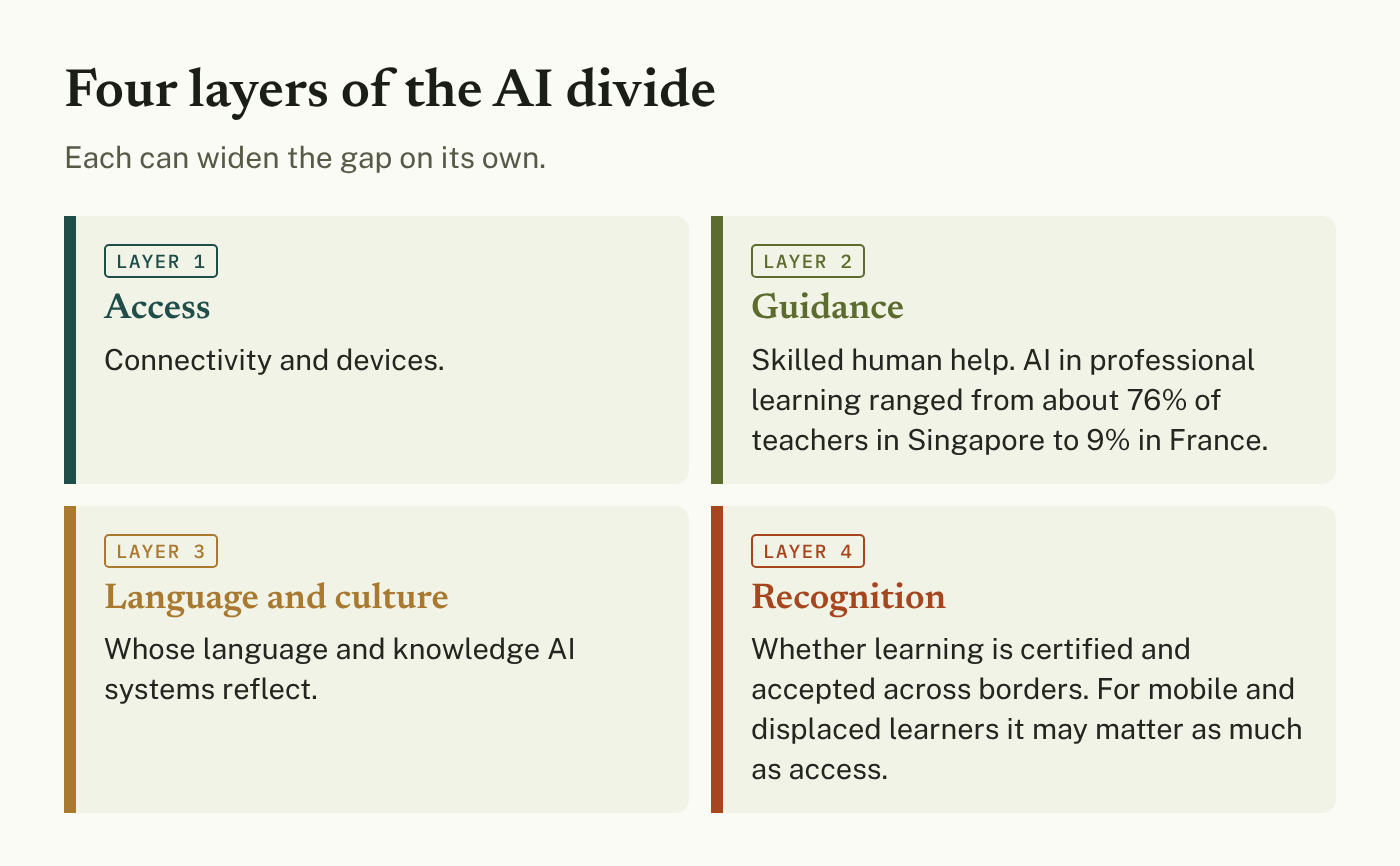
Access
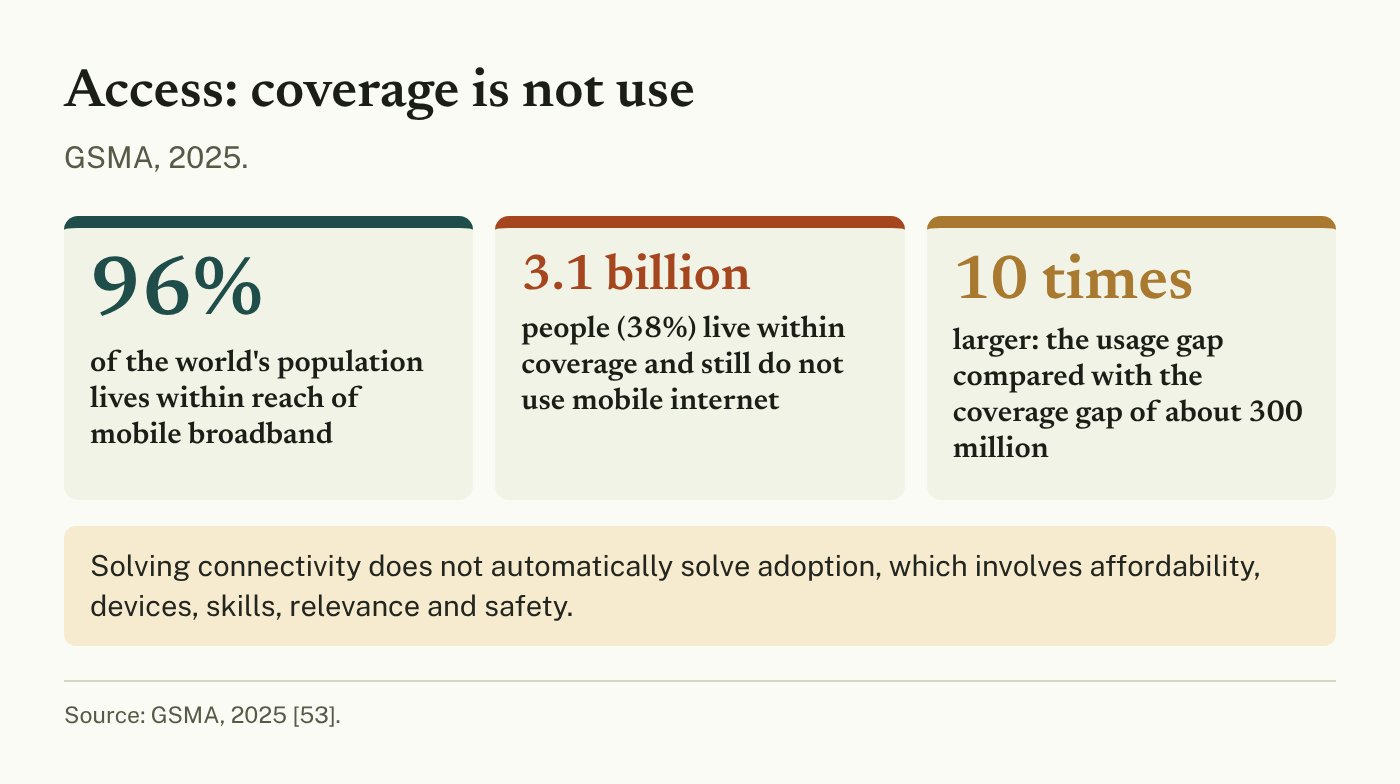
The most basic divide is access to connectivity and devices. The GSMA reported in 2025 that 96% of the world's population lives within reach of mobile broadband, but 3.1 billion people, 38% of the world, live within coverage and still don't use mobile internet. That usage gap is ten times larger than the coverage gap of about 300 million people (GSMA, 2025) [53]. Connectivity and adoption are different problems. Solving the first doesn't automatically solve the second, which involves affordability, devices, skills, relevance and safety.
Guidance
The second divide is skilled human guidance. Teachers' own preparation for AI varies widely between systems. In the OECD's 2024 Teaching and Learning International Survey, the share of lower secondary teachers who had AI in their professional learning in the previous year ranged from about 76% in Singapore to 9% in France (Education International, 2025) [41]. Within systems, students in better-resourced schools and homes are more likely to have adults who can help them use AI well. This is why my newsletters argue that equity work should invest most in teaching that helps disadvantaged students use AI wisely, since they're least likely to get that guidance anywhere else (Penfold, 2026) [97]. Part Seven covers the teacher side of this.
Language and culture
The third divide concerns whose language and knowledge AI systems reflect. Research has found that AI writing suggestions nudge writers towards Western styles and reduce cultural nuance (Agarwal et al., 2025) [3]. Contributors to UNESCO's 2026 collection describe AI tools that mishandle local languages and risk overriding local ways of knowing (UNESCO, 2026) [189]. Learners whose languages are poorly represented in training data receive weaker tools, and may also learn that their own ways of expressing themselves are less valued. Chapter 27 raised the same worry about assessment rubrics that reward polish.
Recognition
The fourth divide concerns whether learning is recognised. Learning that can't be certified, or certificates that aren't accepted across borders, leave learners stranded. A young person educated in the camps on the Thai–Myanmar border told Save the Children that their education wasn't recognised, so graduates struggle to find work (Penfold, 2026) [119]. For mobile and displaced learners, recognition may matter as much as access.
Chapter 49 The weakest link: learners in crisis
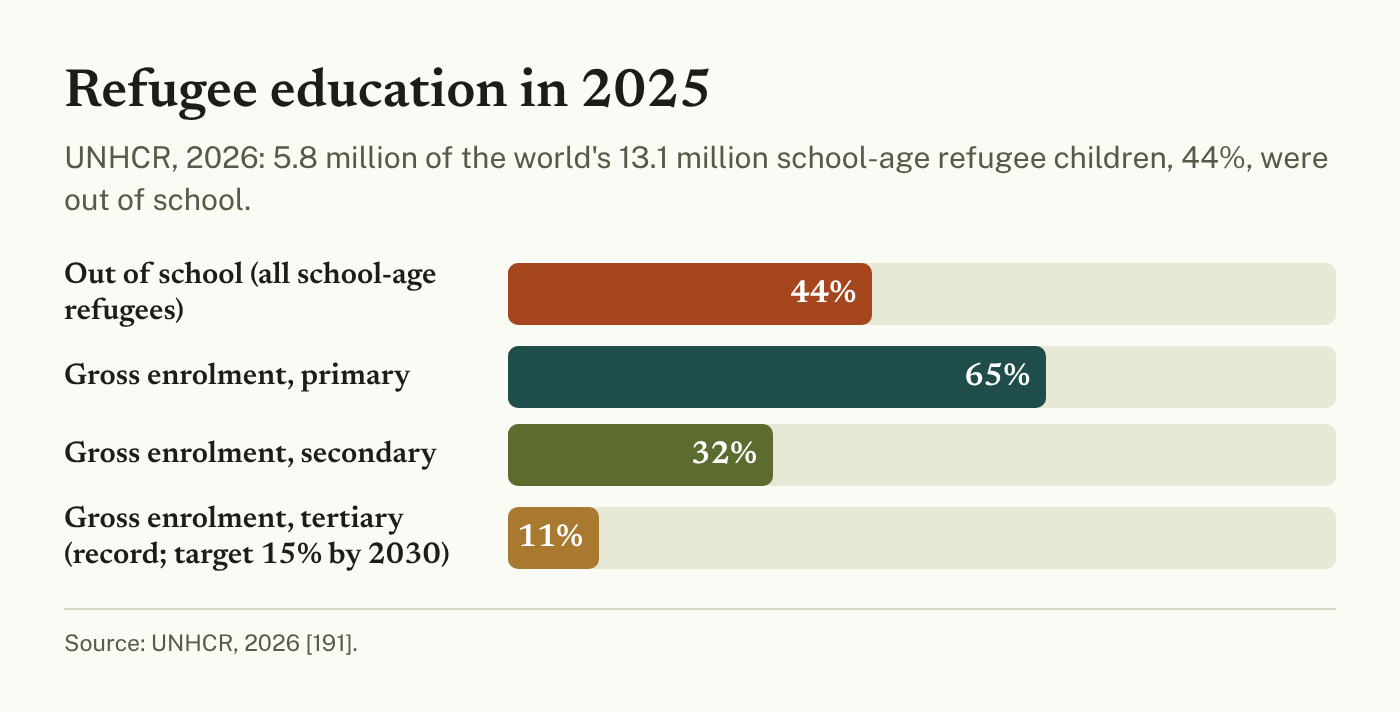
The four layers are hardest for learners in crisis and displacement. UNHCR's 2026 education report estimated that 5.8 million of the world's 13.1 million school-age refugee children, 44%, were out of school in 2025. Gross enrolment was 65% at primary level, 32% at secondary and a record 11% at tertiary level, against a target of 15% by 2030 (UNHCR, 2026) [191].
Each figure hides a particular crisis. In Cox's Bazar, Bangladesh, funding cuts in 2025 led to the closure of more than 6,400 learning centres in the Rohingya camps, putting about 300,000 children at risk of losing their education (Save the Children, 2025) [167]. In Gaza, UNICEF described the education system as on the brink of collapse after two years of war (UNICEF, 2025) [192]. On the Thai–Myanmar border, Save the Children reported in January 2026 that education in the nine refugee camps had reached "breaking point", with aid cuts coinciding with rising enrolment (Save the Children, 2026 [168]; Penfold, 2026 [119]).
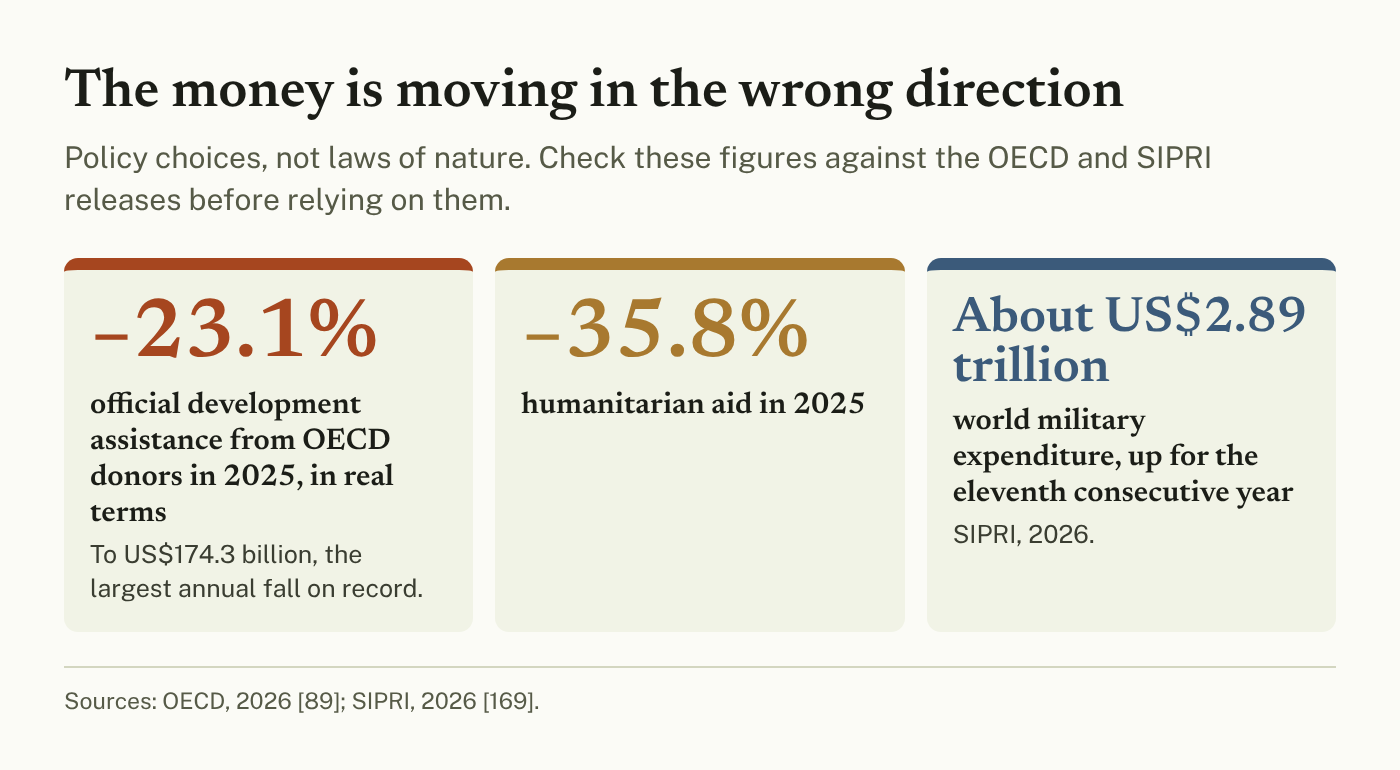
The money is moving in the wrong direction. Official development assistance from OECD donors fell by 23.1% in real terms in 2025 to US$174.3 billion, the largest annual fall on record, and humanitarian aid fell by 35.8% (OECD, 2026) [89]. In the same year, world military expenditure rose for the eleventh consecutive year to about US$2.89 trillion (SIPRI, 2026) [169]. These are policy choices, not laws of nature, but they set the conditions in which AI will or won't reach the learners with the least. Please check these figures against the OECD and SIPRI releases before relying on them.
EdTech Hub and IDRC's foresight study of education in conflict and crisis to 2035 ranks a funding collapse as the likeliest scenario, hybrid learning becoming normal as the most urgent, and borderless accreditation for displaced learners as the least likely but among the most consequential (Rahman & Freeman, 2025 [163]; Penfold, 2026 [119]).
Chapter 50 What works where power, connectivity and funding fail
If AI is to narrow gaps rather than widen them, it has to work at the weakest link. Several approaches already do, or are trying to.
Offline first
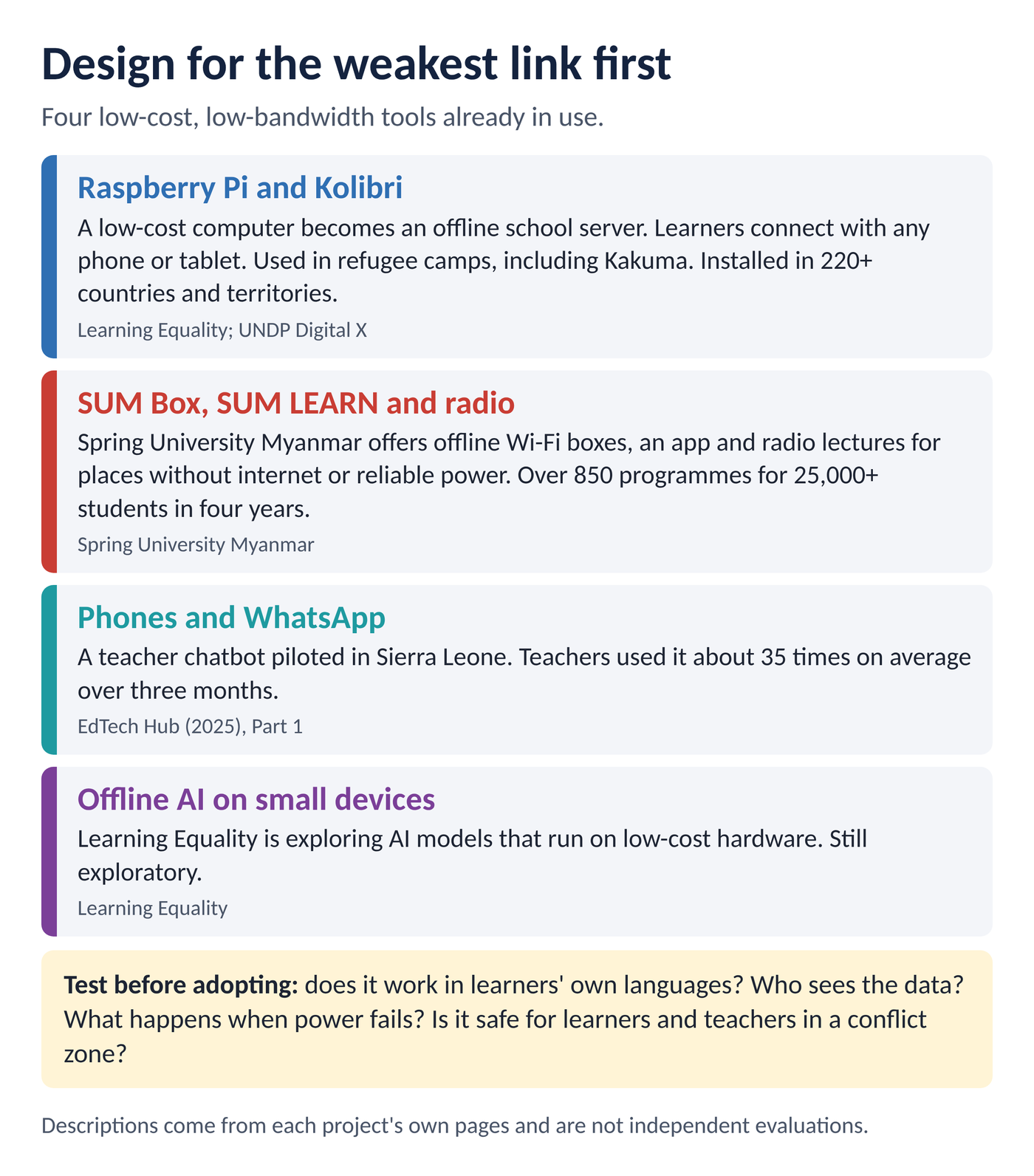
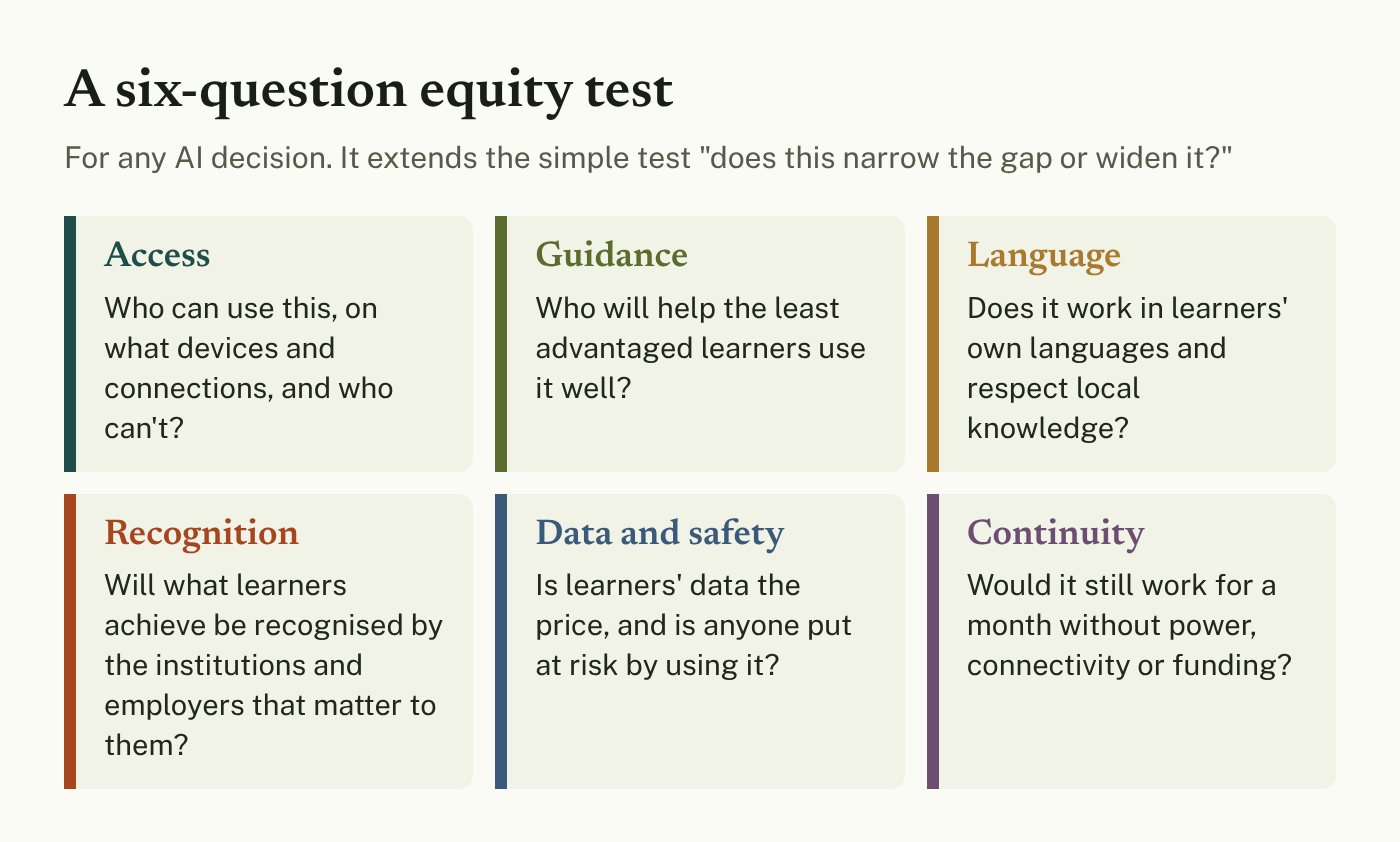
Kolibri, developed by the non-profit Learning Equality, turns a low-cost device into an offline school server that learners reach with their own phones or tablets, and has been used in refugee settings including Kakuma (UNDP, n.d.). In Myanmar, Spring University Myanmar reports using offline Wi-Fi boxes, a learning app and radio lectures to reach students and teachers in conflict areas. It protects the anonymity of teachers and learners because, in a conflict zone, safety is part of the design (Spring University Myanmar, n.d.; Penfold, 2026) [119].
Small AI on basic phones
The World Bank's World Development Report 2026 argues that AI for low- and middle-income countries must often be delivered through voice on basic mobile phones, for people who can't read or can't afford smartphones. It promotes "small AI": affordable models that run on everyday devices (World Bank, 2026) [202].
Supporting the adults
The International Rescue Committee's aprendIA provides low-bandwidth WhatsApp support and short courses for teachers in conflict-affected north-east Nigeria, in English and Hausa (International Rescue Committee, 2026) [59]. Chapter 17 mentioned it as an example of careful support for carers. In many camps, teachers are refugees themselves. Community teaching isn't a future scenario but a daily reality, and the question is whether it's supported, trained and recognised (Penfold, 2026) [119].
Portable, recognised certificates
The Alsama Project launched the G12++ in 2026, a low-cost, capability-based examination intended to give displaced young people a high-school-equivalent certificate that universities and employers will accept. The organisation reports external benchmarking and early acceptance by universities and employers. These claims are its own and haven't been independently verified (Alsama Project, 2026 [4]; Penfold, 2026 [119]). Brave Generation Academy, with which I'm connected, has worked with partners to train camp teachers in Kakuma as remote teaching assistants (Penfold, 2026) [119].
None of these approaches is automatically safe. EdTech Hub's scenarios warn that private providers may be paid in children's data, and that tools may not fit local languages or cultures (Rahman & Freeman, 2025) [163]. Low cost isn't the same as low risk.
Chapter 51 A six-question equity test
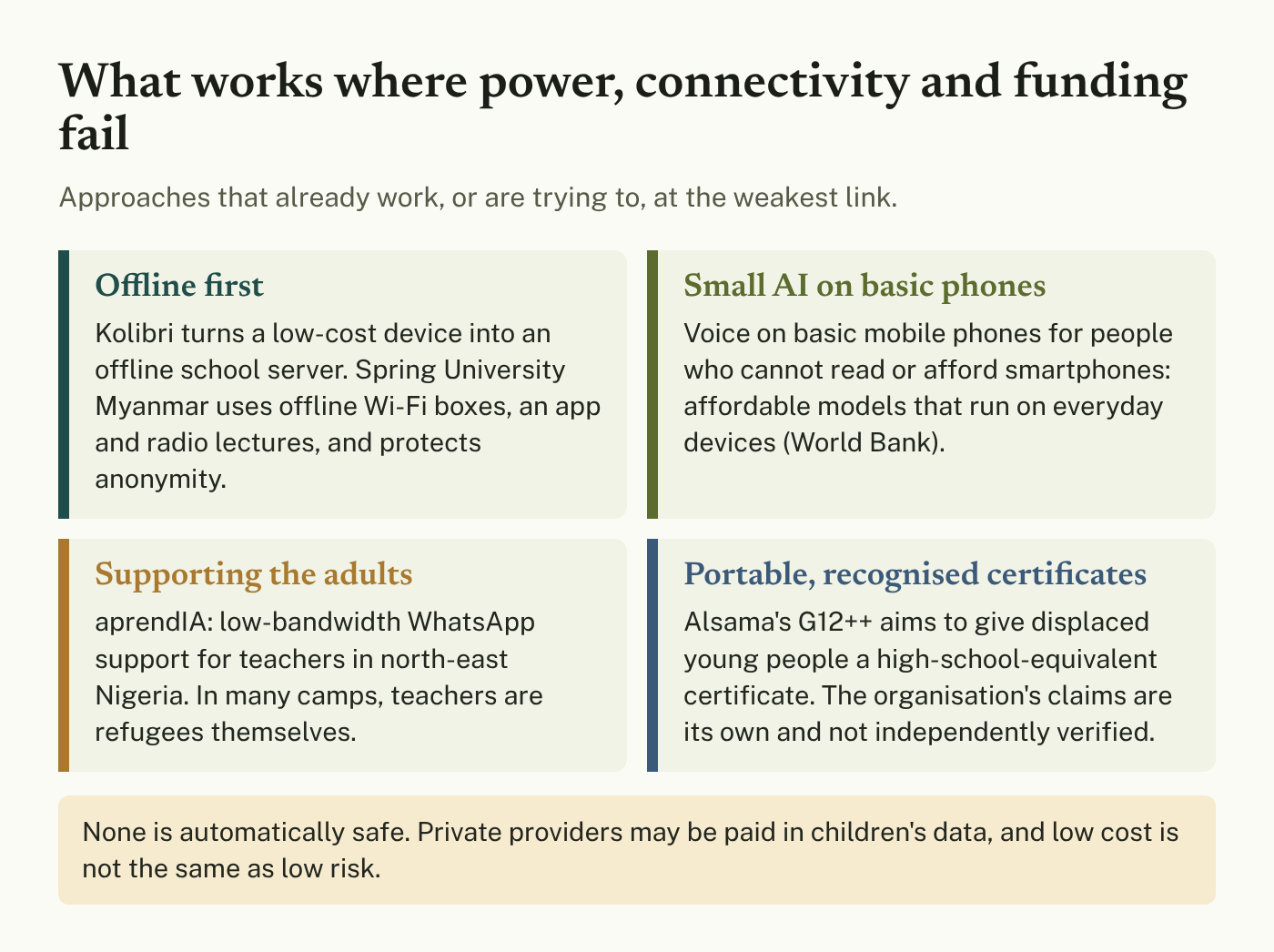
Drawing these strands together, I propose six questions that schools, systems and organisations can ask of any AI decision. They extend the simple test I used in the newsletters, "does this narrow the gap or widen it?" (Penfold, 2026) [97], into its component parts.
- Access. Who can use this, on what devices and connections, and who can't?
- Guidance. Who will help the least advantaged learners use it well?
- Language. Does it work in learners' own languages and respect local knowledge?
- Recognition. Will what learners achieve be recognised by the institutions and employers that matter to them?
- Data and safety. Is learners' data the price, and is anyone put at risk by using it?
- Continuity. Would it still work for a month without power, connectivity or funding?
What to do
For school leaders. Ask of every AI decision whether it narrows or widens the gap. Make sure access to good tools and to skilled guidance doesn't quietly track advantage within your school. Invest most in the students least likely to get support elsewhere.
For systems and donors. Fund the human side, not only the technology: teachers, community educators and the guidance that turns access into learning. Support offline, low-bandwidth and voice-based tools in local languages. Invest in portable, verifiable learner records and recognition across borders.
For organisations working with displaced learners. Plan for lower and less predictable funding. Work offline first. Refuse arrangements in which learners' data is the price. Ask who will recognise a certificate before issuing it. Protect teachers and learners.
What this part can't tell you
This part synthesises data from many sources with different methods and definitions. Several organisational claims about programme reach and recognition couldn't be independently verified. Projections and scenarios aren't forecasts. Much of the evidence on AI and learning comes from well-resourced settings, and its relevance to crisis contexts is uncertain. My involvement with Brave Generation Academy is a potential conflict of interest.
A closing thought
AI won't decide by itself whether it narrows or widens educational gaps. Left to markets and chance, it will probably widen them, because that's how new technologies usually spread. Narrowing them requires deliberate, funded choices about access, guidance, language, recognition, data and continuity, made with the least advantaged learners in mind. The test of AI in education isn't what it does for the best-resourced school, but what it does at the weakest link: in a camp classroom with no power, a teacher who is also a refugee, and a young person whose certificate no one recognises. If it works there, it's likely to work everywhere.
Coach · Part Ten
Think it through
Four short ways to test what this part means for you. There are no right scores. Everything you type stays in this browser and is never sent anywhere.
A situation
A donor offers tablets preloaded with an AI tutor for a learning centre serving displaced young people. Power and connectivity are unreliable. What do you ask first?
Pick the response closest to what you would do.
Read: Chapters 48 to 51
A private self-check
Take any AI decision you are weighing. Rate how well it answers each of the six equity questions.
Reflect
Write a line or two for each. Notes save automatically in this browser.
Ask the book
Common questions about this part, answered from its own text.
What are the four layers of the AI divide?
Access, guidance, language and culture, and recognition.
What is the six-question equity test?
Access, guidance, language, recognition, data and safety, and continuity. It extends the simple test used in the newsletters: does this narrow the gap or widen it?
What works where power, connectivity and funding fail?
The part describes offline-first design, small AI on basic phones, supporting the adults, and portable, recognised certificates.
What should organisations working with displaced learners do?
Plan for lower and less predictable funding, work offline first, refuse arrangements in which learners' data is the price, ask who will recognise a certificate before issuing it, and protect teachers and learners.
Chapter 51; 'What to do'
How reliable are the claims about programme reach and recognition?
Several organisational claims could not be independently verified. Evidence on AI and learning comes mostly from well-resourced settings, and its relevance to crisis contexts is uncertain. The author also discloses involvement with Brave Generation Academy, which is discussed in the part.
'What this part can't tell you'; Chapter 47