Part Eleven
How This Book Was Made
Based on the paper "From Newsletter to Journal in an Evening: A Human–AI Workflow for Rapid, Open and Verified Publication of Applied Education Research" by Paul Penfold (Proceedings of Future Science Archives, 2026), with an added account of how the book itself was made.
The first ten parts argued for care: with children, with evidence, with contracts, with who gets left out. This last part turns that care on the book itself. It explains how the papers behind these chapters were made, what checking found, what could go wrong with this way of working, and how you can judge it for yourself.
Chapter 52 Can good research reach the public in days?
This book began with a simple question: can current, applied research on a fast-moving topic reach the public in days rather than months, without giving up the standards that make research worth reading?
The question matters most where change is fastest. In AI and education, a new model, policy or study can overturn assumptions within weeks. Over 2026 alone, intergovernmental bodies issued new frameworks on AI literacy, England placed AI inside its statutory safeguarding guidance, the European Union delayed its high-risk rules for education, and new evidence appeared on AI tutoring, cognitive offloading and the employment of young workers. A paper written in January and published the following year would miss most of it.
The experiment was to take thematic papers from my newsletter and publish them in a single evening, in an international open-review venue, without peer review at the first stage but with every reference checked, every claim traceable, and the process itself made public. This book is a second step: it takes those papers and turns them into short chapters for readers who won't read a journal article. Eleven papers are behind it, including the process paper this part draws on, which in its published form counts ten.
Why this author, and why this experiment
I've worked in education for six decades, as a teacher, researcher, curriculum and vocational education adviser, school leader and consultant across Asia and beyond. The motivations behind this work are those that have run through that career: a commitment to students' learning, to supporting teachers, to strengthening school leadership and good governance, and, more recently, to understanding how AI is changing learning, work and young people's futures. Those concerns led to the AI in Education – Deliberately Human newsletter and to a twice-weekly briefing for education leaders, from which the papers are drawn.
The experiment also reflects a longer habit of testing new technologies for learning before they become mainstream. In 2008 and 2009, I built the PolyU Virtual Hotel in the virtual world Second Life at the Hong Kong Polytechnic University, which received a teaching and learning innovation award in 2009. I also published research on teaching and on conducting research inside virtual worlds (Penfold, 2009 [94]; Guillet & Penfold, 2013 [54]). That work explored immersive, networked learning more than a decade before Facebook renamed itself Meta in 2021 and brought the idea of the "metaverse" to mainstream attention. Other work has included development education in Asia, among it refugee education on the Thai–Cambodian border, vocational and hospitality education programmes for governments in the region, and innovation in the schools I've led. Trying new tools early, carefully and in public is a habit. This series applies it to publishing itself.
Chapter 53 The speed problem, the money problem and the quality problem
The speed problem
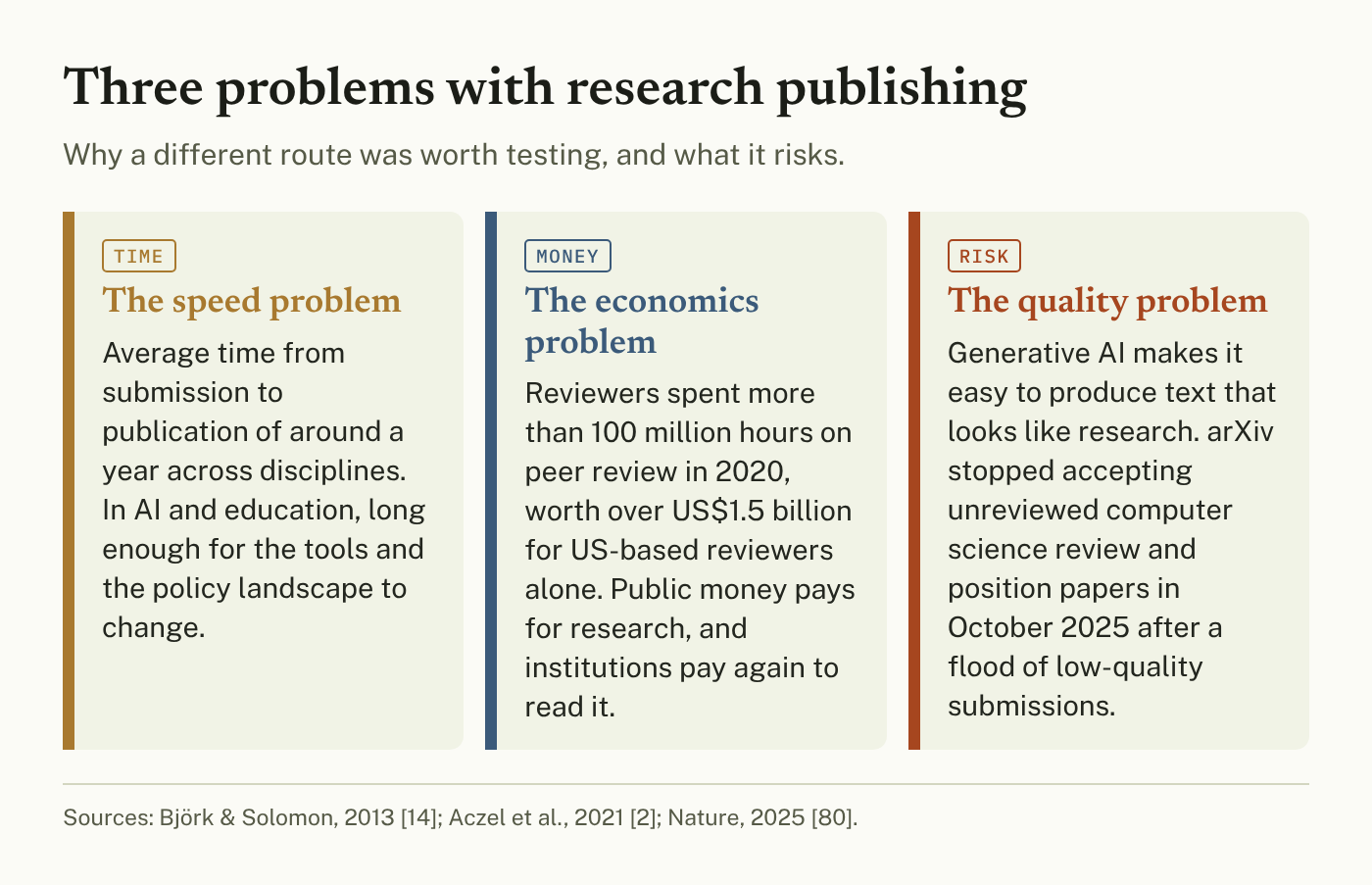
Conventional peer-reviewed publication is slow. A study of publishing delays across disciplines found average times from submission to publication of around a year, with wide variation by field (Björk & Solomon, 2013) [14]. In a slow-moving field that may not matter. In AI and education, a year is long enough for the tools under discussion to be replaced and for the policy landscape to change completely. By the time a paper is published, it risks being out of date.
The economics problem
I also believe that the current academic publishing business is neither ethical nor sustainable, and the evidence supports the concern. Most research is paid for by universities and public funders through researchers' salaries. Researchers then review one another's work largely without payment. One estimate put the time reviewers spent on peer review in 2020 at more than 100 million hours, with the time of US-based reviewers alone worth over US$1.5 billion (Aczel et al., 2021) [2]. Publication itself is concentrated in a small number of commercial publishers, which by 2013 accounted for more than half of all papers in the natural, medical and social sciences (Larivière et al., 2015) [66]. Universities then pay for access through subscriptions, or authors pay article processing charges to make their work open.
The result is that public money pays for research, unpaid academics check it, and institutions pay again to read it. Alternative models that remove charges for both readers and authors are part of the answer.
The quality problem
Speed and openness have their own risks. Generative AI makes it easy to produce text that looks like research. In October 2025, arXiv stopped accepting computer science review and position papers that hadn't passed peer review, after a flood of low-quality submissions it attributed largely to AI (Nature, 2025) [80]. A large-scale study found that the share of scientific papers showing signs of modification by large language models rose quickly after 2022, especially in computer science (Liang et al., 2025) [69]. "Research slop", fluent but shallow or wrong text produced at volume, is a real threat to the scholarly record. Any experiment in faster, AI-assisted publication has to take that threat seriously, and this one tried to.
Chapter 54 The venue, and the 81 articles behind it
Future Science Archives
Future Science is a non-profit, open-access and open-source initiative for innovation in academic publishing, hosted at Mohammed VI Polytechnic University in Morocco in partnership with Aix-Marseille Université, the University of Chicago and Columbia University's Center for Contemporary Critical Thought, and led by Raphaël Liogier (Future Science, 2026) [46]. It charges no submission or reader fees and is funded through public and institutional support. It describes itself as being at an early stage of development, moving from an alpha phase towards a wider beta in 2026.
Future Science Archives is one of its initiatives, an Open Review Archive. It welcomes research from all disciplines, posts manuscripts immediately on submission, and invites open commentary and revision in public, like a preprint enriched by community feedback and editorial oversight (Future Science, 2026 [46], 2026 [47]). Its information for authors is explicit about what this means. Submissions aren't filtered in advance for relevance, originality, importance or quality. Publication isn't a certification of the work. Authors remain fully responsible for content, accuracy, methods, citations and ethics, and works may receive open, post-publication peer review. All authors must follow a code of conduct requiring academic integrity, proper citation, transparency, authorship and conflict-of-interest disclosure (Future Science, 2026) [47].
Why it fitted, and where it doesn't
The venue fitted the experiment for three reasons. It publishes immediately, which made a single-evening test possible. It's free to authors and readers, which matched my view of how publicly funded knowledge should circulate. And it makes evaluation public after publication, which places the responsibility for quality squarely on the authors and invites others to test it.
It also has real limitations, which you should weigh. Its publications aren't indexed in commercial citation databases and carry no impact factor, which matters for early-career researchers whose careers depend on such measures. Experiments with automated AI research and review risk hallucination, bias and a flood of unvetted synthetic literature if safeguards fail. Its long-term sustainability depends on continued public and institutional funding and goodwill. Several features, including automated DOI assignment and AI-assisted reviewing, were still in development at the time the process paper was written, and the paper's own DOI field read "TBD". For now it works better as a research preview than as a primary outlet for mainstream work.
The series didn't begin there. The first article was prepared for a different Future Science initiative, Mirror, which publishes research by AI systems about AI systems. An education review doesn't fit that scope, so I redirected the work to the multidisciplinary archive. That decision is an example of why judgement about venue can't be delegated.
The source corpus
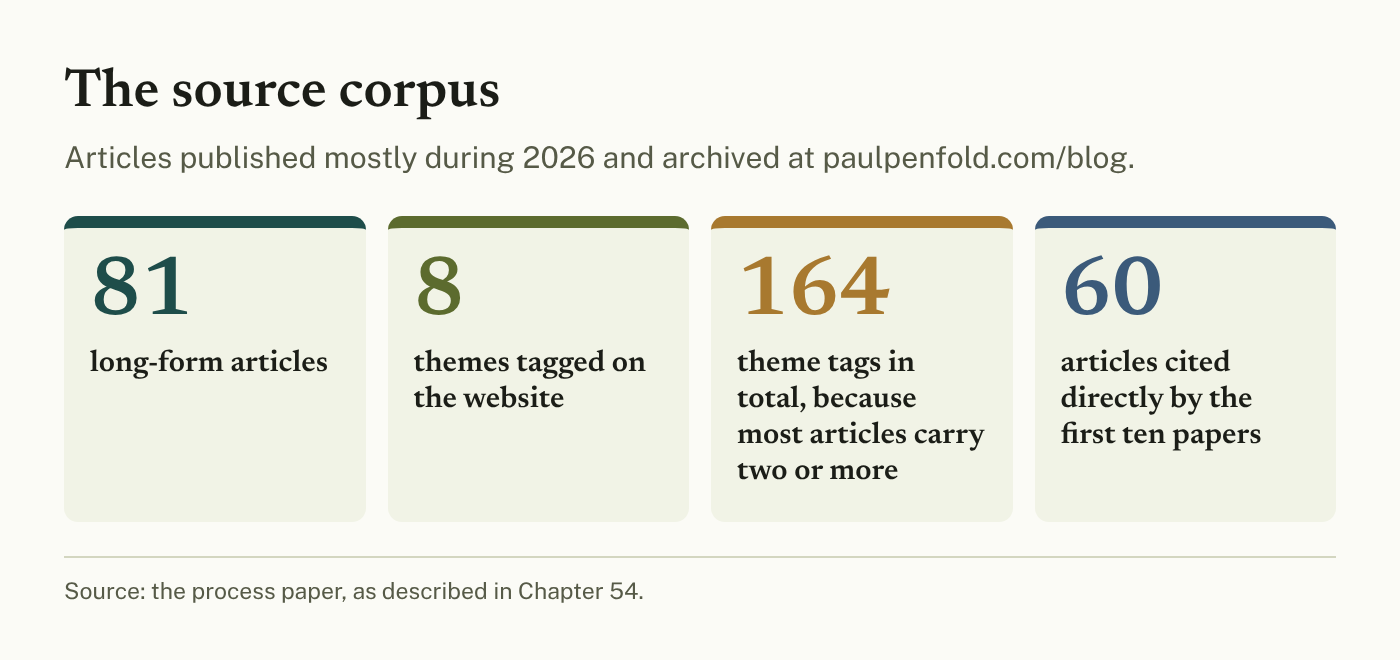
The papers draw on 81 long-form articles I published, mostly during 2026, and archived on my website at paulpenfold.com/blog (Penfold, 2026) [117], alongside a twice-weekly briefing for education leaders. The website tags each article with one or more of eight themes. Because most articles carry two or more tags, the theme counts total 164 rather than 81. According to the process paper, the first ten papers cite 60 of these articles directly, together with an unpublished manuscript and a newsletter report I shared.
The newsletters were written with AI assistance for research, drafting and graphics, and each carried a disclosure to that effect. They draw on reports from UNESCO, the OECD, the World Economic Forum, the European Union, national governments and research institutions, and on my own experience. Their purpose was timely interpretation for busy school leaders, not academic publication. That difference turned out to matter, as the next chapter shows.
Chapter 55 The workflow, and what checking found
Who did what
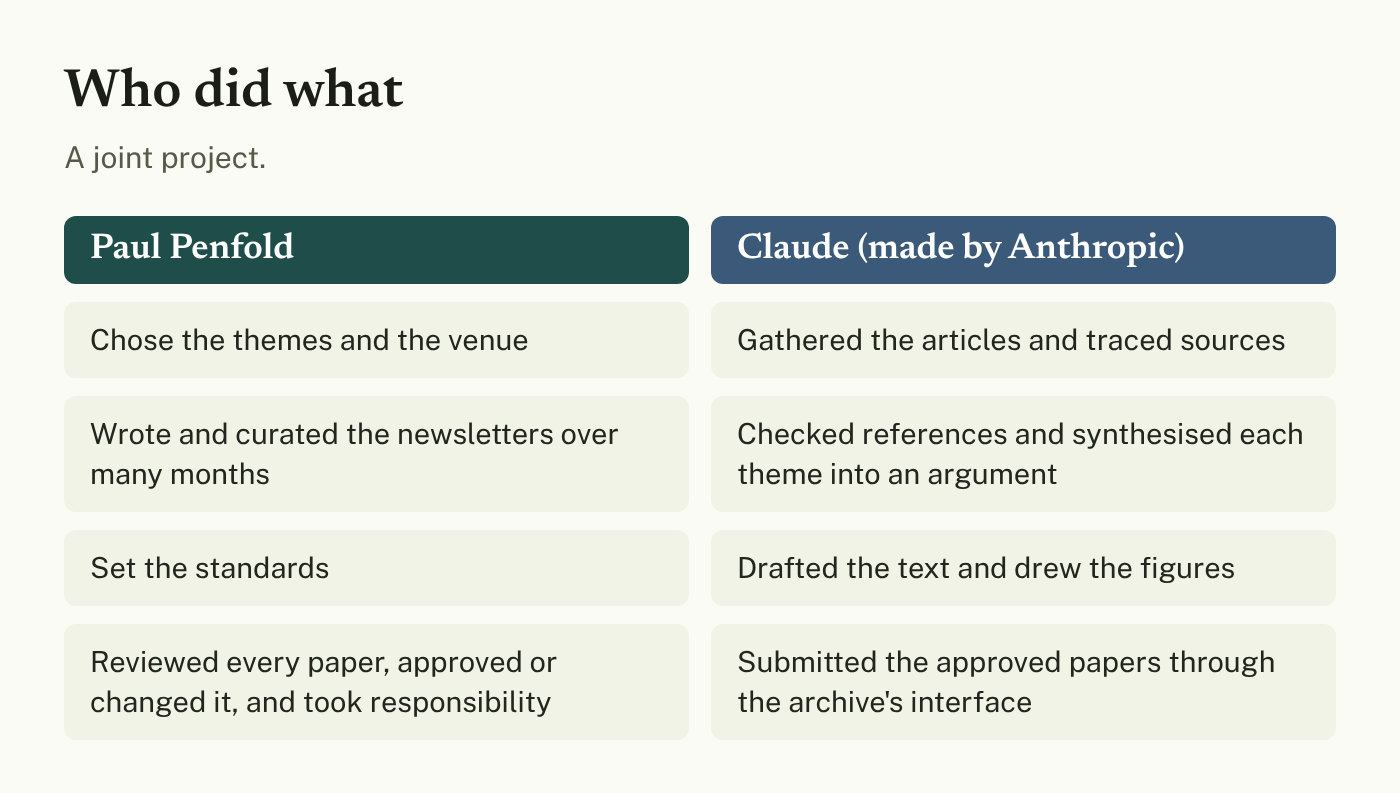
The work was a joint project. I did the thinking that an AI couldn't do: choosing the themes, writing and curating the newsletters over many months, doing the initial research and reading, deciding the venue, setting the standards, reviewing every paper, approving or changing it, and taking responsibility for it. The AI agent (Claude, made by Anthropic) did much of the heavy lifting: gathering the articles, tracing sources, checking references, synthesising each theme into an argument, drafting the text, drawing the figures, and submitting the approved papers through the archive's interface.
The stages
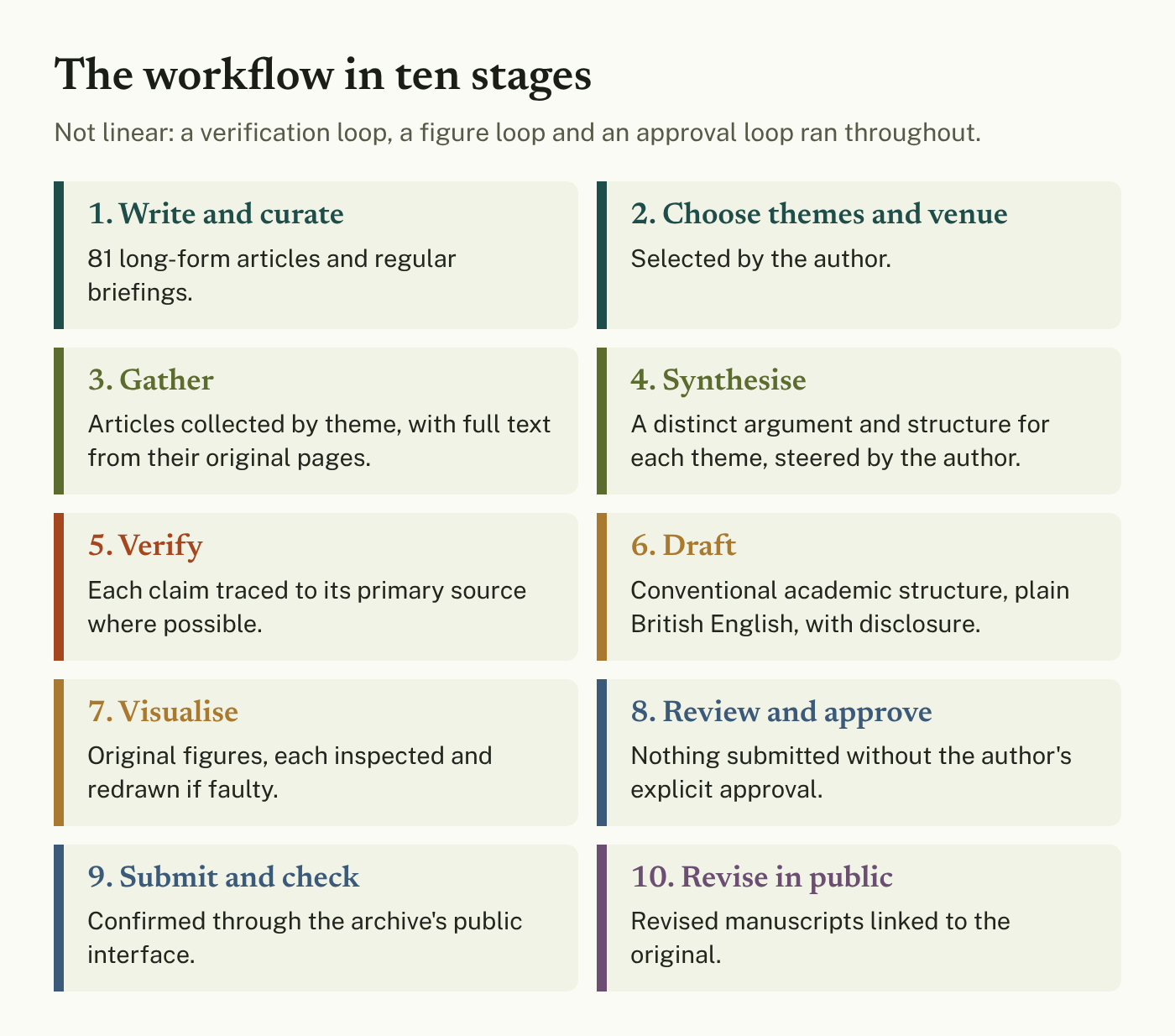
- Write and curate. Over 2025 and 2026, I published 81 long-form articles and regular briefings.
- Choose themes and venue. I selected the themes and the venue.
- Gather. The agent collected the articles by theme from my website and retrieved their full text from their original publication pages.
- Synthesise. For each theme, the agent proposed a distinct argument and structure, avoiding overlap with the other papers, and I steered it.
- Verify. The agent traced each claim to its primary source where possible: checking DOIs against Crossref, reading official documents and press releases, and confirming figures. Claims that couldn't be verified were corrected, attributed or removed.
- Draft. The agent wrote each paper in a conventional academic structure, in plain British English, with the newsletters cited as the source series and a disclosure of how it was made.
- Visualise. The agent drew original figures and a cover image for each paper, inspected every figure and redrew any with faults.
- Review and approve. I reviewed each paper and its figures. Nothing was submitted without my explicit approval, and several papers were changed at this stage.
- Submit and check. The agent submitted each approved paper and then confirmed through the archive's public interface that the paper and every image had published correctly.
- Revise in public. When errors or improvements were found after publication, the agent submitted a revised manuscript linked to the original, so the record of change stays visible.
The process wasn't linear. Three loops ran throughout: a verification loop, in which each claim was checked and the draft revised; a figure loop, in which each figure was rendered, inspected and redrawn until it was clean; and an approval loop, in which I reviewed, asked for changes and approved.
What verification found
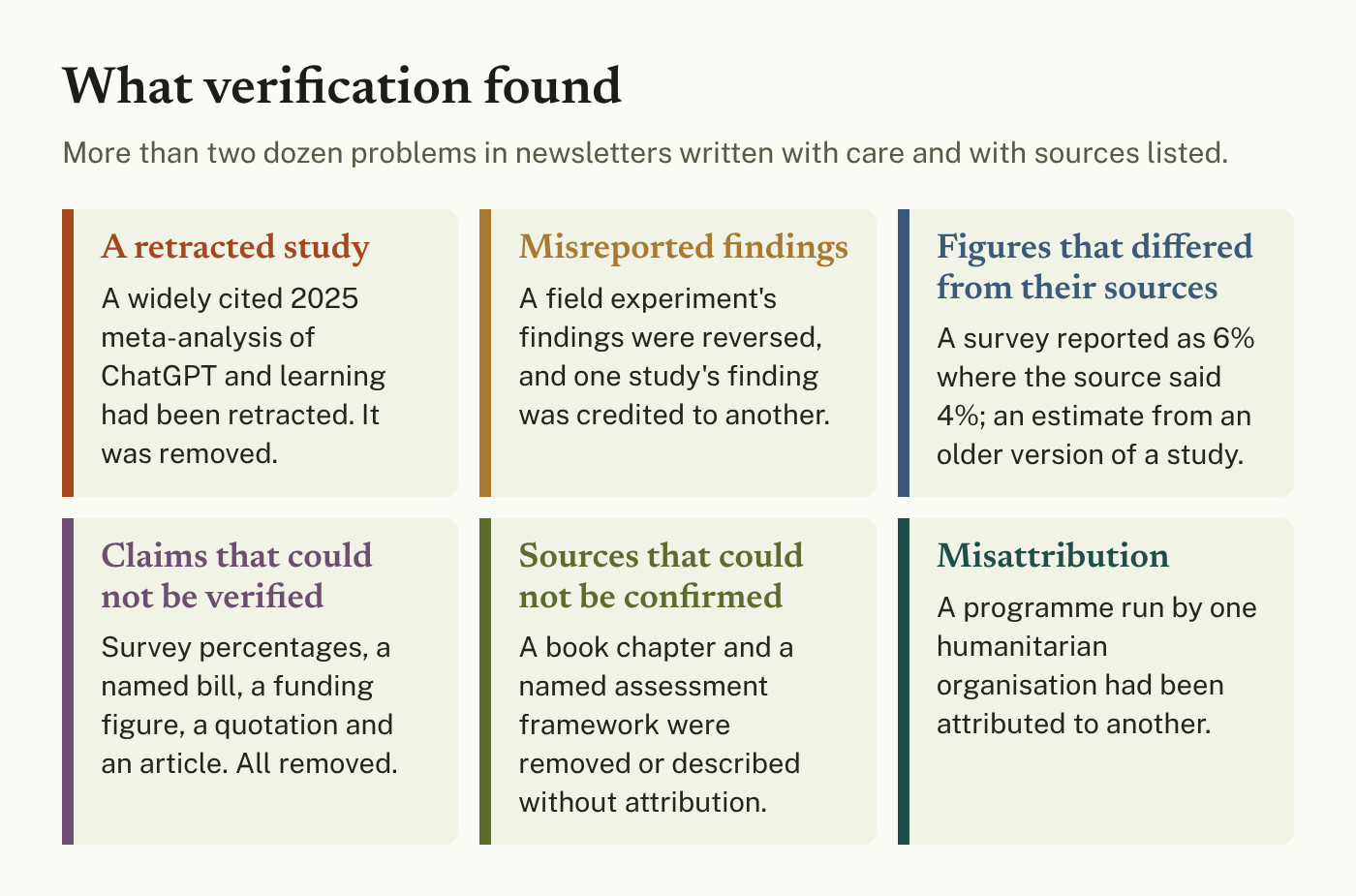
The most important finding of the experiment is how much the verification step mattered. The newsletters had been written with care, with AI assistance and with sources listed. Yet tracing their claims to primary sources found more than two dozen problems, of the kinds that a fast, uncritical conversion of newsletters into papers would have published.
- A retracted study. A widely cited 2025 meta-analysis reporting large benefits of ChatGPT for learning had been retracted. It was removed, and the retraction was noted as a caution in its own right.
- Misreported findings. One newsletter reversed the findings of a well-known field experiment, attributing a performance loss to students who didn't use AI rather than to those who did. Another credited a finding from one study to a different study.
- Figures that differed from their sources. Examples included a survey reported as showing that 6% of teachers found AI guidance clear, where the source said 4%, and an employment estimate from an older version of a study that had since been updated.
- Claims that couldn't be verified. These included survey percentages that couldn't be traced to any primary source, a named legislative bill, a government funding figure, a quotation attributed to a named expert, and an article that couldn't be found. All were removed.
- Sources that couldn't be confirmed. A cited book chapter and a named assessment framework couldn't be found in any public record, and were removed or described without attribution.
- Misattribution. A programme run by one humanitarian organisation had been attributed to another.
Two lessons follow. First, AI-assisted writing can carry errors confidently, and errors persist when text is reused. The newsletters were themselves partly AI-assisted, and some of their errors were the kind AI systems are known to make. Second, AI can also be an effective checker when it's instructed to trace claims to primary sources and to say plainly what it can't confirm. The same technology that creates the risk of research slop can, used deliberately, reduce it. What it can't do is decide what matters, which sources deserve trust, or when a claim should be dropped rather than softened. Those were judgements I made or approved.
The timeline
The first article in the series was published on 25 October 2026. The main series was produced on the evening of 29 October 2026, Thailand time. According to the process paper, the first of the thematic papers was published at 20:40 and the ninth at 22:18 (UTC+7), with revised manuscripts for earlier papers interleaved as figures and corrections were added. Allowing for the earlier preparatory work, the experiment showed that verified, illustrated papers could move from an existing body of practitioner writing to public, citable availability in a single evening.
That speed rested on a large amount of earlier work. The newsletters represent months of reading, thinking, writing and engagement with readers. The evening was the final step, not the whole of the effort.
Chapter 56 Risks, conditions and how this book was made
What this approach is, and isn't
These papers are syntheses and arguments grounded in published evidence and practitioner experience. They aren't new empirical studies. At the time of writing they hadn't been peer reviewed, because the venue's model is to publish first and review openly afterwards. Treat them as working papers that invite challenge, which is what the venue is designed for. The same goes for this book.
The risks
The risks are real. If this approach became common without care, it could add to the flood of fluent, low-value text that already threatens the scholarly record. Academic rigour could suffer if verification is skipped. And researchers could become editors of machine-written text rather than authors of their own thinking, losing the slow, effortful work through which understanding is built. That's the same risk several parts of this book describe for students.
Four conditions
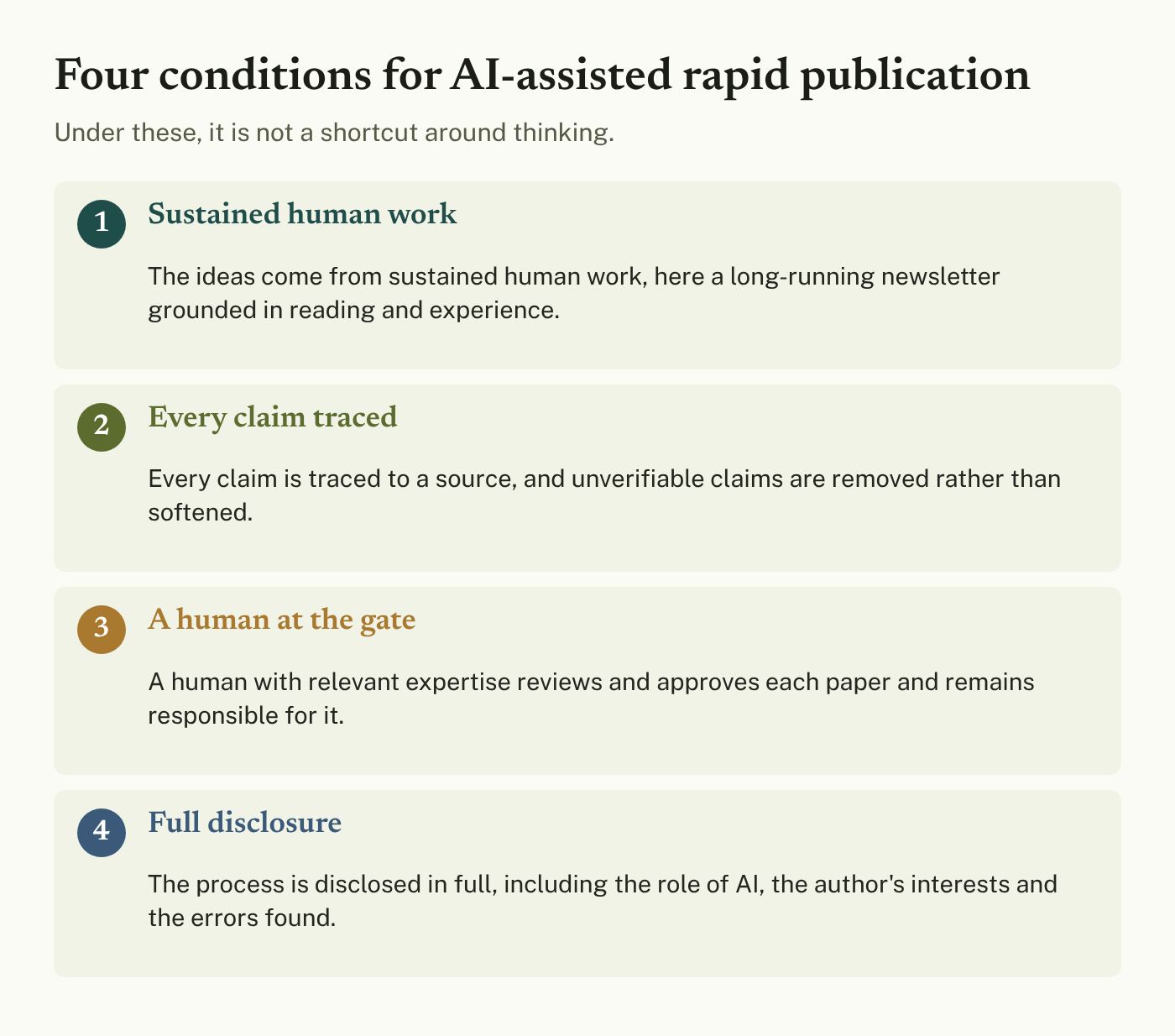
The experiment suggests that these risks can be managed when four conditions hold.
- The ideas come from sustained human work, here a long-running newsletter grounded in my reading and experience.
- Every claim is traced to a source, and unverifiable claims are removed rather than softened.
- A human with relevant expertise reviews and approves each paper and remains responsible for it.
- The process is disclosed in full, including the role of AI, the author's interests and the errors found.
Under those conditions, AI-assisted rapid publication isn't a shortcut around thinking. It's a way of getting the results of thinking into the public domain while it's still useful.
How this book was made
This book is a further step, and it has its own limits, so here is the plain account. The structure of eleven parts and 56 short chapters was agreed first. Claude then drafted each part from the matching paper, keeping to the paper's evidence and wording where the evidence was concerned, and adding cross-references so that studies described in one part point to the part where they're treated in full. The sources were taken from the papers' reference lists, not rebuilt from memory, and merged into one numbered Bibliography at the back. For Part Two, six more newsletters from my blog were added as my own work. I've reviewed and approved the text, and I'm responsible for it. The chapters are shorter than the papers they come from, because readers who aren't specialists tend to prefer short chapters. Some detail from the papers, including the figures, was left out to keep them short.
Because the book was drafted from the papers, any error in a paper will be in the book too, unless it was caught. Readers who rely on a figure should go back to the cited source. The aim is to correct in the open, as with the papers.
Conflicts of interest
The AI that co-wrote this book is Claude, made by Anthropic, an AI developer whose products and leaders are discussed in several parts. I'm connected to Brave Generation Academy, which is discussed in Parts Eight and Ten. These interests are declared where they arise.
A replicable workflow
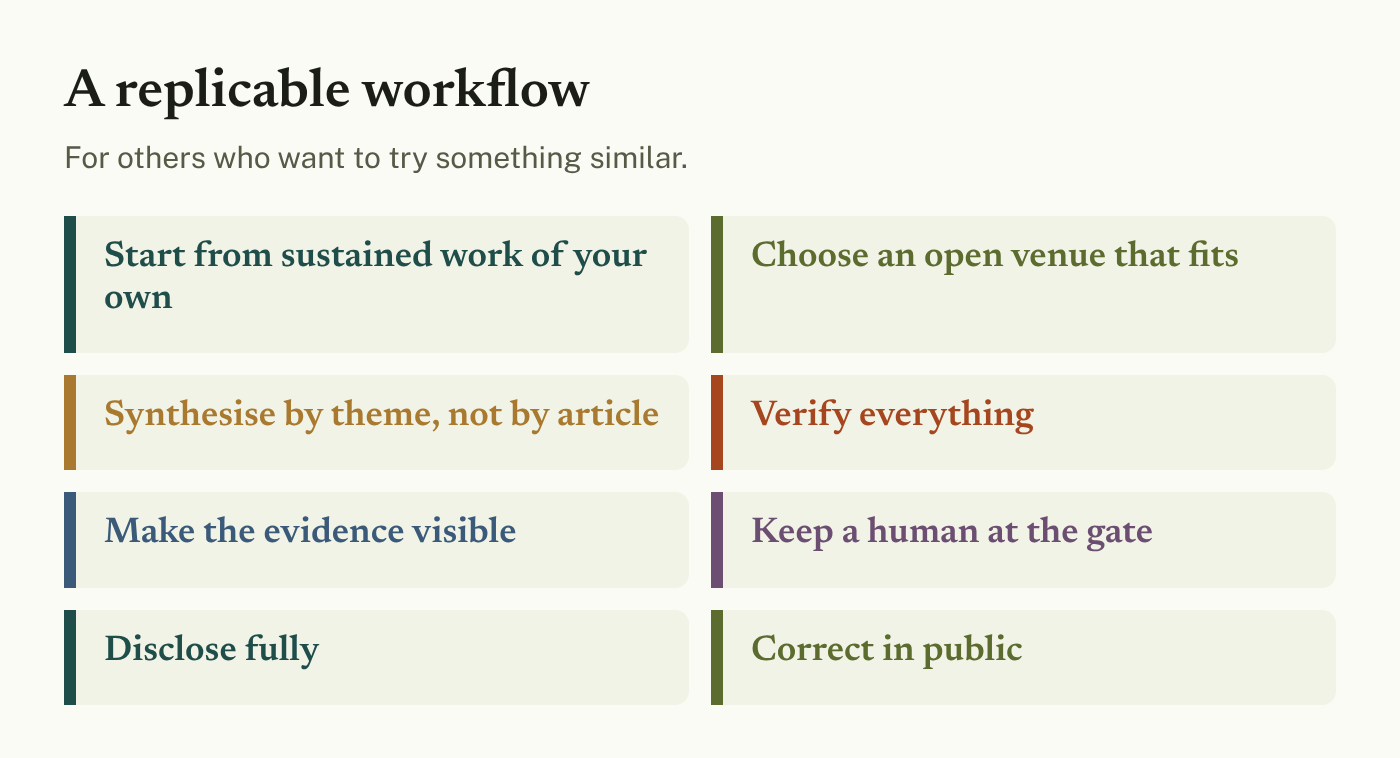
For others who want to try something similar, the experiment suggests a simple sequence.
- Start from sustained work of your own. A body of writing, data or practice that reflects real thinking over time.
- Choose an open venue that fits. Check its scope, its review model and its requirements before you start.
- Synthesise by theme, not by article. Build each paper around an argument, and avoid overlap between papers.
- Verify everything. Trace each claim to its primary source, check DOIs, and remove what can't be confirmed.
- Make the evidence visible. Use original figures, and label claims by the strength of their evidence.
- Keep a human at the gate. Nothing is published without the responsible author's review and approval.
- Disclose fully. State the role of AI, the authors' interests and the limitations.
- Correct in public. Use the venue's revision mechanism, so the record of change stays visible.
The papers behind this book
All are published in Future Science Archives under my name, with Claude disclosed as co-writer. The process paper gives the web address of each of the first ten.
- Learn first, then use AI: Testing an expert consensus on generative AI and learning against the empirical evidence (Part Two).
- What counts as AI literacy? A comparative analysis of international frameworks and system-level policies, 2024–2026 (Part Four).
- When the artefact is no longer evidence: Assessment validity and academic integrity in the age of generative AI (Part Five).
- Governing AI in education: Uneven rules, thin evidence and procurement as policy, 2026 (Part Nine).
- Teachers at the centre: Closing the teacher AI gap through professional learning, time and agency (Part Seven).
- Growing up with machines that talk back: Wellbeing, attachment and the developing mind in AI-mediated childhood (Part Three).
- The broken bottom rung: Entry-level work, durable capability and what schools should prepare young people for (Part Six).
- Leading the redesign: Purpose, ecosystems and sequencing in school leadership for AI (Part Eight).
- Close the gap or widen it? AI, equity and learning at the weakest link (Part Ten).
- Educational futures to 2035 and 2045: Scenarios, switches and the choices to make now (Part One).
- From newsletter to journal in an evening: A human–AI workflow for rapid, open and verified publication of applied education research (this part).
What this part can't tell you
The workflow described here comes from one author, one body of work and one evening, and hasn't been independently evaluated. The counts of papers and articles come from the process paper and need updating where the eleventh paper changes them. Some details of the venue, such as DOI assignment and indexing, were changing at the time of writing.
A closing thought
The question that began this work was whether current, applied research could reach the public in days rather than months without abandoning rigour. For papers on AI in education, the answer was yes, with conditions. The papers were published in a single evening, in a venue that charges no one, with verified references and full disclosure. They were possible because of months of human thinking that preceded them, and they were trustworthy only to the extent that every claim was checked and a responsible human approved every word. The most striking lesson is that verification found more than two dozen problems in material that had already been carefully written. Speed is easy. Speed with care is the harder and more valuable thing, and it's what this experiment set out to test. Whether it succeeded is now for you to judge, in the open.
Coach · Part Eleven
Think it through
Four short ways to test what this part means for you. There are no right scores. Everything you type stays in this browser and is never sent anywhere.
A situation
You have a set of your own newsletters and an AI agent that can turn them into papers in an evening. What do you do before anything is published?
Pick the response closest to what you would do.
Read: Chapters 55 and 56
A private self-check
Think of a piece of AI-assisted work you produce or rely on. Rate it against the book's four conditions.
Reflect
Write a line or two for each. Notes save automatically in this browser.
Ask the book
Common questions about this part, answered from its own text.
How was this book made?
Paul Penfold chose the themes, wrote the newsletters the papers draw on and set the standards. Claude, made by Anthropic, gathered and checked sources, synthesised the themes and drafted the text. Paul reviewed and approved it. The part sets out the stages in full, and the Introduction discloses the arrangement.
Introduction; Chapters 55 and 56
What did verification find?
More than two dozen problems in the source newsletters, including a retracted study, misreported findings, figures that differed from their sources, claims that could not be verified, sources that could not be confirmed and a misattribution. Unverifiable claims were removed.
What are the four conditions?
The ideas come from sustained human work; every claim is traced to a source; a human with relevant expertise reviews and approves each paper and remains responsible; and the process is disclosed in full.
What are the risks?
Adding to the flood of fluent, low-value text that already threatens the scholarly record; skipping verification; and researchers becoming editors of machine-written text rather than authors of their own thinking.
Is there a conflict of interest?
Yes, and the book says so. It was co-written with an AI agent, Claude, made by Anthropic, while several parts discuss Anthropic and other AI developers. The author has also led international schools and works with Brave Generation Academy, discussed in Parts Eight and Ten.
Introduction; Chapter 56